
How to Dematerialise Jointly Held Physical Shares in India
Jointly held old share certificates? Follow the correct Demat account setup, DRF submission, name-order checks, transposition and RTA verification process.
Summary: For jointly held physical share certificates, usually a Demat account is needed with the same owners and the same order of names. This guide covers the DRF workflow, transposition if the holder order is different, transmission on death, document requirements, reasons for rejection, and the separate 2026 SEBI transfer window.
Key Takeaways
- Joint physical certificates ordinarily require a Demat account with the same joint owners and corresponding ownership pattern.
- A request for transposition-cum-dematerialisation may be appropriate if the same holders appear in a different order.
- Transposition is the change of order of names , not owners . The removal or replacement of a living holder is another process .
- In the event of death of a joint holder, surviving holders should approach the DP for transmission-cum-dematerialisation and supporting evidence.
- The crux of the request is the original certificates, a completed DRF, correct DP account details and applicable signatures.
- SEBI’s special transfer window for 2026 will be applicable only to valid transfers made before April 2019 and not to all joint Demat conversions.
🚀 Open your Demat & Trading account
- Free Account opening charges
- Free DP transaction charges ⭐
- Free premium research & market updates
Last updated: 16 November 2026. The first step to dematerialize jointly held physical shares in India is to ensure that the ownership of the certificate and the receiving Demat account is the same. Normally, the names have to be in the same order. If the same people arrive in a different order, a transposition-cum-dematerialisation request can remedy the mismatch. “If two persons hold a certificate, it cannot be credited into one person’s individual Demat account.
The route is based on the issue – death of a holder, name order or change of ownership.
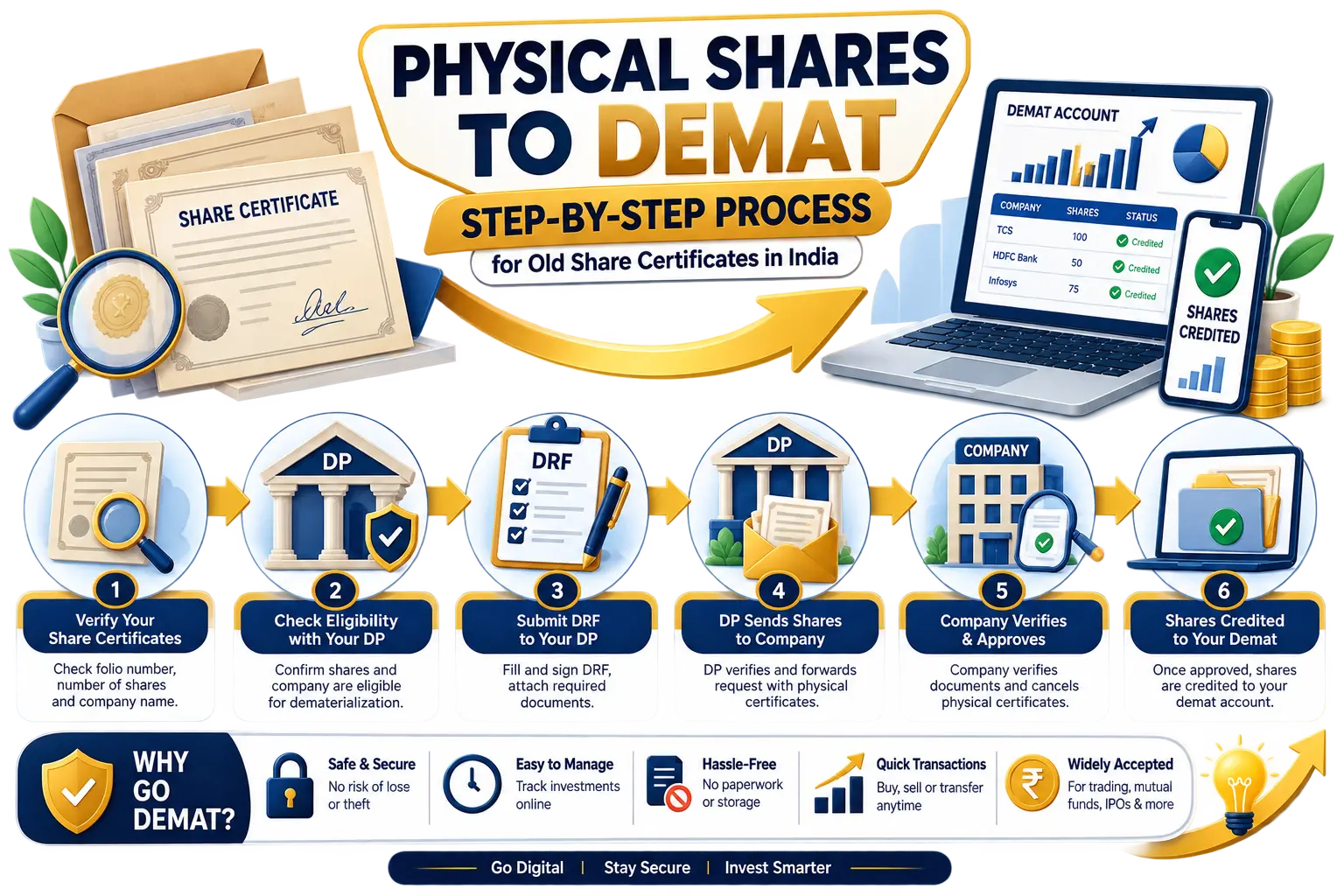
How to Dematerialise Jointly Held Physical Shares: Quick Process
First, you need to compare the physical certificate with the company’s records of shareholders and your Demat account details. If you have old or complex records, get help with the physical-share dematerialisation process before contacting your Depository Participant (DP). The DP checks the documents and transmits the request through the depository system. The company or its Registrar and Transfer Agent (RTA) confirms the physical holding.
Identify all owners exactly as printed on each certificate and confirm the folio and share quantity.
Verify whether the joint Demat account is active with the same holders and in the same order.
Check the company's ISIN, the RTA's records and any pending PAN, KYC, signature or name corrections.
Collect the Dematerialization Request Form (DRF) and, if applicable, a transposition or transmission form from the DP.
DP Process Submit duly filled forms and original certificates through prescribed DP Process. Keep acknowledgment and tracking details.
Follow up on status, respond to discrepancies and verify final electronic credit to correct joint account.
Step 1: Match the Certificate Holders to the Demat Account
Joint ownership is not the same as individual ownership. A certificate in the names of Asha Mehta (first holder) and Rohan Mehta (second holder), for example, would normally be held in a joint account with Asha first and Rohan second. Asha’s personal Demat account even if she is the first holder on the certificate is not an equivalent receiving account.
“Physically held securities having different ownership patterns require respective Demat accounts,” explains NSDL. Joint Demat accounts can have a maximum of three holders. If necessary, verify the details of Demat account opening and check the requirements of opening an account from your DP.
Physical certificate | Proposed Demat account | Likely route |
|---|---|---|
Asha + Rohan | Asha + Rohan | Standard joint dematerialisation, subject to verification |
Asha + Rohan | Rohan + Asha | Transposition-cum-dematerialisation may apply |
Asha + Rohan | Asha only | Not a normal direct Demat conversion |
Asha + Rohan | Asha + Priya | Different owners; transposition alone is insufficient |
Asha + Rohan, Rohan deceased | Asha as surviving holder | Check transmission-cum-dematerialisation |
Step 2: Examine Share Certificates, Folio Details and ISIN
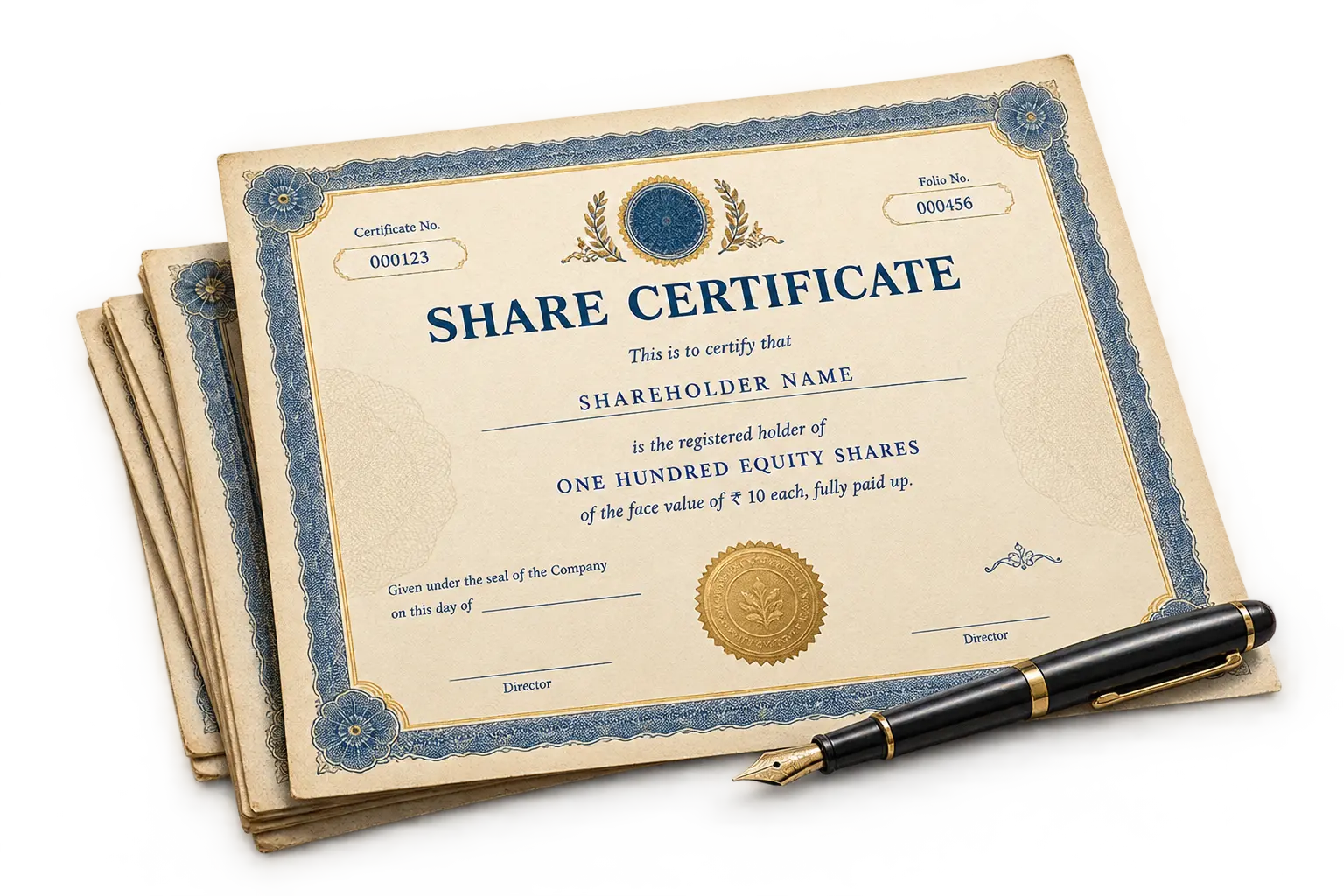
Fill out forms for each company and security, and establish a separate record for each. Issuer Name, Names of Holders, Folio Number, Certificate Number, Distinctive Number Range and Number of Shares. The ISIN identifies a particular security in the depository system. Instead of assuming that an old certificate still corresponds to an unchanged security, confirm the same with the DP or issuer/RTA.
Older certificates may represent securities that have been split, merged, or otherwise acted upon by the company. Please check the current security and amount with RTA prior to applying for credit.
Cross-check the spelling, initials and surname with the Demat account. Even small differences in names
Step 3: Prepare the Documents Required for Joint Dematerialisation
Original certificates and DRF are starting documents. Ask the DP for the relevant supplemental checklist.
DRF: completed for the relevant security and signed by the required holders as per the DP instructions.
Original certificates: as per the quantities of shares requested, with any required surrender mark in accordance with DP instructions.
Demat account details: DP ID Client ID or account number of the beneficial-owner Existing account-holder names
PAN and KYC information: current records for all owners with supporting identity or address documents if a discrepancy needs to be resolved.
Transposition Request Form: when the same joint owners are in a different order.
Transmission documents: In case any joint holder is deceased including the relevant request and proof of death required by the DP / RTA.
Correction evidence: documents that support legal name change or specific issuer/RTA discrepancy as applicable.
To know more about opening a joint account, refer to the separate guide on joint Demat account documents and account opening. This article deals with the conversion of already jointly owned certificates.
Step 4: Submit the DRF and Original Certificates Through Your DP
Complete the DRF with the correct security details and the necessary joint-holder signatures. If the DP asks you to mark the surrender, do so as the DP directs. Do not deface certificates on your own.
Submit the certificates and forms to the DP and get an acknowledgment. The DP checks and forwards the order to the issuer / RTA. The DP receiving the holding does not approve it. The issuer/RTA has to approve the holding before credit.
Keep copies of the certificate numbers and tracking information. The general guide to physical shares to Demat process covers the whole workflow including non-joint holdings.
What Is Transposition-Cum-Dematerialisation?
Transposition means swapping the order of the same holders, not changing who the shares are held by. One folio has Asha–Rohan and the other has Rohan–Asha. If the intended demat account is Asha-Rohan, certificates showing the reverse sequence may be eligible for transposition-cum-dematerialisation.
The DP may require a DRF and Transposition Request Form (TPRF) signed by the holders required. The issuer/RTA confirms the identity and sequence of the owners.
Transposition cannot add Priya, remove Rohan or make Asha–Rohan into Asha alone. Those are ownership changes, not name order corrections . A living holder who wishes to make a transfer must follow the applicable separate securities-transfer process.
What If One of the Joint Holders Has Died?
In the case of death of a joint shareholder, normal transmission cum dematerialization review is required instead of ordinary transposition. For example, if an old certificate is held jointly by Asha and Rohan and Rohan has died, the DP can give advice on a request by Asha as the surviving holder. The receiving account should show the surviving holder or holders in accordance with the applicable procedure.
Expect a DRF, appropriate transmission request and proof of death as specified by the DP. If all holders are dead or if ownership is disputed, nominee, legal-heir or succession procedures might be relevant.
The inheritance-specific documentation and decision points are covered in the separate article on transmission of physical shares after the death of a shareholder.
Can Joint Physical Shares Be Credited to a Single-Holder Account?
Not because one person is first holder or two persons are relatives. A certificate of joint ownership of Asha and Rohan. The ownership configuration would change if it were assigned directly to Asha’s single account. The normal approach is to dematerialize into the correct joint account and to deal with a subsequent change of ownership by the appropriate process where legally permissible and intended.
In case of disputed/erroneous ownership records, please contact the issuer/RTA before transposing.
Common Reasons Joint Demat Requests Are Delayed or Rejected
Holder mismatch: name in certificate and account is missing, extra or different.
Sequence mismatch without TPRF: Same Owners, Reversed Order, No Proper Request for Transposition.
Signature problem: Holder signature missing or significantly changed from available records.
KYC or PAN discrepancy: Current account details do not support the issuer/RTA holding record.
Certificate discrepancy: wrong folio, company, ISIN, quantity, certificate details or evidence of a previous corporate action.
Missing transmission evidence: Evidence The request is for a deceased joint holder but the death related form or documents are missing.
Ownership dispute or restrictions: This issue can’t be solved by administrative Demat request alone.
If declined get the reason in writing and know if certificates will be returned. Fix the defect and resubmit. If there is a dispute over ownership you may need to seek legal advice.
Charges, Processing Time and How to Track Your Request
DP tariffs are varied. Get a written breakdown of dematerialization, maintenance and any courier or correction charges.
Timelines will depend on the completeness of the documentation, the dispatch and checks by the issuer/RTA, especially if the records are old or the holder has passed away. Keep acknowledgment, request number, correspondence until credit is confirmed.
Does SEBI's 2026 Physical-Share Transfer Window Apply?
SEBI’s separate special window is from February 5, 2026, to February 4, 2027, for specified physical securities sold or purchased before April 1, 2019, and qualifying transfer-document cases. It may include some prior transfer requests that have been returned or disapproved. The above is not a blanket permission to change joint ownership or to bypass the normal rules for DRF and holder-matching.
The special-window process has its own eligibility conditions and documentation and restrictions, including a one-year lock-in on securities transferred through that route. This exception does not apply to a person who holds certificates only jointly with a spouse or relative. If there is an old signed transfer deed, ask the issuer/RTA to look at this case separately from normal dematerialization or transposition.
Final Checklist Before Submitting Joint Physical Shares
Record the correct company name, folio, certificate details, share quantity and ISIN.
Confirm that each living joint holder's identity and order match the receiving account, or obtain the correct transposition form.
Check PAN, KYC, name-change evidence and signatures for every relevant holder.
Request the DRF and any transmission or correction forms required for this specific case.
Confirm DP fees and original-certificate submission instructions; retain copies and acknowledgement.
Use the relevant procedure for deceased holders, ownership changes or historical transfers rather than treating all mismatches as transposition.
Track the request until the correct securities appear in the intended Demat account.
The most useful first step is to resolve who holds the shares and in what order. Once that is clear, your DP and the issuer/RTA can determine which paperwork fits the case instead of trying to fix an ownership problem through an unsuitable dematerialisation form.
Frequently Asked Questions
Can jointly held physical shares be dematerialised in a single-holder Demat account?+
Not through an ordinary dematerialisation request. The receiving account generally must reflect the same joint owners. A separate lawful transfer or, after a holder’s death, transmission process may be needed.
What happens if the joint holders are listed in a different order?+
If the certificate and account show exactly the same people but in a different sequence, the DP may accept a DRF with a transposition-cum-dematerialisation form after the relevant checks.
What is the difference between transposition and transmission?+
Transposition rearranges the order of existing joint holders. Transmission addresses a change arising from death or another legally recognised succession event and requires different supporting documents.
Are PAN and signatures required from all joint holders?+
PAN/KYC details and the applicable holder signatures are checked as prescribed by the DP and issuer/RTA. Ask the DP for the exact current requirements and any acceptable name or signature correction evidence.
Can I remove a living joint holder through a transposition form?+
No. Removing a holder changes ownership. Transposition only changes the sequence of the same owners; an actual ownership change must follow the applicable transfer process.
How long does joint physical-share dematerialisation take?+
It depends on the DP, issuer/RTA, completeness of documents and any discrepancies. Obtain tracking details and current estimates from the processing DP rather than relying on a fixed timeline.
Does the SEBI 2026 special physical-share window apply to every joint holder?+
No. It is a separate route for qualifying physical-share transfer cases involving pre-1 April 2019 transactions, open from 5 February 2026 to 4 February 2027, subject to specific conditions.
Disclaimer
InvestEdge360 is operated by Vijayvargiya Financial Services, an Authorized Business Partner of Motilal Oswal Financial Services Ltd. This is not the official Motilal Oswal website. InvestEdge360 does not independently act as a depository, Depository Participant or Registrar and Transfer Agent; the applicable DP and issuer/RTA determine document requirements and process requests. Acceptance, eligibility and timing are not guaranteed.
Research Team
InvestEdge360 Research
Content Research Desk
Insights from InvestEdge360's research desk — written to help investors learn with clarity and invest with discipline.
Need Help With Jointly Held Physical Shares?
Understand the holder-name matching, Demat paperwork and applicable transposition or transmission route before submitting original certificates. Explore document-preparation assistance subject to DP and RTA verification.
Explore Dematerialisation AssistanceRelated Articles
- Demat Account
Physical Shares to Demat: Step-by-Step Process for Old Share Certificates in India
- Investor Education
Physical Share Certificate Lost: What Should Shareholders Do?
- Demat Account
Joint Demat Account in India: Rules, Benefits & How It Works
- Demat Account
How to Open a Joint Demat Account in India: Documents & Process

Was this article helpful?