
Physical Shares to Demat: Step-by-Step Process for Old Share Certificates in India
Learn the physical shares dematerialisation process in India, including required documents, DRF submission, RTA checks, rejection reasons and next steps.
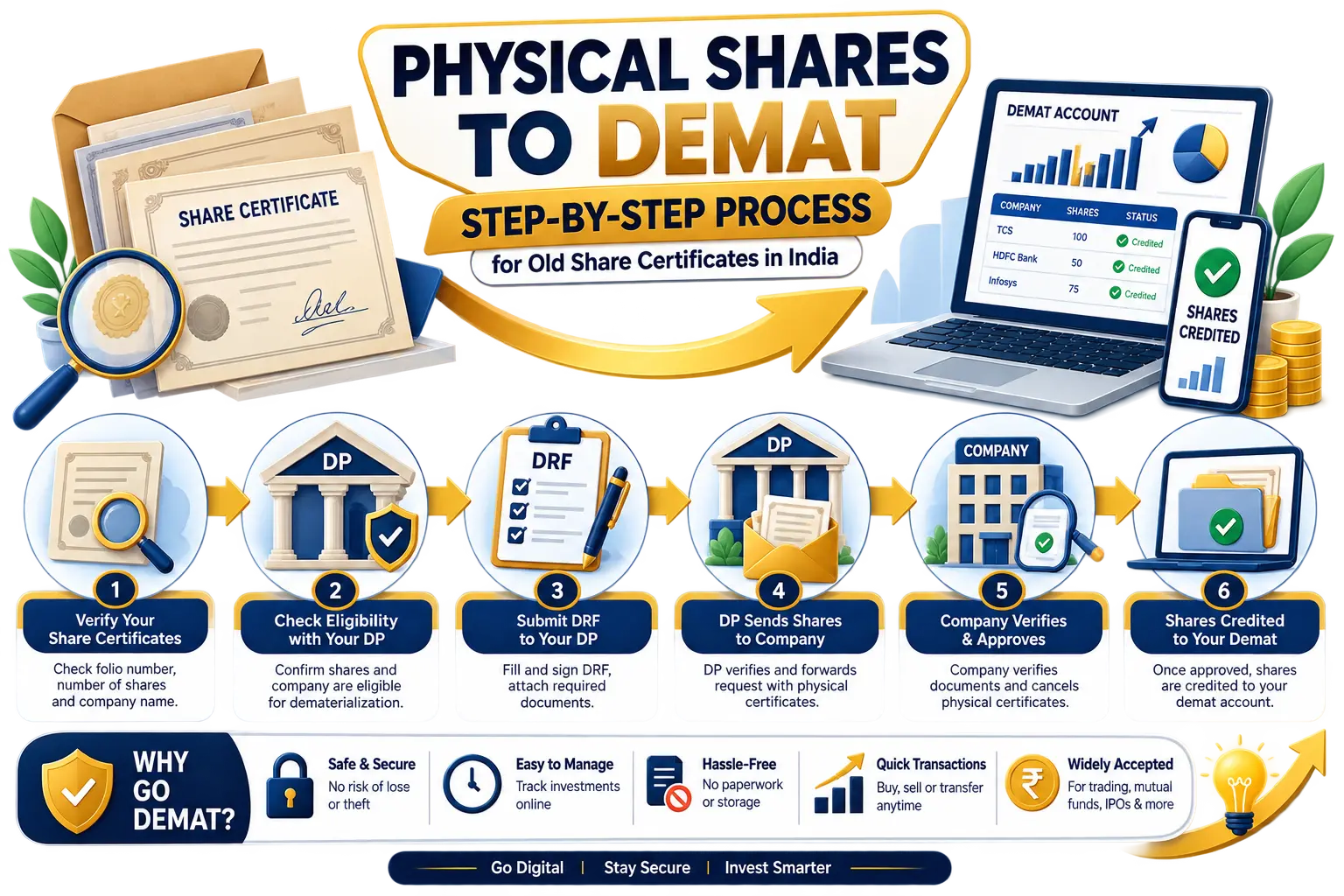
Step-by-step overview of converting old physical share certificates into Demat holdings.
Summary: An India-first manual to help investors convert duly eligible old physical shares certificates into Demat shares by explaining the process step-by-step, along with required documents, DRF submission, RTA verification, rejection reasons and inherent share concerns.
Key Takeaways
- If the physical share certificates meet certain requirements, they can be converted to Demat holdings.
- Demat account holdings should generally track the registered shares.
- DRFs and physical certificates are submitted by a Depository Participant.
- Name, folio and certificate number, and distinctive number mismatches can result in rejection.
- In case of inherited shares and death of the holder, transfer may be required before demat.
- Investors must confirm the requirements with a DP, the issuing company or the RTA before submitting.
The physical shares dematerialisation process enables customers to dematerialize their old paper share certificates. This provides a solution for families with heirloom investments from many years ago.
What Is the Physical Shares Dematerialisation Process?
The dematerialisation of shares (or demat for short) is the process of transferring shares in a physical form to an electronic records system. The equivalent shares are deposited to the investor's Demat account once the request is approved by the Depository Participant (DP) and the issuer or Registrar and Transfer Agent (RTA).
When shares are dematerialised, it changes the form of the shares, it does not transfer the ownership. The shares should ordinarily be in the name of the investor and should be dematerialisable.
Dematerialisation of Physical Shares - A Step by Step Process
1. Authenticating Physical Shares
Verify all certificates. You must know the company name, folio number, distinctive number(s) and certificate number(s), number of shares and face value of each, as well as the name of the shareholder(s) registered on the certificate(s). You must cross check all these particulars against the company and RTA records.
2. Company and ISIN Validation
Verify if the company and the security hold an ISIN and if they are facilitating dematerialisation. In case you are not sure about the RTA or the security's eligibility, check the details with the company, RTA or the depository.
3. Opening a Demat Account
You need to have a Demat account with a depository participant to place a request for physical dematerialisation. Ensure the holder name and pattern of holding is appropriate for the physical certificates.
If you need a new account, see our Demat account opening guide.
4. Demat Account and Physical Dematerialisation Request Form
After confirming the details of the Demat account, ISIN, company, folio and number of certificates and distinctive numbers, access the physical Demat Request form from your depository participant and fill it in.
5. Submit the DRF and Original Certificates
Submit the duly filled DRF and original certificates to your DP. Keep a copy of the documents and obtain an acknowledgment.
6. Issuer or RTA Verification
The issuer or RTA verifies the request against its records. The request may be challenged or rejected if there is a discrepancy in the certificate, the name of the registered holder, distinctive numbers, etc.
7. Shares Are Credited to the Demat Account
If a request is accepted, the corresponding securities will be credited to the investor’s Demat account. Post-processing, check the details of the securities and quantity credited.
Documents Needed to Dematerialize Old Share Certificates
Current share certificates.
The Dematerialisation Request Form (DRF).
Demat account details.
Identity documents (where requested by DP).
Where there is a personal name mismatch, deceased holder, transmission, or ownership concern.
Common Reasons for Demat Rejection
Name mismatch: Holder name mismatches in any of the records (issuer, RTA or Demat).
Ownership pattern mismatch: Joint holders or their order do not match.
Certificate mismatch: Mismatches in the certificate (folio number, certificate number, distinctive numbers, number of certificates).
Certificate validation issue: The issuer or RTA cannot validate the certificate.
Security eligibility issue: The security is not available for dematerialisation through the applicable depository.
Incomplete documentation: Required signatures or supporting documents are missing.
Transmission issue: The registered shareholder has died and the applicable transmission process has not been completed.
In case of rejection of a request, keep the rejection communication or objection and follow the procedure(s) indicated by the DP or the issuer/RTA.
What If the Shareholder Has Died?
A dead shareholder holding shares in a physical certificate is not something you can give to a new Demat account holder. You have to complete the appropriate transfer process. Depending on the situation, documents may be required on the deceased person, succession, nomination, legal heirs etc.
What If Joint Holder Names Are in a Different Order?
In some cases joint holders may appear in different order in family certificates. In the mentioned cases a facility of transposition-cum-dematerialisation may be available. You have to confirm the current arrangements and the form to be submitted from your DP.
How Long Does Physical Share Dematerialisation Take?
The time taken to dematerialise physical shares depends on the DP, documents transmitted & verified by the issuer or RTA. NSDL says in normal circumstances this may take around 30 days. This should not be considered a completion time frame.
Physical Shares vs Demat Holdings
Aspect | Physical Shares | Demat Holdings |
|---|---|---|
Format | Paper certificates | Electronic records |
Storage | Physical documents must be preserved | Holdings are maintained electronically |
Loss risk | Certificates can be lost or damaged | No physical certificate to store |
Processing | More paperwork may be involved | Transactions are processed electronically |
Important Checks Before Submission
Confirm the registered holder names.
Check the security's dematerialisation eligibility and ISIN.
Verify folio, certificate and distinctive-number details.
Check that the Demat account ownership pattern is appropriate.
Keep copies of certificates and forms.
Obtain an acknowledgement from the DP.
Do not send original certificates to an unverified intermediary.
For related learning, read our guide on Demat Account vs Trading Account and explore our share dematerialisation service.
Official Sources and Verification
For the latest requirements, please refer to the following official sources - SEBI, NSDL and CDSL. Requirements change, and this is especially true for transmission, nomination, KYC, name changes and other investor service related matters.
Final Takeaway
The physical shares dematerialisation process involves checking the certificates, confirming ownership and security eligibility, maintaining an appropriate Demat account, submitting the DRF and certificates through a DP, and waiting for issuer or RTA verification.
This article is for educational purposes only and is not personalized investment, legal or tax advice. Verify the latest requirements with your DP, issuer or RTA and relevant regulatory authorities before submitting original documents.
Frequently Asked Questions
Can old physical share certificates still be converted into Demat?+
Yes, eligible physical securities can generally be dematerialised when the certificates are valid and the ownership and security details match issuer or RTA records.
Do I need a Demat account to convert physical shares?+
Yes. The securities are converted into electronic holdings through a Depository Participant and credited to the investor's Demat account.
Can physical shares be dematerialised into someone else's Demat account?+
Generally, dematerialisation is not a substitute for transferring ownership. The Demat account should correspond with the registered ownership pattern.
What happens if the name on my physical share certificate has changed?+
The issuer or RTA may require its applicable name-change procedure and supporting documents. Confirm the current requirements before submitting the dematerialisation request.
What if my physical share certificate is lost?+
A lost certificate cannot simply be submitted for dematerialisation. Contact the issuer or RTA and follow its current procedure for lost securities.
Can inherited physical shares be converted directly into the heir's Demat account?+
If the certificate remains registered in the deceased holder's name, the applicable transmission process generally needs to be completed before the securities can be credited under the appropriate ownership structure.
How long does physical share dematerialisation take?+
The timeline depends on document transmission and issuer or RTA verification. NSDL indicates that the overall process may take about 30 days in normal circumstances, but delays can occur.
Can I sell physical shares without dematerialising them?+
For listed securities, market settlement generally takes place in dematerialised form. Investors should check the current applicable rules before attempting to sell old physical holdings.
Disclaimer
This article is for investor education only and does not constitute investment advice, a recommendation, or an offer to buy or sell any security.
Markets involve risk, including possible loss of capital. Please do your own due diligence or consult a registered adviser.
Research views are informational and may change without notice. Past performance is not indicative of future results.
For educational and informational purposes only. Procedures, forms, deadlines and regulations can change. Verify with your Depository Participant, issuer or RTA what is needed for the submission of original documents. It is your responsibility to determine the latest regulatory requirements.
Ready to Manage Your Shareholdings in Demat Form?
Open a Demat account to hold eligible securities electronically and manage your investments through a digital account.
Open Demat AccountRelated Articles

Was this article helpful?
🚀 Open your Demat & Trading account
- Free Account opening charges
- Free DP transaction charges ⭐
- Free premium research & market updates