
Difference Between Trading and Demat Accounts: A Beginner's Guide for Indian Investors
Confused about the difference between trading and Demat accounts? This beginner's guide explains how each works, why you need both, and how settlement happens.
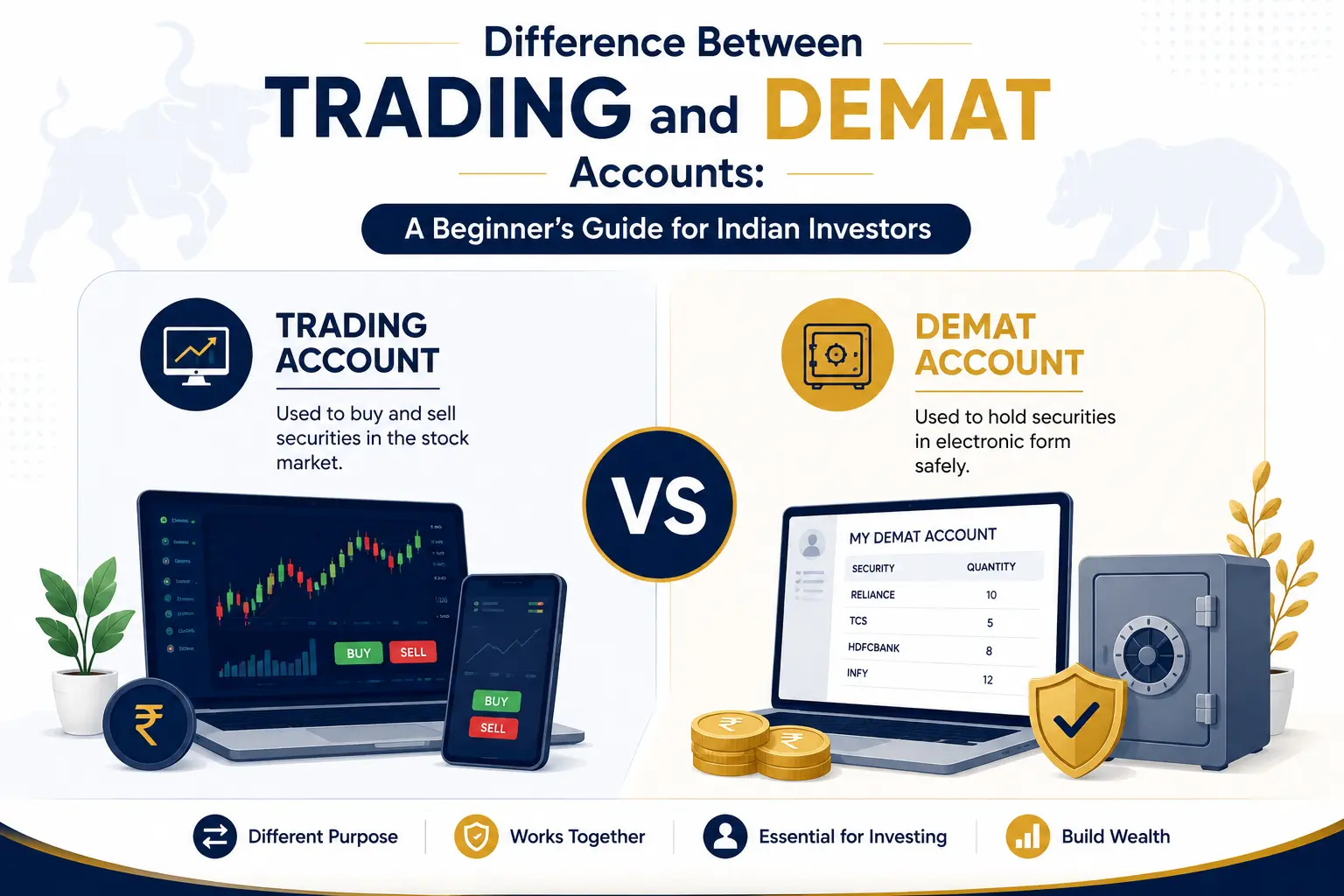
How a trading account and a Demat account work together in Indian stock market transactions
Summary: A beginner-friendly guide explaining the difference between trading and Demat accounts in India — their distinct roles, how they work together with a bank account, the T+1 settlement process, typical charges, and common misconceptions.
Key Takeaways
- A trading account executes buy/sell orders on an exchange; a Demat account holds the securities you own electronically.
- Trading accounts are maintained by your stockbroker; Demat accounts are maintained by a Depository Participant linked to NSDL or CDSL.
- For delivery-based equity investing, you generally need both accounts, working alongside a linked bank account, with T+1 settlement crediting shares to your Demat account.
- Some scenarios, like cash-settled F&O trading or pure mutual fund investing, don't strictly require an active Demat account.
- Trading and Demat accounts carry separate charges (brokerage vs AMC/DP charges) and separate KYC compliance requirements.
- This content is educational; verify current charges and rules with SEBI, your depository, or your broker before acting.
For a beginner in trading, determining the difference between trading and Demat accounts can be tricky. These two terms are usually discussed together, or even used together, in referring to the process of buying and selling equities in India. In the most basic sense, a trading account is used for placing buy and sell orders on any of the stock exchanges like the NSE or BSE. A Demat account is an electronic account where equities are held. Understanding the functions of the three accounts, trading, Demat, and banking, is very important for all new traders.
What Is a Trading Account
A trading account is used for placing buy and sell orders to a particular stock exchange. This type of account is at the disposal of a stockbroker who holds trading rights to that exchange and has SEBI registration. A trading account is the interface to the order matching system of the exchange and therefore a buy or sell order on a trading application is sent to the exchange order matching system from a trading account on the stock exchange. A trading account is used for recording the transacted orders. It does not record a hold of shares.
What Is a Demat Account?
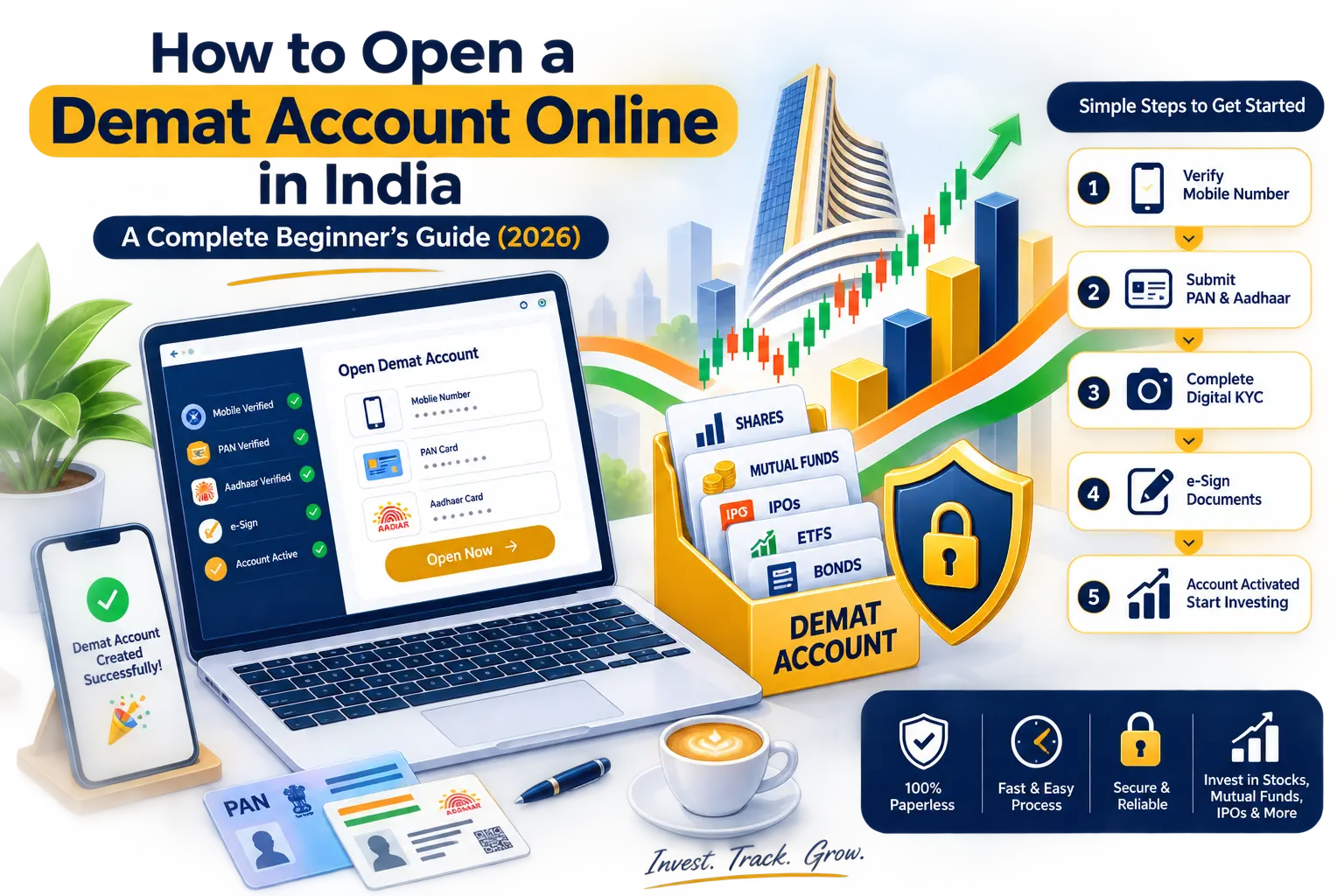
A Demat account is an electronic storage facility provided by a depository participant (DP) of either NSDL or CDSL via a Depository Participant (DP), which is most likely your broker or bank, to dematerialize (electronically) hold your shares, ETFs, bonds, or mutual fund units. Unlike a trading account, a Demat account is a point-in-time snapshot of holdings reflecting the stocks you currently own and not the orders you have transacted for. Prior to dematerialization, share certificates used to exist in physical form and had the risk of loss, theft, or duplication. Now, almost all listed instruments in India are dematerialized and held electronically. Refer to our walkthrough on how to open a Demat account online in India for a step-by-step guide.
Difference Between Trading and Demat Accounts: Key Points
Function: A trading account is used for buying and selling securities; no such function exists for a Demat account.
Nature: A trading account represents the flows in securities over time; in contrast, a Demat account represents a conditioned holding of securities.
Regulator/Maintainer: A stockbroker is responsible for a trading account as an exchange trading member; for a Demat account, NSDL or CDSL is responsible.
Identification: Trading accounts are characterized by client/trading IDs; a Demat account has a Beneficiary Owner (BO) ID.
What it stores: A trading account only routes/places orders, while a Demat account stores the physical shares, bonds, units of ETFs, and other such instruments.
How the Two Accounts Work Together: The Buying Process
THIS IS THE FLOW FOR AN EXAMPLE EQUITY PURCHASE THAT INVOLVES DELIVERABLE TRADING
An order placed to buy a stock is placed in the trading account.
The order is approved and funds transferred, within the broker's limit, from your bank account to your trading account.
The order is directed to the trading exchange. Once the order is matched with a selling order, the transaction is complete.
The clearing and settlement process is initiated and the funds are withdrawn from your bank account. On the next working day, the shares are transferred to your Demat account.
On this day, the selling process is done in the reverse order. Shares are debited from your Demat account and the sale proceeds are credited to your bank account. This is the reason that most brokers give the option of a combined account, which is called either 2-in-1 or 3-in-1 account. This provides a trading Demat and a bank account all integrated and simplified. If you are looking to buy a bundled account, you can use our comparison of Demat accounts in India.
Do You Always Need Both Accounts?
For delivery-based equity investments, both accounts are necessary. One cannot operate fully without the other. Here are the exceptions you should know:
Cash-Settled F&O: Most F&O contracts are cash-settled and do not rely on securities delivery, making a Demat account unnecessary for their trading. While most investors keep a Demat account, some do not for lack of other investments. However, some stock derivative contracts can lead to physical settlement and require a Demat account.
Holding Only, No Active Trading: If shares were passed down to you or allocated to you through an IPO and you will not engage in active trading, then you are legally required to have a Demat account to hold those shares. However, a trading account is required to sell shares on the exchange.
Mutual Funds: Mutual funds can be purchased through a Demat account or directly from the Asset Management Company/Registrar. This means a Demat account is not necessary for mutual fund purchases — see AMFI for more on how mutual fund folios work.
For the average beginning investor, the advice is clear: it is essential to open both accounts together because most brokerages offer both accounts simultaneously.
Charges: Trading Account vs Demat Account
Both accounts can incur individual charges. Here’s where you’re likely to find them:
Trading account charges Brokerage fees are the primary charges in a trading account and may be based on a flat-rate or percentage basis, depending on the broker and the type of trade. Most trading accounts also incur opening fees and a fee for the use of the trading platform.
Demat account charges Charges for a Demat account may consist of an Annual Maintenance Charge (AMC) and charges for Debit-related Party (DP) transactions that occur when shares are sold.
The amount typically charged by a broker varies based on a variety of factors, including whether or not it is a full-service or discount broker. Fees and charges are subject to periodic change, so it is important to check the current fees and charges posted on the broker’s website. Demat account charges are addressed more fully in our related guide.
Benefits of Having Both Accounts in Sync, KYC, and Compliance
It is vital that trading and Demat account KYC information is the same and up to date. Both your trading and Demat accounts cannot be in a non-compliant state. Exchanges and depositories have the ability to block or freeze a non-compliant account. For example, trading accounts that have non-compliant KYC may be blocked from new order entry, and Demat accounts may be frozen from any debits until compliance is met. In addition, you should always keep your PAN, Aadhaar, address, and income updates current with your broker/DP. For official advice on rights of an investor, complaints, and dispute resolution, visit the SEBI investor resources.
Common Beginner Misconceptions
“They’re the same account”: While they are linked, legally and functionally, they are different. One is your broker’s trading membership, and the other is a depository membership.
“I can buy shares without a Demat account”: This is not possible for delivery-based equity purchases.
“Closing my trading account also closes my Demat account”: They must be closed separately, and you can even have Demat account dues with AMC that continues to accumulate even if you stopped trading.
“A 2-in-1 account means there’s only one account number”: Even in bundled accounts, the trading ID and the Demat BO ID will be different.
While some beginners prefer starting with individual equity trading after they learn how these accounts interact, it is common to start with a structured methodology like an SIP in mutual funds or index funds.
Conclusion
A trading account and a Demat account are functionally different. Understanding the difference between trading and Demat accounts helps beginners understand how orders are placed, how securities are held, and how the banking account completes a transaction in India for delivery-based equity transactions. This is one of the first accounts you will open with a SEBI-registered broker as a beginner and it is important to understand the difference to help with contract note analysis and charge tracking as well as troubleshooting KYC issues. This article is meant to provide educational information and is not intended as a recommendation or an offer to provide services.
Frequently Asked Questions
What is the main difference between a trading account and a Demat account?+
A trading account is used to place buy and sell orders on a stock exchange, while a Demat account is used to hold the securities you own in electronic form. One handles the transaction flow; the other holds your actual holdings.
Can I have a trading account without a Demat account?+
You can technically have a trading account for certain cash-settled derivative segments without an active Demat account, but for delivery-based equity buying and selling, you need both, since purchased shares must be credited somewhere.
Can I have a Demat account without a trading account?+
Yes, if you only want to hold securities you've received through means like IPO allotment, inheritance, or a gift, without actively trading. However, you would need a trading account to sell those shares on the exchange later.
Why do brokers offer a 2-in-1 or 3-in-1 account?+
A 2-in-1 account bundles a trading account and a Demat account (and a 3-in-1 adds a linked bank account) so beginners can place orders, hold securities, and settle funds through one integrated experience, even though each account has a distinct ID behind the scenes.
How long does it take for shares to reach my Demat account after buying?+
Under the T+1 settlement cycle used for Indian equities, purchased shares are typically credited to your Demat account one working day after the trade date, assuming the trade and payment process without issues.
Do trading and Demat accounts have separate charges?+
Yes. Trading accounts typically involve brokerage charges per trade, while Demat accounts typically involve an Annual Maintenance Charge (AMC) and DP transaction charges on sell-side trades. Both may attract GST, and exact amounts vary by broker.
What happens if my KYC is not updated on my trading or Demat account?+
Exchanges and depositories can restrict activity on accounts with deficient KYC — for example, blocking new trades on a trading account or freezing debits on a Demat account — until the KYC details are updated and verified.
Is a Demat account required to invest in mutual funds?+
Not necessarily. Mutual funds can be held either in a Demat account or directly as a folio with the fund house or its registrar, so a Demat account is not mandatory purely for mutual fund investing.
Disclaimer
This article is for investor education only and does not constitute investment advice, a recommendation, or an offer to buy or sell any security.
Markets involve risk, including possible loss of capital. Please do your own due diligence or consult a registered adviser.
Research views are informational and may change without notice. Past performance is not indicative of future results.
This article is for educational purposes only and does not constitute personalised investment advice. Settlement cycles, charges, and regulatory requirements may change; verify current details with SEBI, NSE, BSE, your depository (NSDL/CDSL), or your broker before making decisions.
Ready to Start Investing?
Open a linked trading and Demat account with a SEBI-registered broker to start buying and holding shares in India.
Open Demat AccountRelated Articles
Was this article helpful?
🚀 Open your Demat & Trading account
- Free Account opening charges
- Free DP transaction charges ⭐
- Free premium research & market updates