
How to Open a Demat Account Online in India: A Complete Beginner's Guide (2026)
A step-by-step beginner's guide to open a Demat account online in India — documents, e-KYC, charges, NSDL vs CDSL, and the new SEBI nomination rule.
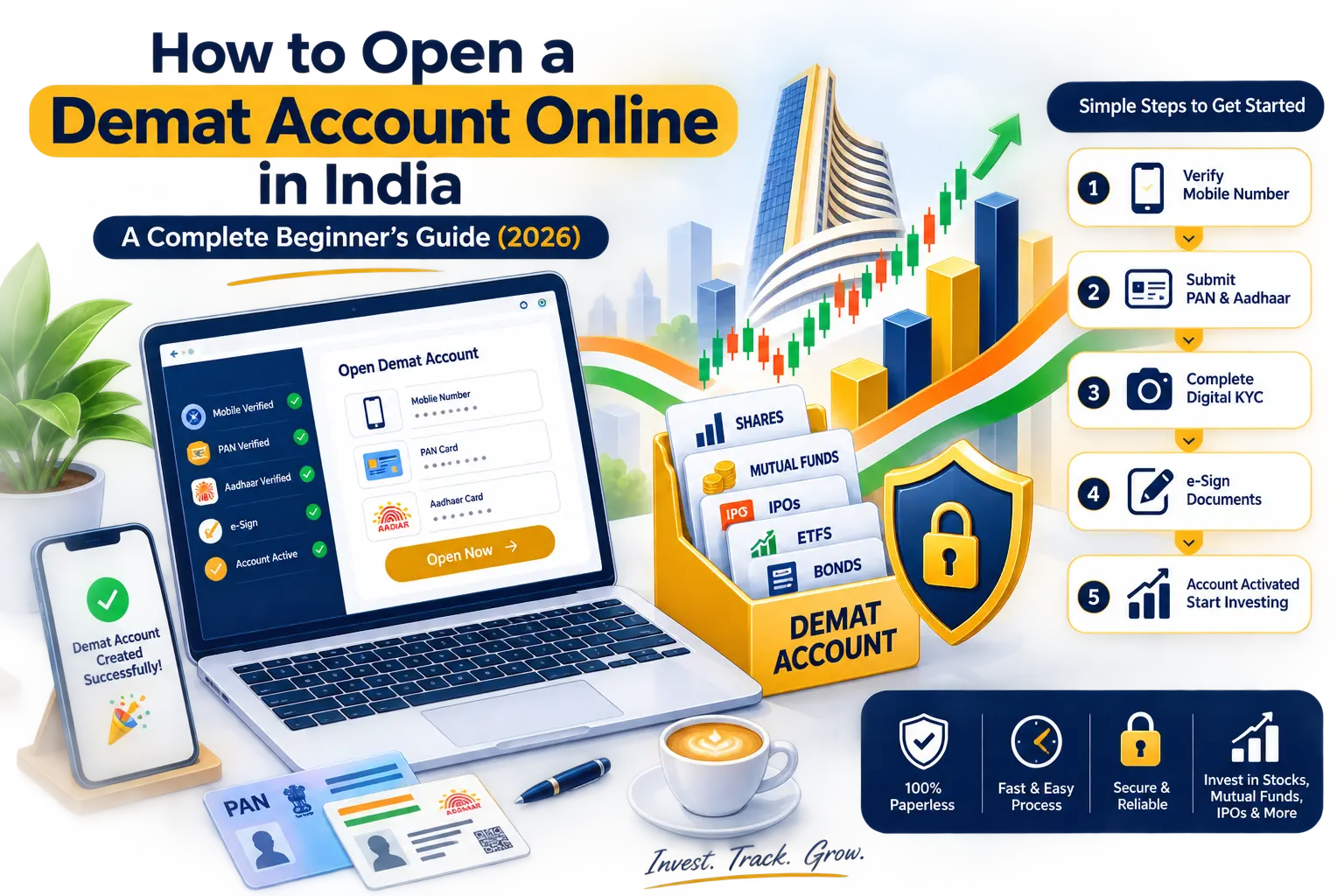
Opening a Demat account online in India via Aadhaar-based e-KYC
Summary: A beginner-friendly, India-first guide covering eligibility, documents, the step-by-step online process, NSDL vs CDSL, typical charges, and the new SEBI nomination rule for opening a Demat account online in India.
Key Takeaways
- A Demat account is mandatory to hold and trade shares, ETFs and bonds in India, and works alongside a linked trading account.
- PAN, Aadhaar (mobile-linked) and a bank account are the core requirements; PAN-Aadhaar linkage on the Income Tax portal helps avoid KYC rejection.
- The online process — e-KYC, document upload, video IPV and e-sign — can typically be completed in under 30 minutes, with activation in 24-48 hours.
- Compare AMC, DP transaction charges and platform quality across SEBI-registered brokers, not just account-opening offers.
- From September 1, 2026, new single-holder Demat accounts must either nominate a beneficiary or formally opt out under revised SEBI rules.
- This content is educational; always verify current charges and rules directly with SEBI, your depository, or your broker before acting.
If you want to purchase your first share in an Indian company, invest in an ETF, or start a stock SIP, the first thing you must do is have a Demat account. A Demat account stores all your shares, bonds, ETFs, and mutual funds in digital format, instead of the old physical share certificate system. Thanks to Aadhaar-based e-KYC, first-time investors can open a Demat account online in India in 30 minutes, and it is operational in 24-48 hours. This article breaks down the Demat account process, fees, and commonly made mistakes.
What Is a Demat Account and Why Do You Need One?
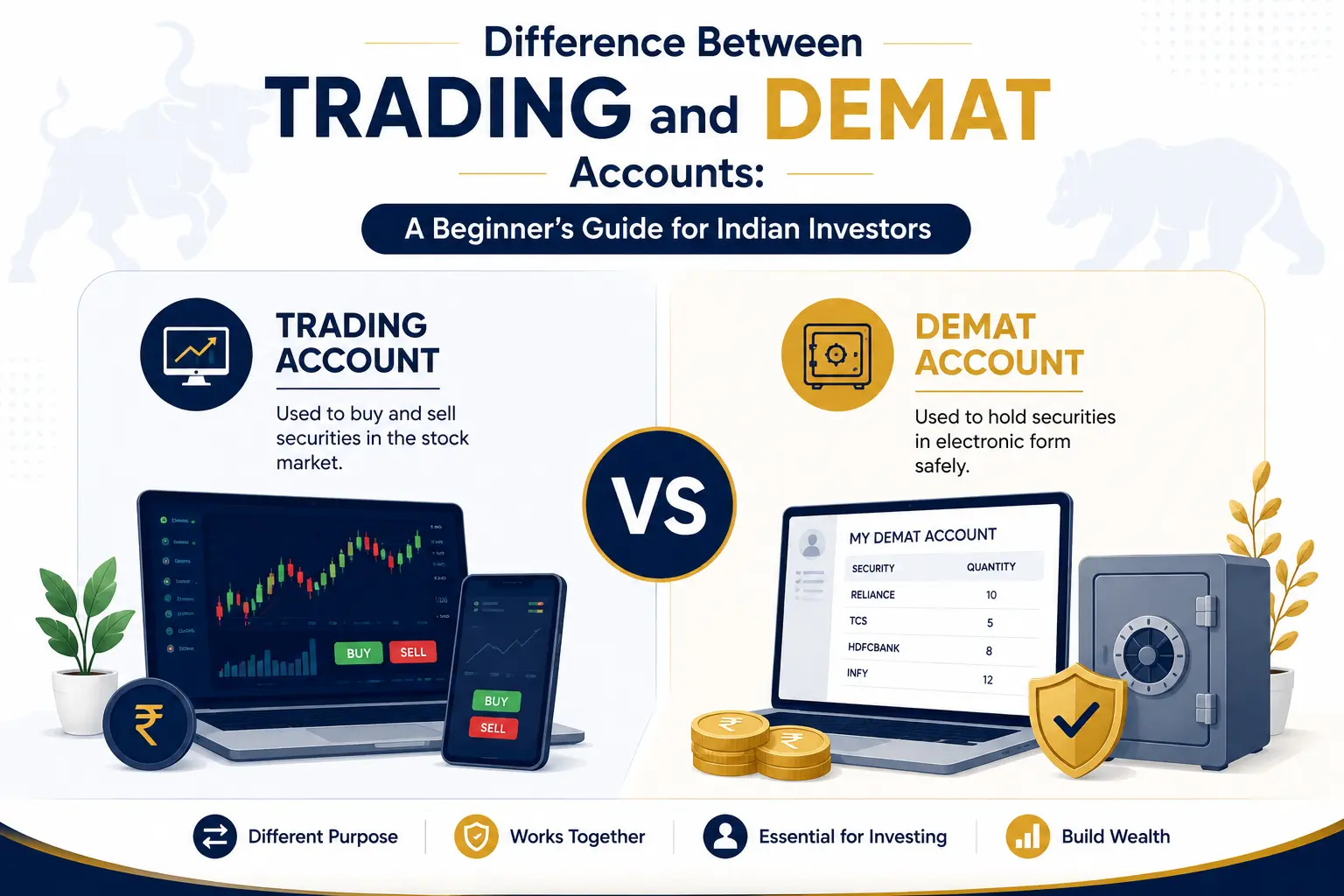
A Demat account is an electronic storage facility for your securities. All securities transactions in dematerialized form are handled by two depositories in India: NSDL (National Securities Depository Limited) and CDSL (Central Depository Services Limited). A broker acts as a participant or intermediary of the depository (DP), and is known as a Depository Participant (DP). Your Demat account is typically created in conjunction with a trading account. The trading account is used to place buy/sell orders on the NSE (National Stock Exchange) or BSE (Bombay Stock Exchange). The shares that are purchased are transferred to the Demat account, and are sold on a T+1 basis. Legally, you cannot hold or trade listed Indian securities without a Demat account. For a more thorough comparison of the practical difference between trading and Demat accounts, take a look at our other article on this.
Who Can Open a Demat Account in India?
Most resident Indian adults who hold a valid PAN card, an active mobile phone number with an Aadhaar card, and a bank account can open a Demat account online in India without complications. There are usually no minimum income requirements. People such as students, employees, homemakers, or retirees are able to open an account. There are some exceptions:
Minors: Legally, trading accounts or accounts used for investing cannot be opened for minors. Therefore, a demat account must be created in the name of a minor and be controlled by the parent or guardian. This demat account is only used for securities that are given as gifts or passed on through inheritance.
NRIs: Non-Resident Indians require an NRE or NRO-linked Demat account for funds that are eligible for repatriation, as well as declarations pertaining to the FEMA (Foreign Exchange Management Act).
HUFs, companies, trusts and LLPs: These non-individual entities would require additional constitutional and authorisation documents in addition to the Standard Individual KYC.
This guide describes the process for the usual case of a resident individual investor looking to open a Demat account online in India.
Documents Required to Open a Demat Account Online
The following documents are needed in a soft copy format:
PAN card - required for virtually all individual Demat accounts and used as primary KYC.
Aadhaar card - required for e-KYC and e-sign and needs to have the mobile number linked for OTP.
Bank account details - usually verified with a cancelled cheque, bank statement or penny-drop verification.
Proof of address - if it is not the same in your Aadhaar (utility bill, passport, voter ID, etc.).
A recent picture and signature - captured digitally in the process.
Income proof - needed by many brokers when one intends to trade in derivatives (F&O).
Ensure that your PAN and Aadhaar are linked on the Income Tax India portal, as a mismatch here is one of the most common reasons for KYC rejection.
Step-by-Step Process to Open a Demat Account Online in India
While the screens may differ slightly among brokers, the core steps in opening a Demat account online in India are the same across SEBI-registered platforms.
Step 1: Choose a SEBI-Registered Broker or DP
Pick a broker that is registered with SEBI and connected to either NSDL or CDSL. Consider the account opening charges, Annual Maintenance Charges (AMC), transaction fees, ease of platform use, the quality of research, and the level of customer support. Many brokers advertise "free account openings", and although that number is attractive, all of the other figures may be more important in the long term. If this is confusing for you, our Demat Account comparison for popular Demat accounts in India may help.
Step 2: Enter Basic Details and Verify Mobile/Email
You'll register with your mobile number and email ID, each verified via a One-Time Password (OTP).
Step 3: Complete Aadhaar-Based e-KYC
An OTP will be used to verify your identity and your address through Aadhaar. This can also be done using DigiLocker. Many brokers will auto-populate your name, date of birth, and address using Aadhaar. Ensure that the information in your Demat account matches your PAN card.
Step 4: Upload PAN, Bank Proof and Photograph
Clear scans and photos of your PAN card and bank proof must be uploaded. A short identity matching video must be taken as well.
Step 5: Complete In-Person Verification (IPV)
SEBI requires In-Person Verification for all new Demat and trading accounts. This will be done via a short, live, KYC video call. You must verify your PAN card and confirm a few details. This video will be saved for record for compliance.
Step 6: Add Bank and Nomination Details, Then e-Sign
To finalize your application, add your bank details for fund settlement, nominate or formally decline (check below), review the account opening agreement and e-sign with Aadhaar-based e-sign.
Step 7: Account Activation
Your Demat and trading accounts should get activated within 24 to 48 hours, but it may take a few working days in some cases. You will receive a unique Demat account (Beneficiary Owner/BO) number via email and SMS.
NSDL vs CDSL: Does It Matter Which Depository You Get?
You usually do not have a choice of NSDL or CDSL. This is decided by the depository your selected broker is member of. Both are regulated by SEBI and offer similar services and protection to their clients, and the practical differences are in the DP's fee structures rather than client safety. For more details have a look at NSDL vs CDSL: what's the real difference.
Demat Account Charges You Should Know
Demat accounts are rarely completely free. Depending on broker costs, GST, etc. following charges may apply:
Account opening charges: Most discount brokers have removed this charge already, but some full service brokers have a small one time charge.
Annual Maintenance Fee (AMF): A maintenance fee charged by a broker and payable annually or every quarter. Under the BSDA framework offered by SEBI, some investors may be eligible for reduced or no-AMFs, depending on the holding value. Please check the current values with your DP before making this corporate assumption.
DP (transaction) charges: There are charges with selling of shares that are debited and buysides are normally free.
Other: There are some other small fees like dematerialization, pledging, and off-market transfers.
Exact rupee amounts change frequently as brokers revise tariffs, so always verify current charges on your chosen broker's official fee page before opening an account. For a deeper breakdown, see our guide to understanding Demat account charges.
The exact numbers change quite often, so please check what the latest charges are with your broker before opening an account. Please see our detailed guide on Demat account charges for more information.
Important: New SEBI Nomination Rules for Demat Accounts
SEBI has changed the framework of nominations for demat accounts and mutual funds and will be applicable from 1 September 2026. New single-holder demat accounts must mandatorily have a valid nomination or opt-out declaration. Leaving the field blank is no longer an option.
This version of the framework was designed to streamline documentation, allow nominations to be quickly amended, and make transferring assets to the legal heirs easier while requiring less paperwork in the event of an investor's death. As the specific documentation requirements have been changing through 2026, please check the latest official SEBI circular or your broker's current nomination form for the most up to date requirements before you submit the form. Please also note that the nomination rules and survivorship provisions of joint accounts differ from single holder accounts.
Common Mistakes First-Time Investors Should Avoid
Incorrectly entering personal information resulting in Aadhaar and PAN mismatches: These can result in delays or rejections of applications.
Blindly choosing “zero brokerage” offers: Look at AMC, DP charges, and the reliability of the trading platform.
Failing to nominate anyone: This makes the distribution of your assets to your heirs a costly and time-consuming process.
Unnecessarily creating multiple accounts: Tracking multiple accounts for AMC and documentation is an added cost and complexity for a beginner.
Not verifying broker registration: Ensure that your broker is a SEBI-registered stock broker and depository participant before you provide your KYC.
Once your Demat account is active, many first time users opt to begin their investing journey through a diversified approach such as a SIP in mutual funds or index funds, so that they can familiarize themselves with the platform and market movements before they begin stock trading.
Conclusion
Opening a Demat account in India is easier than ever, thanks to the digitization of most of the process. If you want to open a Demat account online in India, you should still exercise care while completing the application. All documents (PAN Charts and Aadhaar) should be kept consistent and linked. A broker should be selected after reviewing the charges (not only the brokerage), which should be SEBI registered. Your nomination should also be entered honestly, and the account opening agreement should be reviewed before e-signing. The content provided is meant to be informational and is not personalized advice for investment, so please contact SEBI, AMFI, or your financial advisor to obtain personalized advice.
Frequently Asked Questions
How long does it take to open a Demat account online in India?+
The online application itself can often be completed in 15-30 minutes if your documents and Aadhaar-linked mobile are ready. Account activation typically takes 24-48 hours, though it can occasionally take a few working days depending on the broker and verification load.
Is it possible to open a Demat account without a PAN card?+
For most individual investors, a PAN card is mandatory to open a Demat account. There are limited exceptions for certain categories of investors as specified by SEBI and the depositories, but for a typical resident individual, PAN is required.
Can I open a Demat account without Aadhaar?+
Aadhaar-based e-KYC is the fastest, fully digital route. If Aadhaar-based verification isn't possible for you, brokers usually offer an alternative offline or physical KYC process using other accepted identity and address proofs, though this takes longer.
Do I need a trading account along with a Demat account?+
Yes, in practice. A Demat account holds your securities, while a trading account is used to place buy and sell orders on exchanges like NSE and BSE. Most brokers open both together as a linked pair during onboarding.
What are the charges for opening and maintaining a Demat account?+
Charges can include a one-time account-opening fee (often waived by discount brokers), an Annual Maintenance Charge (AMC), and DP transaction charges on sell-side trades, plus GST. Exact amounts vary by broker and change periodically, so check your broker's current fee schedule before opening an account.
Can a student or homemaker open a Demat account?+
Yes. There is generally no minimum income requirement to open a Demat account in India — students, homemakers, salaried individuals and retirees can all apply, provided they meet standard KYC and documentation norms.
What is the new SEBI nomination rule for Demat accounts?+
Under SEBI's revised framework effective from September 1, 2026, investors opening new single-holder Demat accounts or mutual fund folios must either nominate a beneficiary or submit a formal opt-out declaration; leaving the nomination field blank is not permitted.
Can I have more than one Demat account?+
Yes, an individual can open multiple Demat accounts, including with different brokers, as long as each meets KYC requirements. However, managing multiple accounts means tracking separate AMC and charges, so beginners often start with one account.
Disclaimer
This article is for investor education only and does not constitute investment advice, a recommendation, or an offer to buy or sell any security.
Markets involve risk, including possible loss of capital. Please do your own due diligence or consult a registered adviser.
Research views are informational and may change without notice. Past performance is not indicative of future results.
This article is for educational purposes only and does not constitute personalised investment advice. Charges, rules and regulatory timelines mentioned may change; verify current details with SEBI, your depository (NSDL/CDSL), or your broker before making decisions.
Ready to Start Investing?
Open your Demat account online with a SEBI-registered broker and take the first step toward building your equity portfolio.
Open Demat AccountRelated Articles
- Demat Account
Difference Between Trading and Demat Accounts: A Beginner's Guide for Indian Investors
- Demat Account
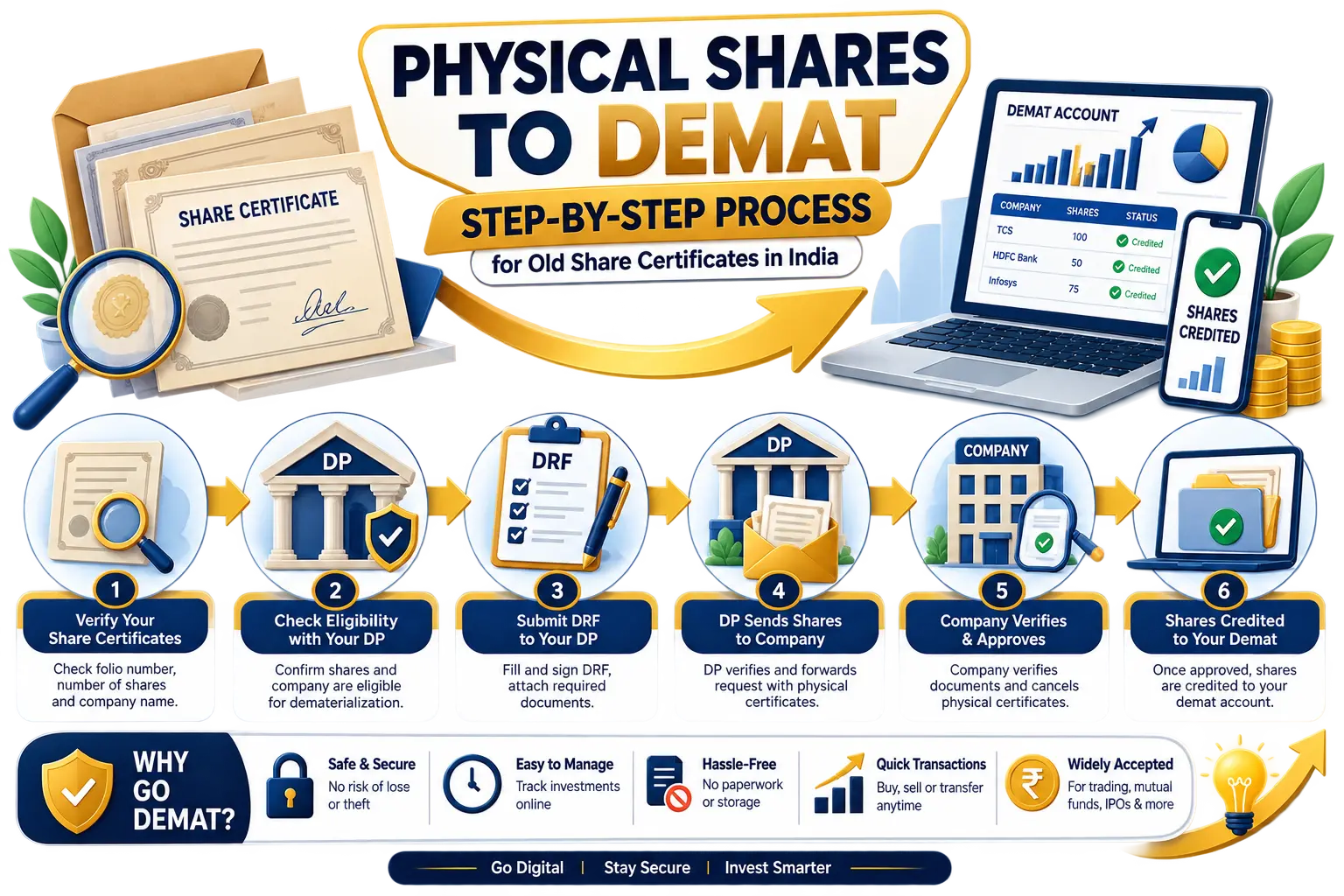
Physical Shares to Demat: Step-by-Step Process for Old Share Certificates in India
- Demat Account
IEPF Form 5: How to Claim Old Shares and Unpaid Dividends in India
- Demat Account
How to Open a Demat Account for NSE IPO: Complete Guide


Was this article helpful?
🚀 Open your Demat & Trading account
- Free Account opening charges
- Free DP transaction charges ⭐
- Free premium research & market updates