
Transmission of Physical Shares After Shareholder Death in India: Nominee, Legal Heir and Documents
Learn how nominees, surviving joint holders and legal heirs can claim physical shares after a shareholder's death, with documents, RTA steps and demat conversion.
Summary: Upon the death of a shareholder, the physical shares have to be transmitted by the issuer or its RTAs after the claimant’s entitlement has been confirmed. The process would depend on whether the shares were held in a single name, jointly, or with a registered nominee. In any of the above cases, a nominee may lodge a claim, but nomination does not necessarily confer the right of beneficial inheritance on the legal heirs. The claimant may be required to submit a death certificate, original certificates, PAN, KYC documents, evidence of succession, and prescribed forms. Upon approval of the claim, the securities are required to be credited to an eligible demat account. Other delays may be attributable to family disputes and IEPF transfers.
Key Takeaways
- “Transmission” means recording of the name of the successor in title of the securities of a deceased shareholder.
- A registered nominee, a joint holder and a legal heir may be required to follow different procedures.
- Nomination aids the company in processing the transmission, but does not resolve inheritance issues among legal heirs.
- The checklist prescribed by the RTA, which is currently being followed, determines the documents required for the particular folio and the category of the claimant.
- After the approval process, physical securities are dematerialised and credited to an eligible demat account.
- Lost certificates, After approval, physical securities generally need to be dematerialised and credited to an eligible demat account.mismatches, family disputes and IEPF transfers can require additional documentation or a separate process.
When a shareholder passes away, family members may come across share certificates, dividend records, or letters from the company among the shareholder’s financial documents. It is important to understand the transmission of physical shares after a shareholder's death to clarify that, in the absence of a family member providing evidence of the shareholder’s investment, the company or its Registrar and Transfer Agent (RTA) will not automatically consider the shares as transferred. The company and its RTA have to verify the claimant and go through the requisite process of transfer.
Need help with the transmission of physical shares after a shareholder's death? Access expert physical share assistance to understand documentation, company procedures, and the step-by-step process for claiming inherited shares.
The process will vary based on how the shares were held, that is, in a single name, jointly, or with a registered nominee. The process will also be affected by the presence or absence of a will, the availability of a succession certificate/probate, and the physical condition of share certificates. This process is explained with examples to assist the beneficiaries of an Indian shareholder.
What is transmission of physical shares?
Transmission of shares is the recording of the change of ownership of shares in the name of the successor, following the death of the shareholder. This differs from a transfer. A transfer happens when a living holder voluntarily transfers shares to another. Transmission takes place following a legal event like death, insolvency, or succession.
As regards physical shares, the claimant approaches the company or its RTA with the required documents. The company checks the documents and records the eligible successor or surviving holder. Currently, under the SEBI (Interim Regulation) 1995, physical shares, in the ordinary course of business, cannot be transferred by sale or gift, but transmission and other authorized service requests are dealt with in accordance with the rules which SEBI publishes on its website. The family, therefore, has to distinguish between a transmission claim and an ordinary transfer.
Who can claim shares after the shareholder's death?
The way the deceased shareholder held the shares determines the claimant and the document required for transfer of shares.
1. Shares held in a single name with a registered nominee
Where the deceased shareholder appointed a nominee, the nominee presents the death certificate, original share certificates and prescribed claim documents. The company or RTA verifies the nomination and the claimant’s identity and processes the request.
A registered nominee is entitled to receive the shares on the death of the holder. However, nomination and legal heirship are not always the same. Registration of a nominee may enable the company to transmit the shares to that person, but this does not necessarily determine the claim of the legal heirs, override the claim arising under the succession law, a valid will or a court order. A nominee should obtain legal advice if other legal heirs dispute the claim.
2. Shares held jointly
Where shares are held jointly, and one of the joint holders dies, the surviving joint holder or holders present the death certificate and request for transmission of the shares. The shares are transmitted to the surviving joint holder or holders in accordance with the order of names registered and the procedure of the company.
An example is shares registered in the names of A and B jointly, and on the death of A, B would normally make an application to have the shares registered in his name. Generally, in the absence of the surviving joint holder, the legal heirs of the deceased joint holder do not replace the surviving joint holder through the ordinary means of succession. However, on the death of the surviving joint holder, the legal heirs of the deceased joint holder succeed to the shares in accordance with the nomination or succession documents.
3. Shares held in a single name without a nominee
This is generally a more involved process and documentation. The legal heir or representative may be required to establish the right to succeed to the shares in accordance with the applicable law of succession. The company may seek proof of the succession to the shares in the form of a succession certificate, grant of Probate of a Will, Letters of Administration, a Court Order or other evidence as deemed necessary based on the requirements of the applicable SEBI framework.
Where the value of the securities is less than or equal to the threshold stipulated and conditions satisfied in the applicable SEBI procedures, simplified processes are available. Such processes may involve the execution of various documents, such as, a legal heirship certificate, family arrangement, indemnity, no objection and other required documents. Exact documentary processes are a function of the value of the securities, if there is a dispute, existence of a will and the level of verification required by the company. Contact the RTA for the latest procedures and the current checklist before arranging affidavits or legal documents.
Nominee vs legal heir: what is the difference?
Point | Nominee | Legal heir |
|---|---|---|
How identified | Person recorded as nominee in company or depository records | Person entitled under applicable succession law, will or court process |
Role in transmission | Can submit a claim where a valid nomination is registered | May claim where no nominee exists or where succession documents establish entitlement |
Documents | Death certificate, identity and prescribed nomination/transmission forms | May require will, probate, succession certificate, legal-heirship or other supporting documents |
Family disputes | Nomination does not automatically resolve beneficial ownership disputes | Entitlement may need to be established under succession law or a court's directions |
It is important not to assume that a nominee and a legal heir are interchangeable. The nominee is recorded for the purpose of the company's or depository's transmission process. The ultimate rights among family members can depend on personal succession law, a valid will and the facts of the case. Where competing claims exist, the company may require a court order or other legally acceptable resolution before proceeding.
Documents required for transmission of physical shares
Prepare the documents in accordance with the claimant category and RTA's latest checklist. Below are some of the documents requested:
Death certificate: Company/RTA accepted copy. Please make sure the details of the shareholder are legible.
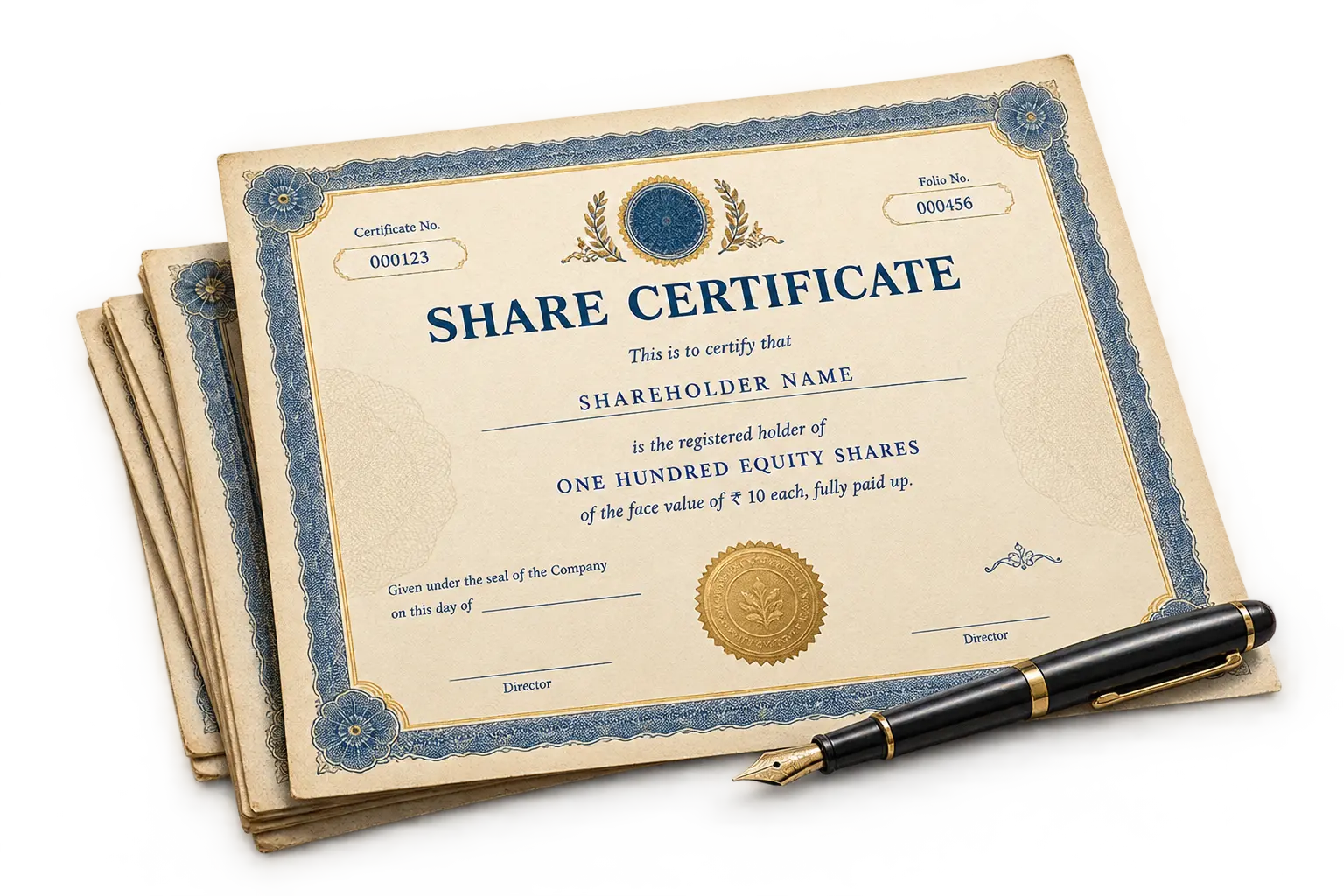
Original share certificates: If available, please obtain copies and note the certificate numbers, distinctive numbers and submit the originals.
Transmission request form: A transmission request form as per the company/RTA.
Claimant's PAN: PAN details and a copy as required for identity and record for Tax purposes.
Identity and address proof: Document as per the current KYC requirements.
Bank details and proof: If required, a cancelled cheque or bank verification.
Nomination or succession evidence: Evidence as per the claim route. i.e. nomination, will, probate, succession certificate, letters of administration, legal-heirship certificate, court order, etc.
Affidavit, indemnity and NOC: As per the claim route, required value and claimant's relationship with the shareholding, other legal heirs involved.
This is a general checklist. Do not sign blank forms. Do not send original documents unless retained copies are taken. Ask the RTA if original documents, self-attested copies, notarization or attestation are required.
Transmission of Physical Shares After Shareholder Death: Step-by-Step Process
Identify the holding details. Locate the details of share certificates, share folio numbers, name of the company, name of the shareholder(s), and number of the certificates, if any. In the absence of share certificates, inform the RTA; do not treat the case as that of a standard lost certificate case.
Confirm the registered holder pattern. Check whether the holding is single-name, joint or supported by a registered nominee. This determines who should submit the claim and which documents are likely to be needed.
Find the company's RTA. To identify the company's current RTA, refer to the company's website, the latest annual report or the latest filing made by the company to the exchange.
Request the applicable transmission checklist. State your category of claim and give the folio number. Also request the latest forms and the documents which may be required for the holding.
Prepare and submit the claim. Submit the completed Transmission Request and supporting documents in the manner and at the address specified by the RTA, retaining a copy of each. Send by registered mail and request service proof.
Respond to any discrepancy or objection. If the RTA determines a name, signature, date, folio or succession detail is not correct, provide an explanation. If the claim is disputed, you should consult a lawyer before executing an affidavit.
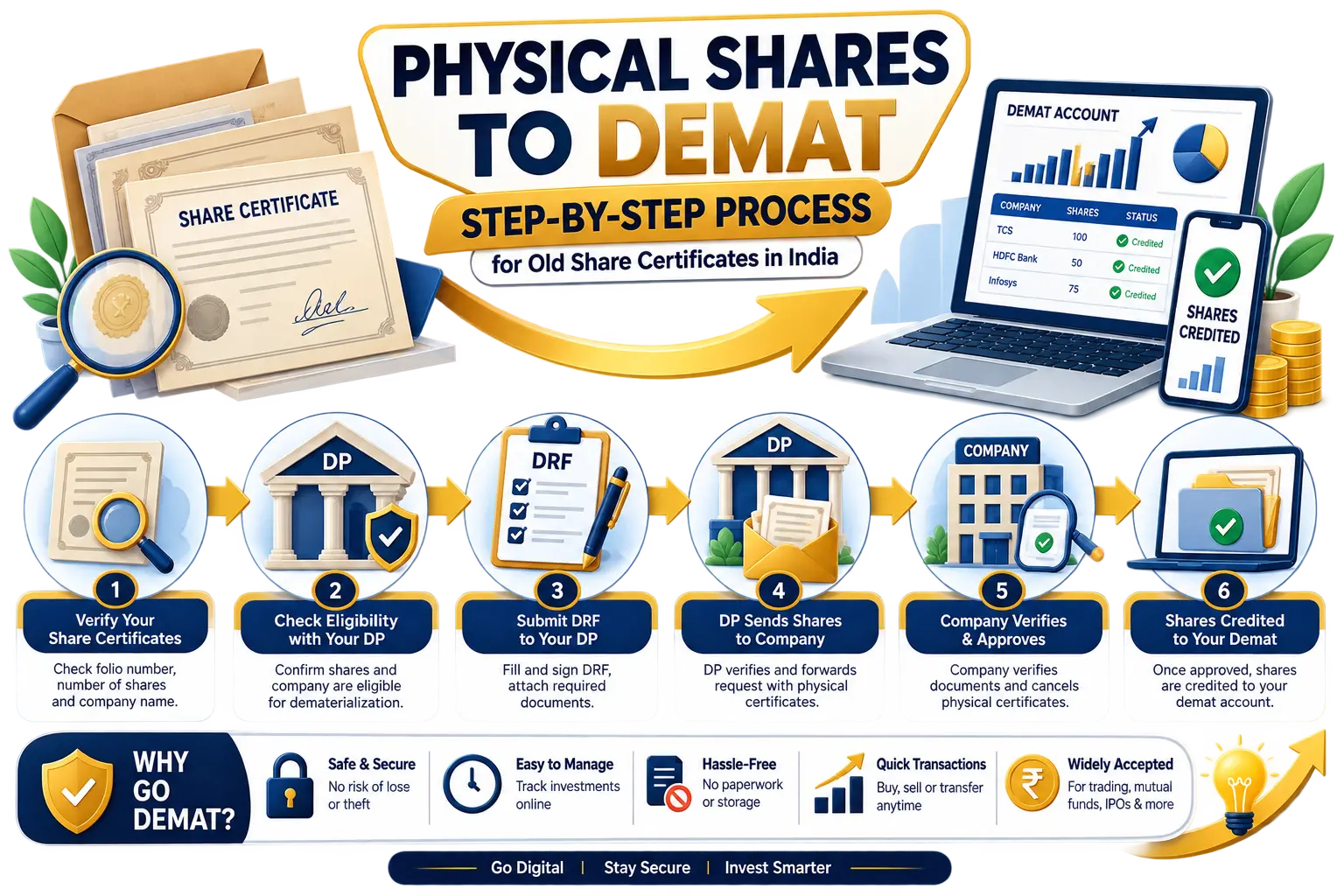
Complete dematerialisation. After the Transmission is approved, the securities must be held in the dematerialized form. Following the RTA’s directions, get the shares transmitted to the eligible claimant’s dematerialized account.
Families that need assistance with understanding the physical certificate process and company/RTA follow up may wish to review the physical share service process before submitting a claim.
What happens after the company approves the transmission?
Approval does not mean the family should immediately try to sell or transfer the old paper certificates. The next step is to ensure that the transmitted securities are credited in dematerialised form to the eligible claimant's demat account, following the RTA's instructions and the applicable depository process, such as that of NSDL.
The claimant may need an active demat account with matching holder details. In a joint holding, the demat account's holder names and order generally need to satisfy the applicable requirements. If the claimant does not have a demat account, they should arrange one before the credit stage and confirm the exact account format with the RTA and depository participant.
For a practical explanation of converting paper certificates into electronic holdings, see guide to the physical shares dematerialisation process. You can also review dematerialisation service information for the related process.
Common complications and how to handle them
Share certificates are lost or damaged
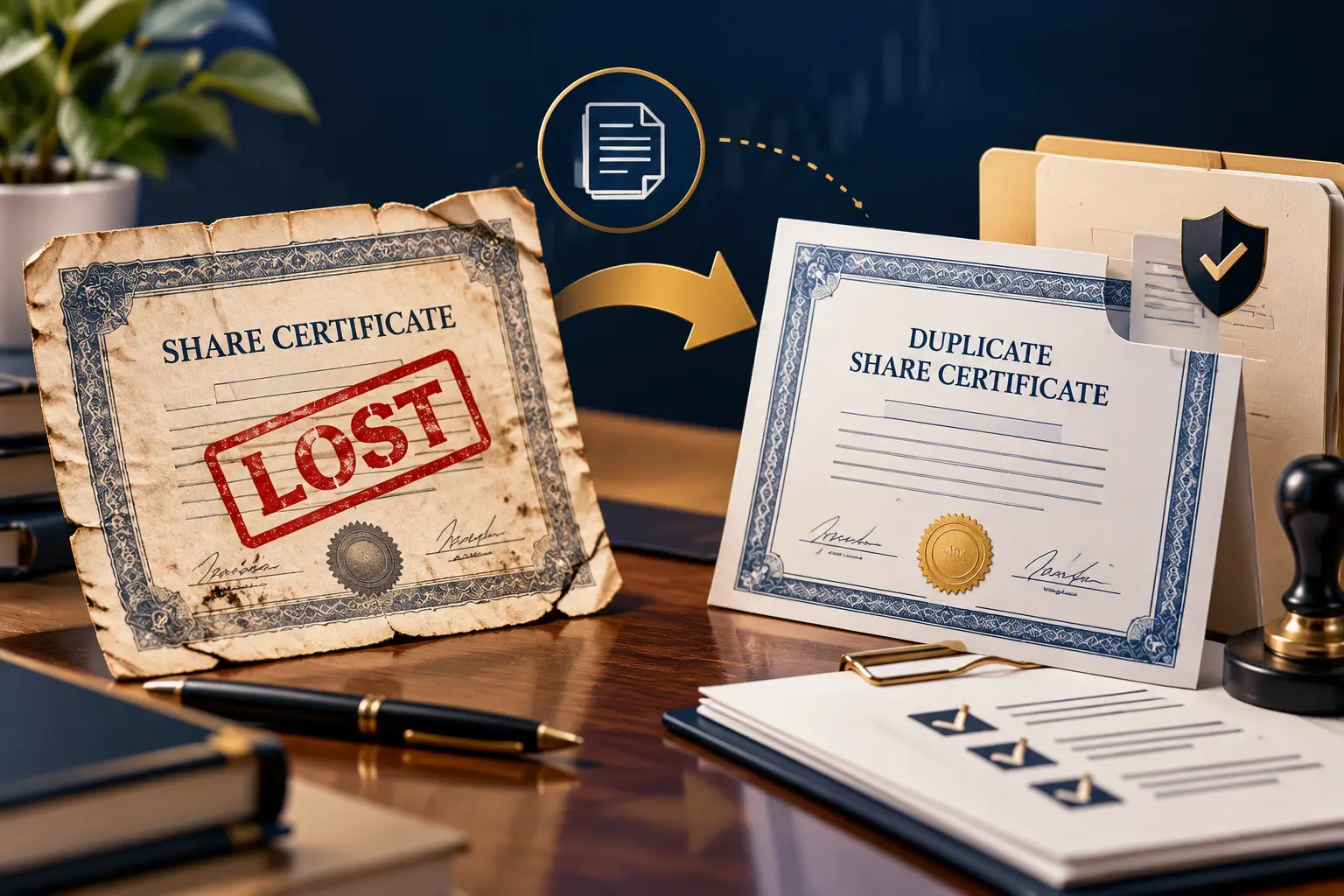
Do not abandon the claim solely because the original certificate cannot be found. Inform the RTA and ask for its procedure for reporting loss, placing a stop or caution where applicable, and obtaining a duplicate or replacement certificate or completing the relevant service request. A police complaint, indemnity, affidavit or other documents may be required depending on the facts. Guide on what to do when a physical share certificate is lost explains the separate lost-certificate process.
Do not abandon the claim just because the share certificates are lost. The RTA should be informed of the loss and the procedure for placing a stop or caution should be advised. The RTA should be requested to issue a duplicate or replacement certificate and complete the service, as the case may be. A police complaint may be necessary, depending on the facts of the case. For lost certificates, the RTA may prescribe some other documents in lieu of a police complaint. Please refer to our what to do if your physical share certificate is lost page for more information regarding the lost-certificate process.
Name mismatch or old address
Earlier address, spellings, and names changed due to marriage, are some of the differences that may be seen in older share certificates. The RTA may require supporting evidence such as identity documents, Gazette Notification, Marriage Certificate, Affidavit, etc. Do not try to correct the certificate yourself.
Multiple legal heirs or a family disagreement
If family members disagree about who should receive the shares, avoid submitting NOCs and affidavits with inconsistent statements. A family agreement may not be sufficient for the company to resolve a disputed claim. Get legal advice regarding the will, the Applicable Succession Law and any Court process that may be applicable.
Shares or dividends transferred to IEPF
In case shares have been transferred to the Investor Education and Protection Fund (IEPF) and dividends have not been paid for the stipulated period, it is likely that the shares will not be returned through the regular company processes. The claimant may need to go through the respective IEPF claim process. Determine the status of the shares with the company/Registrar and Transfer Agent (RTA), and check the official IEPF portal before doing so.
How to reduce delays in a transmission claim
Match the shareholder's name and folio against the original certificates before completing forms.
Ask the RTA for the latest checklist, instead of relying on old forms that you have downloaded from unrelated websites.
Keep scans of all certificates and documents and maintain a record of what you have submitted and when.
Do not take NOCs by family members as succession documents where the RTA or the law requires a succession document.
Take legal advice for will disputes, competing claims, minor heirs, and complex family situations.
There is no single reliable timeline for every claim. Processing time depends on the completeness of the documents, the claimant category, the need for legal evidence and any discrepancies, so ask the RTA for the applicable service timeline and an acknowledgement reference.
Where to get help with a physical-share transmission claim
There are several connected tasks to transmission, such as identifying the issuer and the RTA, ascertaining the claimant category, arranging succession documents, responding to record mismatches, and dematerialization. The sequence of these tasks depends on the evidence available and the nature of the holding. Readers requiring assistance reviewing the physical certificate process can look at physical share support proccess and check with the relevant company/RTA regarding the process.
Conclusion
The transfer of physical shares post the death of a shareholder is a documentation and verification process and is not an automatic change of ownership. Others, like a surviving joint holder, registered nominee, or legal heir, may follow other processes, and the difference between nomination and inheritance is particularly relevant in the presence of a will or a family dispute. The process involves identification of the folio and holder pattern, request for the latest RTA checklist, submitting evidence and completion of dematerialization upon approval.
Readers interested in other financial literacy and general market trends resources may visit financial advisor resources. This article is for general information and educational purposes and should not be considered legal advice on succession, inheritance, or adversed ownership.
Frequently Asked Questions
How can I transfer physical shares after the shareholder's death?+
The eligible claimant should contact the company or its RTA, identify the folio and holder pattern, obtain the applicable transmission checklist, and submit the death certificate, share certificates and required identity and succession documents. After verification, the company records the transmission and provides instructions for dematerialisation.
Can a nominee claim physical shares after the shareholder dies?+
A registered nominee can generally submit a transmission request with the prescribed documents. However, nomination does not necessarily determine the ultimate beneficial rights between family members. Any dispute involving a will or legal heirs may need to be resolved under applicable succession law or through a court.
What happens to jointly held shares when one shareholder dies?+
The surviving joint holder or holders generally apply to have the securities transmitted to the surviving holder or holders. The RTA will ask for the death certificate and its prescribed documents. If the last surviving holder dies, the claim is handled under the applicable nomination or succession route.
Is a succession certificate always required to claim shares after death?+
Not necessarily. The documents depend on whether there is a registered nominee, joint holder, will, the value and circumstances of the claim, and the applicable SEBI procedure. Some claims may qualify for a simplified documentary route, while disputed or complex cases may require probate, a succession certificate, letters of administration or a court order. Obtain the current RTA checklist.
Can legal heirs claim shares if the original physical share certificates are lost?+
A claim may still be possible, but the claimant must inform the company or RTA and follow its lost-certificate procedure. The RTA may require an affidavit, indemnity, police complaint or other documents depending on the circumstances. Do not submit a standard transmission claim as though the original certificates were available.
Do inherited physical shares need to be converted into demat form?+
After the transmission is approved, the claimant will generally need an eligible demat account so the securities can be credited electronically. Confirm the required account holder names and sequence with the RTA and depository participant before submitting the dematerialisation request.
What if the deceased shareholder's shares have been transferred to IEPF?+
If the shares have been transferred to IEPF, the claimant may need to follow the separate IEPF claim procedure rather than only the ordinary RTA transmission route. Confirm the status with the company and RTA, then consult the official IEPF portal for the current claim requirements.
How long does it take to transmit physical shares after death?+
The timeline varies with the completeness of the documents, the claimant category, the need for succession evidence and any discrepancies or objections. Ask the RTA for the applicable service timeline, obtain an acknowledgement and track the request using its service reference.
Disclaimer
This article provides general educational information about transmission of securities in India. It is not legal advice and does not determine inheritance rights or resolve disputes between nominees and legal heirs. Requirements may vary by issuer, RTA, claimant category, value of the holding and applicable law. Confirm the current checklist directly with the company or RTA and consult a qualified legal professional for succession disputes, probate, competing claims or complex family arrangements.
Research Team
InvestEdge360 Research
Content Research Desk
Insights from InvestEdge360's research desk — written to help investors learn with clarity and invest with discipline.
Need a Demat Account for Inherited Shares?
Explore the Demat account process and understand the account requirements before the securities are credited following an approved transmission.
Open Demat AccountRelated Articles
- Physical Shares
How to Get Duplicate Share Certificates in India: Step-by-Step Guide
- Demat Account
Physical Shares to Demat: Step-by-Step Process for Old Share Certificates in India
- Investor Education
Physical Share Certificate Lost: What Should Shareholders Do?
- Demat Account
IEPF Form 5: How to Claim Old Shares and Unpaid Dividends in India

Was this article helpful?
🚀 Open your Demat & Trading account
- Free Account opening charges
- Free DP transaction charges ⭐
- Free premium research & market updates