
Physical Share Certificate Lost: What Should Shareholders Do?
Lost a physical share certificate? Learn the steps, documents, duplicate certificate process, demat requirements and ways to protect your shareholding.
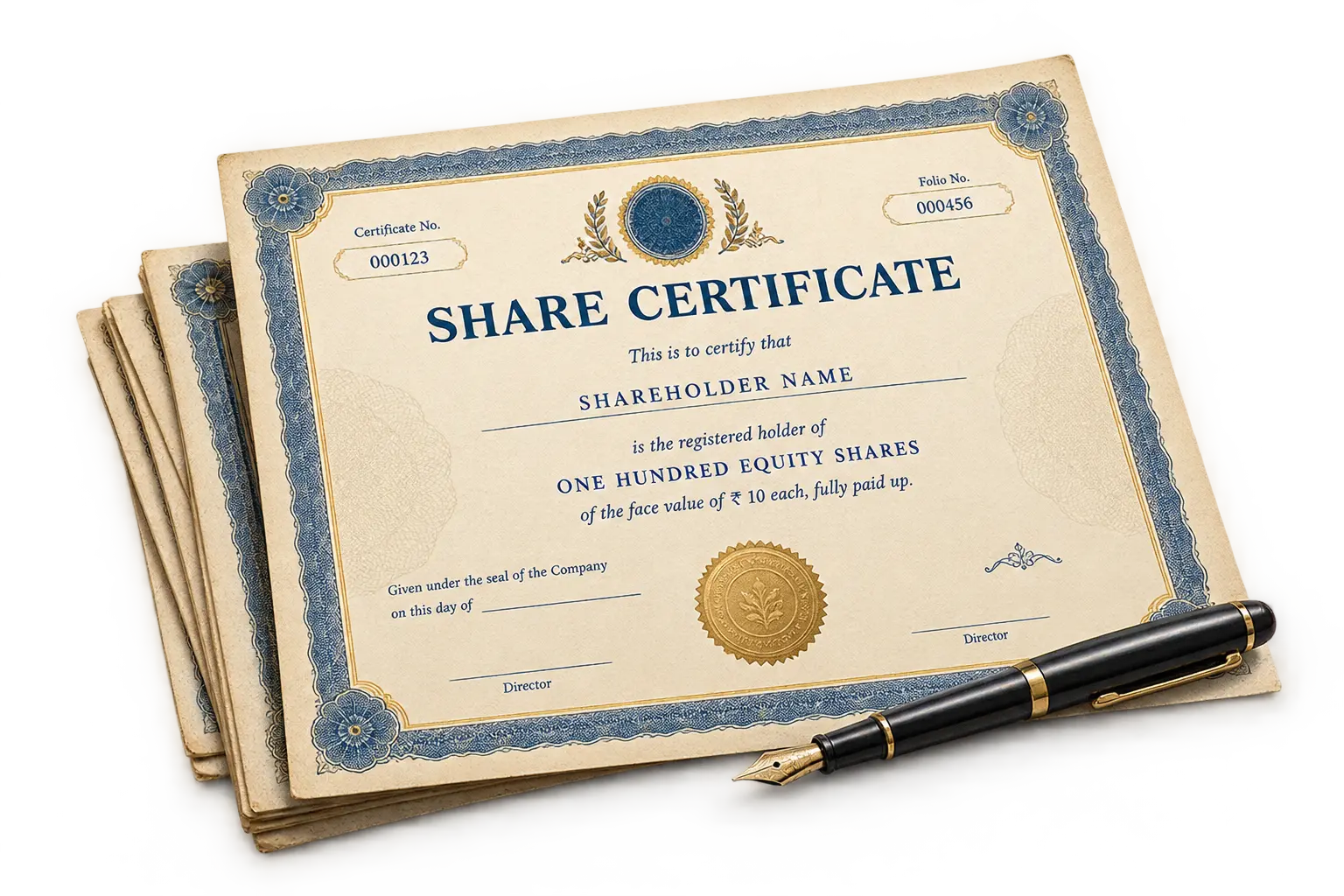
Steps to resolve a lost physical share certificate.
Summary: An India-first practical guide for shareholders on procedures to be followed for loss of share certificate, RTA contact, preparation of Form ISR-4, processing of duplicate-security, credit of securities in demat account and issues pertaining to SEBI.
Key Takeaways
- Just because a certificate is lost does not mean the shares are also lost.
- Contact the company or the Registrar and Transfer Agent (RTA) and provide the details of the folio and certificate.
- The forms ISR-4 and the latest demat details are essential in the process of obtaining the duplicate shares.
- SEBI has increased the limit up to ₹10 lakh for the simplified documentation process for duplicate certificates and standardized the documentation process for duplicate certificates.
- As per the amendment notified on April 2, 2026, the securities for which the entitlement is verified, will be credited to the investor’s demat account.
- For physical transfer of securities other amendments/ notifications are applicable.
If a physical share certificate is lost, misplaced, damaged or cannot be located, the underlying shareholding is not automatically lost. However, shareholders should act carefully because the certificate contains important details used to establish and process the holding. In India, requests relating to lost physical securities are generally handled through the company and its Registrar and Share Transfer Agent (RTA), subject to the applicable SEBI requirements and verification.
How things have changed! There have been various amendments by SEBI to ease the process of obtaining duplicates of share certificates. From the 2nd of April 2026, securities that are requested by an eligible investor will be credited to the investor’s demat account, and a Letter of Confirmation will no longer be issued. Hence, it becomes very essential for an investor to update their KYC and have an active demat account.
Physical Share Certificate Lost: What Should You Do First?
Although it's a difficult situation to be in, don't jump to the conclusion that your shares are also missing, until you’ve looked into it a bit more. Locate the company the shares were issued by, as well as the registrar and transfer agent (RTA).
Search old investment files, dividend records, correspondence and bank statements for the company name and folio number.
Do you have photographs or copies of the lost certificate?
What is the name of the registered shareholder? What is the folio number? What is the certificate number? Is there a range of numbers printed at the bottom of the certificate?
Check whether the company has appointed an RTA and identify the current RTA contact details from the company's official investor-relations page.
Have you made recent changes to your PAN card, bank account, email ID, mobile number and nominee?
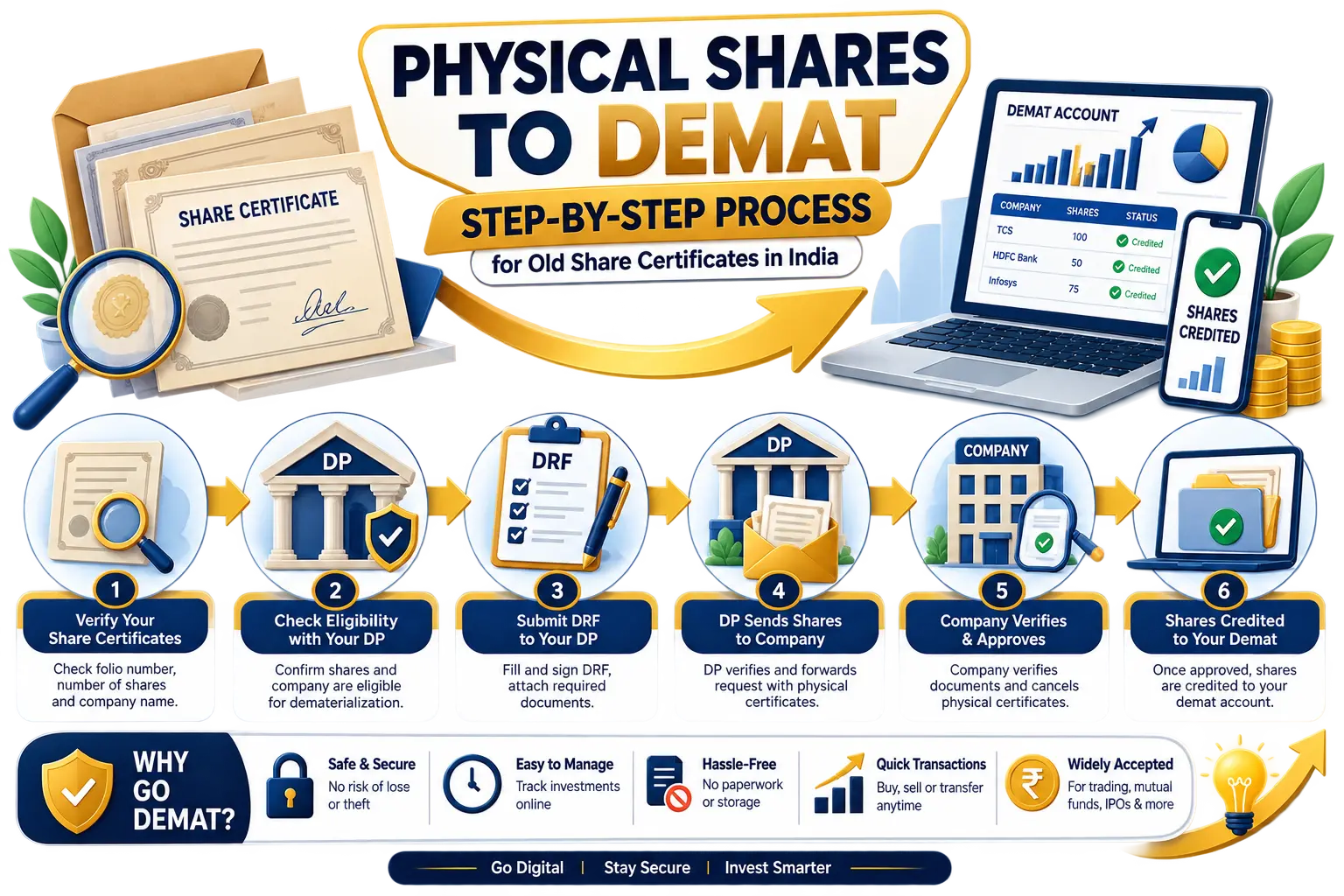
Open a demat account because duplicate securities are processed in dematerialised form under the current framework.
As a general rule, do not give your share certificates to unverified persons. The first Persons that you should contact are the Company’s Registrar and Transfer Agent (RTA).
Step 1: Identify the Company, Folio and Shareholding
The folio number is the most relevant information in this step. It allows the RTA to retrieve the shareholder’s record even if the share certificate is not available.
In the absence of the folio number, pertinent information can be found in old dividend warrants, dividend advice, company reports, tax records, company and RTA correspondence, and old share certificates.
A shareholder can be issued multiple folios and share certificates. It is advisable that the shareholder provides a complete list of all share certificates and folios to the RTA.
Step 2: Contact the Company or Its RTA
For listed securities, investor service requests such as duplicate certificates, transmission, transposition and related physical-security matters are generally processed by the company's RTA or the company in accordance with the applicable framework. SEBI's investor guidance also directs investors to approach the registered RTA or the company for such service requests.
SEBI's investor information explains that RTAs handle requests including duplicate certificates for lost securities and other shareholder-service matters. Investors should use the RTA details published by the company rather than relying on an old address printed on a decades-old certificate.
You can also review SEBI's investor information on Registrars and Transfer Agents before starting the process.
Step 3: Prepare Form ISR-4 and Your Demat Details
Form ISR-4 is used to make various requests, including the issue of Duplicate Certificates, by an individual in respect of securities held in physical form.
The details that are required to be provided in the aforementioned form, include details of demat account. Generally, an investor is expected to provide details of his/her demat account along with a recent Client Master List (CML) attested by the Depository Participant. The details of demat account should be in conformity with the details of the shareholder as recorded by the Company/Registrar and Transfer Agent (RTA).
Form ISR-4 also requires details of request for various services, including KYC. Accordingly, the investor should be prepared to furnish his/her PAN and /or attestation of his/her signature and/or nomination details and/or opt out details, as the case may be.
Step 4: Provide Proof of Identity, Address and Ownership Details
The RTA has to be satisfied regarding the identity of the person making the request for issue of Duplicate Share Certificate. Therefore, identity and address proof in self attested form along with duly filled up relevant forms and supporting documents may be enclosed.
Following particulars are required to be provided
AN and ID proof of the Shareholder.
Proof of current Address, if required.
Folio no. and Name of the company.
Details of the shares (Number, distinctive nos. and Certificate no.)
Latest CML of share from Demat account.
Relevant affidavit-cum-indemnity or undertaking prescribed for the value of the securities.
Any available copy, scan or historical record of the lost certificate.
The documents actually required to be submitted would depend on various factors, viz. the value of the shares, the status of the shareholder and also the checklist of the concerned RTA. The recent forms and documents required to be submitted by the RTA should be used.
Step 5: Understand the Current Duplicate Certificate Rules
SEBI simplified the documentation framework for duplicate securities certificates through its December 24, 2025 circular. The framework increased the threshold for simplified documentation from ₹5 lakh to ₹10 lakh and introduced a standardised Affidavit-cum-Indemnity format.
Approximate value of securities | General documentation approach |
|---|---|
Up to ₹10,000 | An undertaking in the prescribed format may be used on plain paper, with notarisation dispensed with under the simplified framework. |
Above ₹10,000 up to ₹10 lakh | A standardised Affidavit-cum-Indemnity arrangement is generally applicable, subject to the RTA's current checklist. |
Above ₹10 lakh | Additional safeguards and supporting evidence may be required, depending on the case and applicable requirements. |
The valuation threshold is important because the documentation burden can increase for higher-value holdings. The applicable value is determined under the regulatory framework at the relevant stage of the request. Because procedures can be updated, investors should verify the current checklist directly with the RTA before preparing documents.
SEBI's December 2025 circular on duplicate certificates is an important reference for the current framework.
Step 6: What If the Certificate Was Stolen?
A stolen certificate requires a different level of response than a misplaced or lost certificate. Notify the RTA and/or the company, and take action as required under the circumstances and the value of the certificate. In such cases, it may be necessary to file a police complaint, FIR, or any other document required as a part of the process.
More stringent procedures may be required for a certificate of higher value. Each case of loss of a certificate should be evaluated on its merit. The RTA may request supporting documents in support of the case.
If you believe that some other person may use the lost certificate, you should inform the RTA and give the reason for your belief. Keep proof of your communication with the RTA.
Step 7: What Is The Process After I Submit My Request?
Both the RTA and the company will review your request and verify the shareholder's right to the request and review the supporting documents.
It is important that all the details and names are the same across all supporting documents. Inconsistencies may cause additional requests for clarification.
Make sure you keep all the supporting documents you submit to the RTA. These may include a signed request form, supporting documents, email and courier confirmation, service request number and/or acknowledgment.
What Happens to the Shares After a Duplicate Certificate Request?
Current regulations allow companies to issue duplicate securities in the dematerialised form. Therefore, investors should not expect the issuance of physical certificates.
As of 2 April 2026, the companies are also exempt from the requirement to issue letters of confirmation, along with due diligence, for transfer of securities to investors’ demat accounts. Thus, the process of obtaining duplicate certificate has become shorter and easier for the investors.
Having a proper demat account becomes vital to claim the lost securities.
What happens when physical shares are located in an unclaimed or suspense account?
Sometimes locating shares that have been transferred to the IEPF (Investor Education and Protection Fund) may be more difficult than tracking down misplaced share certificates. The reason being, share certificates may be lost or misplaced, but shares may also be transferred to the IEPF if they are held unclaimed for a specific period of time by a company.
In such cases, the shareholder will have to make a claim with the IEPF and also seek the support of the company or its nodal officer.
It is important that you check the company’s investor relations information and the IEPF site procedure to assess if your shares are held in IEPF, prior to making a request for duplicate share certificates.
For more details, please read our article on IEPF claims in India.
Can You Transfer Physical Shares After Losing the Certificate?
Share certificates represent legal title to shares. Losing a certificate can create a number of problems. The shareholder should not assume that shares can be transferred or sold just because the share certificate is not available.
In the case of listed shares, physical transfers of shares have been restricted since 1 April 2019. Shares are transferred by means of an appropriate stock scheme resolution, and the shares are credited to the shareholder's demat account.
On 5 February 2026, SEBI reopened a time-bound window to process the transfer and dematerialization of selected physical shares which were transacted before 1 April 2019. The window, which closes on 4 February 2027, is only accessible if the physical share certificate is held by the shareholder. It should be understood that SEBI has provided this window only in respect of selected physical shares and that this will not be the case for the majority of shares where certificates have been lost.
For further information on this window, refer to the Circular of SEBI on special window for transfer and dematerialisation of physical securities.
How to Protect the Underlying Shareholding
A lost certificate is a practical problem, but it is also an opportunity to bring an old physical holding up to date. Once the entitlement is resolved, investors should consider maintaining the securities in demat form and keeping the related records organised.
Ensure that your PAN, KYC and your holdings are all updated.
Keep the demat account active and ensure the holder names match.
Register or review nomination details where applicable.
Update bank, email, mobile and address information with the RTA or through the prescribed process.
Keep digital copies of important shareholder documents in a secure location.
Track dividend payments and corporate communications.
Keep the RTA's acknowledgement and final demat credit record for future reference.
If the holding involves a deceased shareholder, multiple holders or a legal-heir situation, the process can be different from a straightforward lost-certificate case. In that situation, do not use a simple duplicate-certificate process without checking the applicable transmission requirements.
Common Mistakes to Avoid
Using old formats: Recent formats of ISR-4 and supporting documents are provided by the RTA/SEBI only and must be used.
Neglecting requirement of demat: Duplicates of securities are processed in the credited demat account and therefore the applicant must have a demat account.
Submitting mismatched names: Differences between the folio and demat account can delay processing.
Sending documents to wrong address: Confirm the present address of the RTA from the company website.
Assuming every case needs the same paperwork: Documentation depends on value and circumstances.
Ignoring IEPF status: In case old securities are in IEPF, claims will be made in accordance with the procedure prescribed for IEPF.
Expecting a new physical certificate: Current processing is designed around dematerialised credit.
What You Need to Know When Your Share Certificate Goes Missing
Identify the Company and the RTA.
Locate the folio number and particulars of certificates.
Check the status of the holding and corporate benefits.
Open or verify a demat account in the name of the holder.
Obtain the latest Form ISR-4 and RTA checklist.
Prepare KYC, identity, address and ownership documents.
Make necessary arrangements of undertakings and/or Affidavit-cum-Indemnity.
Submit the request through the company's RTA or prescribed channel.
Track objections and respond with additional documents if required.
The securities will be credited to your demat account only after the company’s process the request.
For a broader overview of physical-share services, investors can also visit Explore Physical Shares Services.
Conclusion
Just because a physical share certificate lost does not mean the investment is also lost. The real challenge is to identify the account and ownership details and contact the respective company/RTA, complete the required forms and document,s and provide a corresponding demat account.
Obtaining a duplicate share certificate has become easier thanks to recent amendments made by SEBI. However, RTA's have the right to change the checklists; therefore, it is important for the investors to go through the latest requirements before finalizing their documents. This article is for the educational purpose of investors and should not be considered for legal, tax, or investment advice services.
Authority references: SEBI Form ISR-4, SEBI duplicate-certificate circular, SEBI direct-credit circular.
Frequently Asked Questions
What should I do if my physical share certificate is lost?+
Identify the company and RTA, locate the folio details, notify the RTA, arrange a matching demat account and submit the prescribed duplicate-certificate request with the required documents.
Can I get a duplicate physical share certificate?+
Under the current SEBI framework, duplicate securities are processed for issue in dematerialised form, so investors should generally expect credit to a demat account rather than a replacement physical certificate.
Is an FIR always required for a lost share certificate?+
No. Requirements depend on the value and circumstances of the holding. Higher-value or particular cases may require additional evidence, so the current RTA checklist should be verified.
What is Form ISR-4 used for?+
Form ISR-4 is used for duplicate certificate requests and other specified investor service requests relating to securities held in physical form.
Do I need a demat account to resolve a lost physical share certificate?+
A demat account is important under the current process because verified duplicate securities are credited in dematerialised form.
What happens if my lost shares have moved to IEPF?+
If the securities have already been transferred to an IEPF-related account, the applicable IEPF claim process must generally be followed rather than relying only on a duplicate-certificate request.
Can old physical shares be transferred today?+
Listed physical securities generally cannot be transferred through the old physical-transfer route. SEBI has a special window for certain eligible pre-April 1, 2019 transactions, subject to specific conditions.
How long does it take to receive the shares in demat?+
The time varies by case, documentation and verification. SEBI's 2026 direct-credit framework is intended to streamline processing, but investors should not assume a guaranteed turnaround time.
Disclaimer
This article is for investor education only and does not constitute investment advice, a recommendation, or an offer to buy or sell any security.
Markets involve risk, including possible loss of capital. Please do your own due diligence or consult a registered adviser.
Research views are informational and may change without notice. Past performance is not indicative of future results.
Procedures, documents required, and RTA checklists are subject to changes. To confirm the latest requirement, approach the concerned company, RTA, SEBI and other concerned authorities. Only then, a service request can be processed.
Research Team
InvestEdge360 Research
Content Research Desk
Insights from InvestEdge360's research desk — written to help investors learn with clarity and invest with discipline.
Need Help With Physical Share Services?
Explore practical resources for lost certificates, duplicate certificates, dematerialisation and other physical-share service requirements.
Open Demat AccountRelated Articles

Was this article helpful?
🚀 Open your Demat & Trading account
- Free Account opening charges
- Free DP transaction charges ⭐
- Free premium research & market updates