
How to Get Duplicate Share Certificates in India: Step-by-Step Guide
Lost a physical share certificate? Learn the duplicate share certificate process in India, required documents, RTA steps and how shares reach your Demat account.
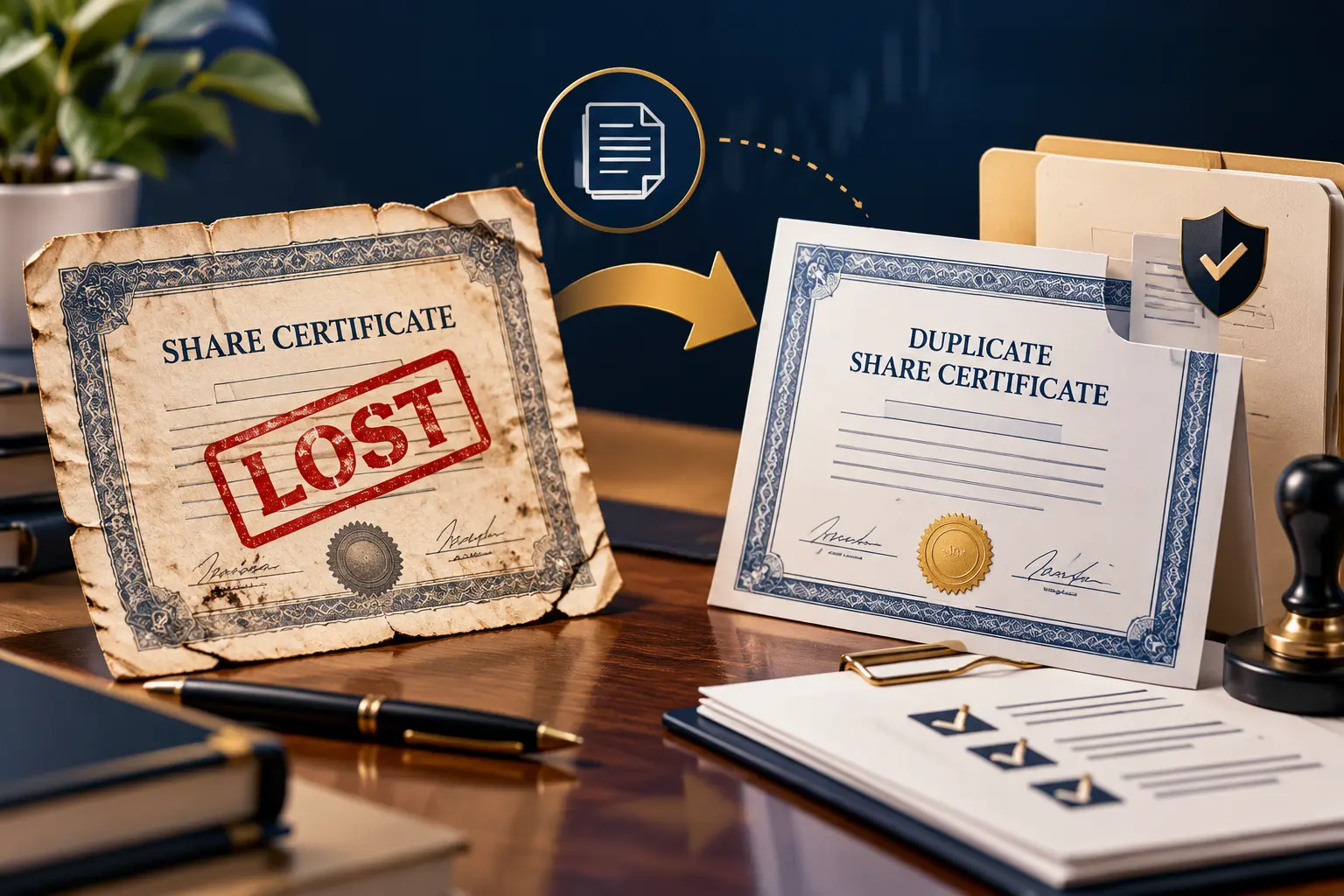
Step-by-step guide to resolving a lost physical share certificate and receiving securities in Demat form.
Summary: A practical manual for Indian shareholders who have lost, misplaced or no longer have an original physical share certificate. The article details the process of contacting the issuer or RTA, filling out Form ISR-4, furnishing KYC and Demat information, comprehending the present affidavit-cum-indemnity or undertaking requirements, determining if additional loss documentation is required, and tracking the securities via direct Demat credit. It also differentiates between lost and torn or damaged certificates and warns investors to verify the latest issuer, RTA and SEBI requirements before submitting the documents.
Key Takeaways
- A lost physical share certificate does not necessarily mean that the underlying securities have been lost.
- The duplicate-security process involves important documents like Form ISR-4 and current KYC and Demat documentation.
- The need for an affidavit, indemnity, undertaking, police complaint or public-notice depends on the rules and circumstances that apply.
- Lost and damaged certificates may have different service-request procedures.
- Currently, SEBI procedure includes direct credit of eligible duplicate securities into the investor’s Demat account after due diligence.
- Investors are advised to check with the concerned issuer or RTA for the latest requirements before submission of any documents.
It’s quite common to lose a physical share certificate. Usually, it’s not a major issue because the shareholder can just request a new one. However, things can get quite stressful when the shares are part of an old investment or a family holding. In a case like that, what the shareholder needs to do to get the shares in electronic form is defined by the process called Duplicate Share Certificate India. In this process, the shareholder gets the share in electronic form once the ownership is established. The purpose of this process is not to get a new physical share certificate. Current SEBI norms state that, after completing due diligence, the issuing company or RTA can credit the securities to the shareholder’s Demat account.
This blog post describes what to do in case a physical share certificate is lost, the documents that may be required, how the RTA or issuing company verifies a claim, what happens after the claim is approved and other pertinent information. Due to the different types of securities, issuers, and different sets of regulations, the process and required documents can also vary. Therefore, it is important for shareholders to check the latest process and requirements with the issuing company or RTA.
What Is the Duplicate Share Certificate Process in India?
A share certificate is a legal document issued by a company to shareholders as proof of their investment. In the event of loss or theft of such a document, the issuing company is required by law to provide a duplicate share certificate. The process serves to protect the interests of the shareholder as well as the company, from an unauthorized claim, while also confirming the true and legitimate ownership of the person making the claim.
In the case of listed securities, an investor can approach the RTA (Registrar and Transfer Agent), or the Investor/Share Services (ISS) Department of the listed company. Responses provided in SEBI’s Investor FAQs indicate the RTA or company is the point of contact for service requests made by investors.
A primary distinction is the way duplicate securities are issued. In the past, duplicate securities were issued in the form of a physical paper certificate. Currently, if a duplicate share request is confirmed, the shares are credited directly to the Demat account of the shareholder via the depository.
In case you require assistance to understand any document(s) related to an old or lost physical holding, please review InvestEdge360’s physical shares services for information on physical-share related assistance.
Step 1: Confirm That the Certificate Is Actually Lost
Check all your records carefully prior to beginning a duplicate share certificate request. Old physical certificates are sometimes stored with bank documents, tax records, lockers, family records, or other investment documents.
Collect all info that you can find about the holding, like the company name, folio number, certificate number, distinctive numbers, number of shares, registered holder's name, and old dividend warrants. Even if the physical certificate is not available, the information above will help the RTA to locate the relevant folio and confirm the holding.
Do not consider a damaged certificate as a lost certificate. The applicable process may be different, depending on whether the original certificate is available for surrender.
Lost vs Damaged Share Certificate: What Is the Difference?
A lost share certificate means that the original physical certificate is not available with the shareholder. The certificate may have been misplaced, stolen, or lost or destroyed during movement or storage.
A damaged or torn certificate is different because the original document is still available. In such cases, the original certificate may be asked to be surrendered for further processing under the applicable replacement, renewal or exchange process.
Situation | Typical issue | What the investor should do |
|---|---|---|
Certificate lost | Original certificate is unavailable | Contact the issuer/RTA and follow the duplicate-security procedure |
Certificate stolen | Original is believed to have been taken | Inform the issuer/RTA and follow the applicable loss and verification requirements |
Certificate torn or damaged | Original certificate is available but unusable or impaired | Retain and surrender the original as required by the issuer/RTA |
Certificate details unclear | Certificate number or folio information may be difficult to read | Share available records with the RTA for identification and verification |
Step 2: Contact the Issuer or Registrar and Transfer Agent
Identify the RTA or company department handling physical shareholding. Typically, for listed companies, the RTA processes requests relating to investors. However, some companies may have their own in-house investor/share department.
Tell the RTA that you have lost the original share certificate and ask them what documents you need to provide for a duplicate-security request. Also, request them to provide you with the latest version of the checklist and/or other forms.
It is recommended not to rely on old checklists, as SEBI norms/forms/procedures are changed from time to time. For instance, the latest Form ISR-4 is being used by Companies to process requests made by clients for various investor services and has undergone changes from time to time.
Step 3: Complete Form ISR-4 and Demat Details
Form ISR-4 is the investor service request form used for various requests such as issue of duplicate certificates. The current form also contains Demat-related information since securities arising from eligible investor service requests are processed for credit into a Demat account.
Generally, the shareholder will have to provide information such as the:
Name of the registered security holder.
Folio Number and particulars of the securities, if available.
Certificate number and distinctive number range, if available.
Number and type of securities concerned.
PAN and other KYC details, if required.
Demat account details for credit of the securities.
Recent client master list (CML) from the Demat account, if required by the current process.
The exact documents and format should be verified with the concerned RTA before submission.
Step 4: Complete Your Identity and KYC Verification
The RTA must confirm that the person making the request is the registered security holder or is authorized to make the request. Therefore, the identity and address proofs, PAN and signature, etc. may be verified against the records of the company or the RTA.
Currently, SEBI’s Form ISR-4 entails validation of Demat Account information and a recent CML for processing requests for related services. Investors should confirm that information in their Demat account is in conformity with the information held by the Issuer/ RTA, as the case may be.
If a folio has obsolete data such as outdated address, absence of PAN or different signatures, etc. the RTA may require additional processes to be taken before permitting a request for Duplicate Securities.
Step 5: Understand the Affidavit, Indemnity or Undertaking Requirements
One of the important aspects of the duplicate share certificate process is to provide the issuer or RTA with a declaration and protection, when the original certificate is not available.
The latest version of the SEBI requirements states that for amounts above the stipulated value, an Affidavit-cum-Indemnity will be required, and for amounts up to the stipulated value, an Undertaking will be required. The applicable value and document format should be checked against the latest SEBI framework and the RTA's guidelines at the time of the request.
This is crucial because the older versions of the SEBI requirements may state a different format of the document to be submitted or refer to procedures like notarization, indemnity bonds and/or sureties which may not be required to be followed currently. Investors should use the latest format prescribed by the RTA for their request instead of following an old online checklist.
Step 6: Check Whether Police Complaint or Newspaper Notice Is Applicable
Investors often believe a police complaint and newspaper notice are required for every lost share certificate. This shouldn’t be treated as a universal rule.
The earlier versions of SEBI’s framework stated additional conditions for larger value of lost securities to include documentation such as an FIR, e-FIR or police complaint and a newspaper advertisement in the circumstances mentioned above. Subsequently the regulatory frameworks underwent a review and simplification, and therefore, the current requirements must be confirmed with the latest SEBI framework and the concerned RTA before publication of the claim.
If the RTA, specifically, requests a police complaint, public notice or other evidence of loss for a particular case, the shareholder should provide the same and keep all evidence.
Step 7: Submit the Complete Duplicate-Security Request
Once all the documents and forms are completed, the request should be submitted on the channel prescribed by the issuer/RTA. Generally, a request is submitted with Form ISR-4, together with the identity and KYC documents, the required affidavit-cum-indemnity or undertaking and the Demat account documents.
Check all the information, signatures, and documents, to see if there is any inconsistency. Inconsistent information may result in a deficiency being raised and may cause a delay in processing.
Retain all documents submitted and any communication received from the RTA.
Step 8: RTA or Issuer Verification
An RTA or issuer will check the documents and confirm the claim with its records. In the process, verification may include the identity of the registered holder, folio details, certificate details (issued date, cut-off, etc.), distinctive numbers, KYC details and other relevant records.
This process is to confirm the genuineness of the claim and to avoid duplication of claims, fraud and unauthorized allotments.
Investors should not be under the impression that by filing Form ISR-4, the claim process is initiated and the RTA is bound to approve their request. If records do not match, or additional information is required, then RTA may also seek clarification and/or additional information.
Step 9: Securities Are Credited to the Demat Account
This is one of the major changes the investor should be aware of while going through the old documents related to duplicate certificates.
As per the current SEBI framework, a duplicate physical certificate is not issued in the form of a new paper certificate. After verification and processing, the issuer or RTA initiates the process of crediting the securities to the investor’s Demat Account.
With the SEBI January 2026 circular, the requirement of Letter of Confirmation was removed and due credit through the depository system was permitted. This means that the investor should have a relevant Demat account and latest required CML and related Demat information.
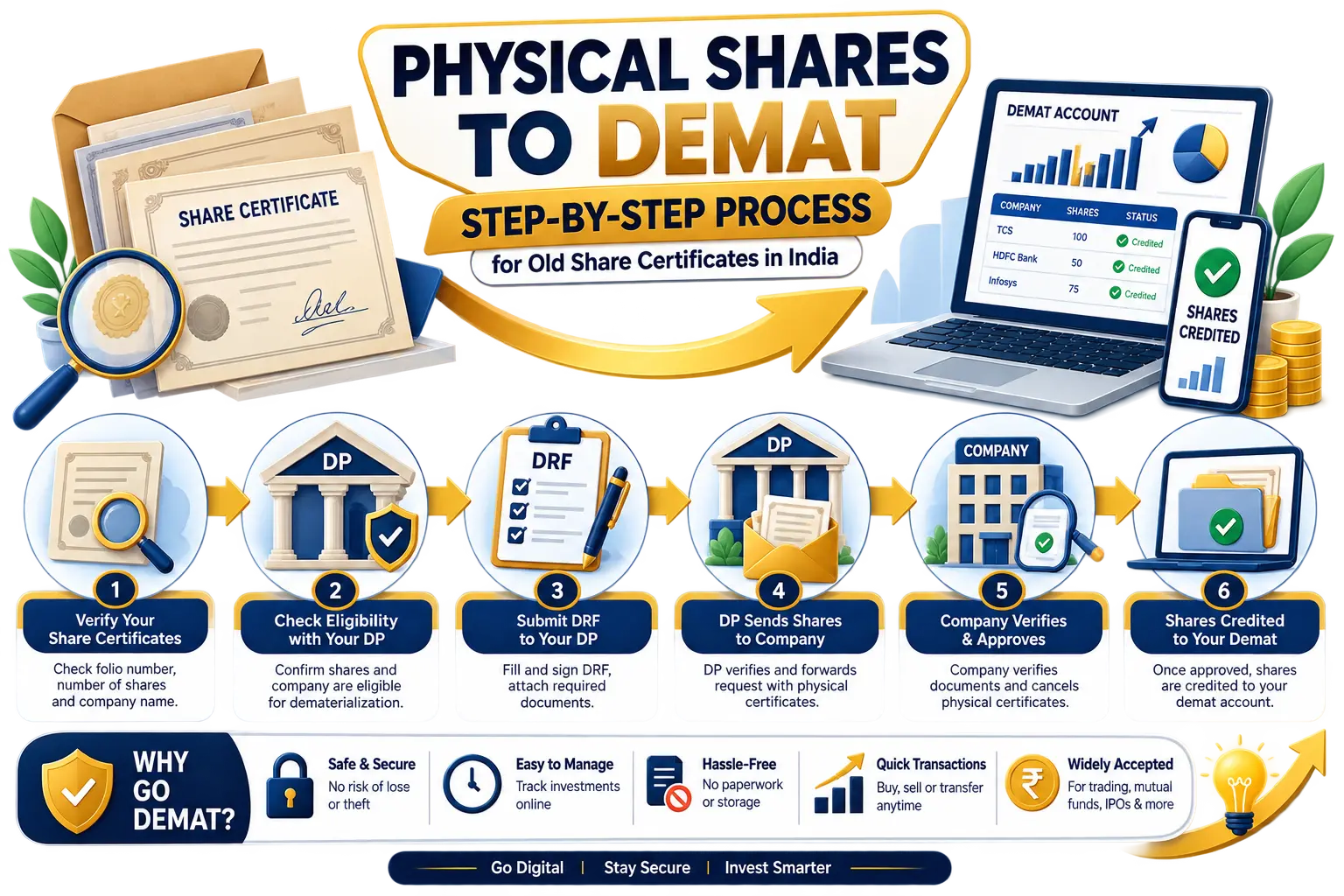
Once your lost share certificate issue is resolved, you can learn how to convert physical shares to demat and hold your recovered securities electronically.
Step 10: Check Your Demat Account After Processing
Upon completion of process by RTA and Depository, check the relevant Demat account to see if securities have been credited.
Make sure you verify the company name and number of securities credited. Also, check for any restrictions and lock-ins. If credit is not in expected form, contact RTA/Depository Participant (DP) with acknowledgment and transaction details.
Ensure to keep the final communication received from the RTA and supporting documents for your record.
What Happens if the Physical Share Certificate Is Damaged Instead?
If the original certificate is torn, faded, mutilated, defaced or damaged in any way, do not treat the situation as a lost certificate. The process can be different, as the original document is available for surrender.
As per current SEBI framework, if physical securities are available, the RTA can retain them and process the securities in dematerialized form. In such cases, the shareholder is required to approach the RTA for appropriate replacement, renewal or exchange process, instead of making a loss report claim.
Readers who wish to have a detailed understanding of conversion of physical shares to electronic form, can go through our article on physical shares dematerialisation.
Common Mistakes to Avoid
Using Old Checklists: Make sure to use the latest version of forms and instructions as requirements change.
Thinking Newspaper Ads are Always Required: Confirm the requirement case-by-case.
Submitting mismatched KYC information: Differences in name, PAN, address or signature can create additional verification requirements.
Ignoring the Demat requirement: Current duplicate-security processing leads to electronic credit rather than a new paper certificate.
Confusing lost and damaged certificates: The procedure may be different for a damaged certificate that is still available.
Sending original documents without keeping copies: Maintain a complete record of every document and acknowledgement submitted.
Expecting a fixed processing timeline: Processing depends on document completeness, verification and the circumstances of the case.
How Long Does a Duplicate Share Certificate Request Take?
There is no standard timeline for processing these requests. A number of different factors can affect the time it takes to process your request. Some of those factors include, but are not limited to, the issuer, RTA, completeness of documentation, KYC status, value of the securities, and the complexity of the ownership records, and whether additional verification is required.
The SEBI framework lays down processing requirements for different types of investor service requests. However, investors should not interpret this as a strict timeline within which their requests will be processed. Investors should check the status of their request, if it has not been processed, with the RTA and provide their service request acknowledgment.
What to do After Lost Shares are credited to Your Demat Account
Because the shares have now been electronically credited to your demat account, the main document issue with respect to physical certificates has now been resolved. Maintain your DEMAT account statement and RTA communications to show that the process is complete.
If this demat account holding is a part of an old family investment, also ensure that nominations, PAN, and other relevant records are up to date for future servicing.
For assistance in completing documentation, processing physical share certificates or other similar issues, the physical shares assistance page is a good place to start. Please note, this does not replace the process that the issuer or RTA may have in place.
Duplicate Share Certificate India: Quick Checklist
Confirm that the original physical certificate is genuinely lost or unavailable.
Find the listed company and its current RTA or investor-service department.
Please collect the details of the unique number, the certificate, the folio and the shareholding you hold in your records.
Arrange the required Demat account and latest CML as applicable.
Complete the existing Form ISR-4 and mandatory KYC documents.
Latest applicable Format of affidavit-cum-indemnity or undertaking to be used.
Please let me know if you need any police complaint / public notice / additional evidence for your case.
Submit the documents through the prescribed process of issuer/RTA and retain copies.
Respond promptly if the RTA identifies a deficiency or requests clarification.
After the securities are credited, verify the Demat Account
Frequently Asked Questions
Can I get a duplicate share certificate if I have lost the original?+
Yes, a shareholder can request duplicate securities through the applicable issuer or RTA process. The request remains subject to verification, documentation and the applicable regulatory requirements.
Do I need Form ISR-4 for a lost physical share certificate?+
Form ISR-4 is the SEBI investor service request form that includes a request for issue of duplicate certificates. Use the latest version and confirm the current requirements with the concerned RTA.
Will I receive a new physical share certificate?+
Under the current SEBI framework, duplicate securities are processed for direct credit to the investor's Demat account rather than issuing a new physical certificate.
Is a newspaper advertisement mandatory for every lost share certificate?+
No. Such requirements should not be assumed to apply universally. Confirm whether a newspaper notice or other loss evidence is currently required for your specific case with the RTA.
Is an affidavit and indemnity required for every duplicate certificate request?+
Documentation depends on the value and circumstances of the request. The current framework provides for an affidavit-cum-indemnity in specified cases and an undertaking for cases within the applicable lower-value threshold.
What if my share certificate is torn but I still have it?+
A damaged or torn certificate is different from a lost certificate. If the original is available, the issuer or RTA may require it to be surrendered under the applicable replacement, renewal or exchange process.
How long does it take to receive duplicate shares?+
There is no guaranteed universal timeline. Processing depends on documentation, verification, the issuer or RTA and the circumstances of the holding.
Can the recovered shares be credited directly to my Demat account?+
Yes. Current SEBI procedures provide for eligible securities arising from duplicate-security requests to be credited directly to the investor's Demat account after the required due diligence.
Disclaimer
Procedures, forms, thresholds and documentation requirements for physical securities are subject to change and may vary depending on the issuer, RTA, security value and individual circumstances. Please check with respective / concerned issuer / RTA and applicable SEBI requirements for the latest requirements before submitting any service request.
Research Team
InvestEdge360 Research
Content Research Desk
Insights from InvestEdge360's research desk — written to help investors learn with clarity and invest with discipline.
Need Help With a Physical Share Certificate Issue?
If you are dealing with a lost, damaged or old physical share certificate, explore the relevant physical-share assistance options and understand the documentation involved.
Open Demat AccountRelated Articles

Was this article helpful?
🚀 Open your Demat & Trading account
- Free Account opening charges
- Free DP transaction charges ⭐
- Free premium research & market updates