
Why Your Demat Account May Have More Than One Holder: Joint Holdings Explained
Understand how a joint Demat account in India works, including multiple holders, holder order, operation, transmission, rights and key considerations.
Summary: A practical guide explaining how joint Demat accounts work in India, including multiple holders, holder order, operating modes, communication, nomination and transmission considerations.
Key Takeaways
- A joint Demat account can have up to three joint holders.
- The order of name on the account can be important to how the account may be administered and transferred.
- The mode of operation of the joint account will determine how the joint holders may provide instructions.
- A joint holder is not the same as a nominee and should not be confused as the same.
- The transmission of a joint account requires the appropriate documents and a depository process after the death of a joint holder.
- Investors should ensure they are aware of the current DP rules, the charges, and the regulatory requirements prior to proceeding further.
A joint Demat account in India allows securities to be held electronically in the names of more than one person. This can be useful for family members or other investors who want to hold investments jointly, but it also creates responsibilities that are easy to overlook. The order of names, mode of operation, communication preferences and what happens when one holder dies can all matter.
For beginners, the important point is that a joint Demat account is not simply a single-person account with an extra name added for convenience. The account has a defined holding structure and operating instructions. Understanding those details before opening or using the account can help avoid confusion later.
In this guide, we explain how joint Demat holdings work in India, how many holders can be included, what the first holder means, how joint accounts may be operated, and why transmission considerations should be discussed before the account is opened.
For official investor information, you can also refer to SEBI and the investor resources of CDSL and NSDL.
What Is a Joint Demat Account in India?
A joint Demat account is a dematerialised securities account held in the names of two or more eligible individuals. SEBI investor guidance states that a Demat account can be opened in a single name or jointly, with a maximum of three account holders: one main holder and two joint holders.
The securities recorded in the account are held under that joint ownership structure. This means the names and their sequence are important. A Demat account should generally match the ownership pattern in which the securities are held. SEBI's investor FAQ also notes that securities with different ownership patterns cannot simply be combined into one Demat account.
For example, securities held individually in the name of Rahul may require an individual Demat account, while securities held jointly in the names of Rahul and Priya would require an account reflecting that joint holding pattern.
How Many Holders Can a Joint Demat Account Have?
For an individual joint Demat account, the commonly applicable structure permits up to three holders. These are generally described according to their order in the account, such as first holder, second holder and third holder.
The first holder is important for several operational and communication purposes, but being the first holder does not automatically mean that the other holders have no rights in the securities. The account structure and the selected mode of operation determine how instructions can be given and how the account is administered.
Account structure | Typical meaning | Important point |
|---|---|---|
Single holder | One individual is recorded as the holder | Ownership and account administration relate to that holder |
Two holders | Two individuals jointly hold securities | Order of names and operating instructions matter |
Three holders | Three individuals jointly hold securities | Transmission and surviving-holder arrangements require attention |
The exact account-opening process, documentation and available operating options can depend on the Depository Participant, so investors should read the account-opening form and terms carefully.
Why is the Order of Joint Holders Important?
In a joint Demat account, the order of the holders is key. The ‘first holder’, ‘second holder’ and ‘third holder’ positions define the account’s ‘holding pattern’, and therefore, should not be taken lightly.
Things can even get tricky when it’s time to transfer the securities. Let’s say there is an account held jointly by A, B and C, and B passes away. In order for securities to be transferred to A and C using the relevant depository process, the remaining account holders A and C would need to have the account in the same order of names.
As per the NSDL Investor Guide, surviving joint account holders would normally be required to have a Demat account in the same order of surviving joint names, as the original joint account. CDSL also describes the transmission of electronic holdings to surviving joint account holders.
Hence, family members should always take holder order seriously. They should reserve the order of holder positions when account is created. They should also understand the order of holder positions and how the arrangements would change if one of the holders is no longer available.
How is a Joint Demat Account Operated?
The way that instructions are given determines who can give the instructions for the account. The depository and the method of setting up the account may allow for different means.
Joint operation
Under a joint operating system, instructions may require the participation of approval of the joint holders as described in the account terms. This system can offer a greater level of control by the joint holders, but may involve greater inconvenience for routine instructions.
Anyone of the holders or survivor
Some joint account systems allow the account to be operated by any one of the holders during their lifetime, as long as it is not inconsistent with the terms and operating limits opened with the account. The operating guidelines of NSDL’s joint Demat accounts allow the setting up of joint accounts on the basis of Jointly and Anyone of the holder or Survivor.
The important point to keep in mind is that just because an account is a joint account does not mean all joint accounts operate as the same. Check what operating method is made available and chosen by the other joint holders, before signing the account opening forms.
What Does the First Holder Mean?
The first holder is the one among the registered holders, whose name appears first. The first holder is of importance for the purpose of communication and administration of accounts.
Consider the example of the NSDL. They have the facility of communication to either the first holder or all the holders. If communication to the first holder is chosen, then based on their preferences, the communication will be efficient.
This does not mean that the preference should automatically go to the first holder. There is a difference between being a joint owner and co-owning and operating an account. Investors should understand this before structuring their accounts.
Rights and Responsibilities of Joint Holders
Joint holders must understand that a joint account is an arrangement for shared ownership, and not just a facilitation for access to another person’s investment.
Ownership structure: Securities are registered in the name and order applicable to the Demat account.
Account operation: The mode of operation instructs the order of instructions for the joint account.
Communication: Statements and other communication will be as per communication mode and instructions applicable to the joint account.
KYC: Each account holder will need to comply with relevant KYC norms.
Transmission: Post the death of one of the joint holders, the surviving holders and the applicable depository procedures will determine the next course of action.
Documentation: Holders must maintain records of all documents pertaining to the account, nominations, etc.
It is perfectly sensible for the joint holders to have a discussion to appoint one of them for routine communications, to decide how to make investments, and to decide on substitute holders in case unavailability of joint holders.
What Happens When One Joint Holder Dies?
When opening a joint account, understanding an important concept called transmission is essential. When a joint account holder passes away, securities can be transferred via a transmission process vs. a normal sale.
Securities can be transferred to all joint holders through a process called transmission. CDSL describes transmission as the transfer of securities to joint holders where one joint holder passed away. NSDL states that joint holders can get transfers of securities if the required documentation is submitted and verified.
Just because securities can be transferred via transmission doesn’t mean all issues of succession are resolved. There can be legal issues pertaining to legal heirs and succession of the joint holder.
Most of the SEBI documents on joint account holders discuss the right of survivorship and the role of surviving joint holders, also stating that securities of the joint holder that passed away can be transferred to the surviving joint holder if there are no legal issues and the surviving joint holder has obligations to the legal heirs.
Prior to opening a joint account for estate planning, one should review the rules and consult a professional because of the complexities that can exist with the ownership and succession of the joint account holders.
Joint Demat Account vs Single Demat Account
Feature | Single Demat account | Joint Demat account |
|---|---|---|
Number of holders | One holder | Two or three individual holders may be recorded |
Ownership pattern | Individual ownership | Joint holding structure |
Holder order | Not applicable as a joint sequence | Important for the registered holding pattern |
Operation | Generally based on the individual account mandate | Depends on the selected joint operating mode |
Transmission | Nominee or legal-heir process may apply | Surviving-holder process may apply, subject to rules |
Communication | Generally directed to the account holder | May follow first-holder or all-holder communication preferences |
What Situations Would call for a Joint Demat Account?
A joint demat account could come in handy in cases where two or more members of the family wish to keep their investments jointly. For instance, parents and guardians may wish to place certain investments together. Co-owned physical securities may need a demat account to document the ownership.
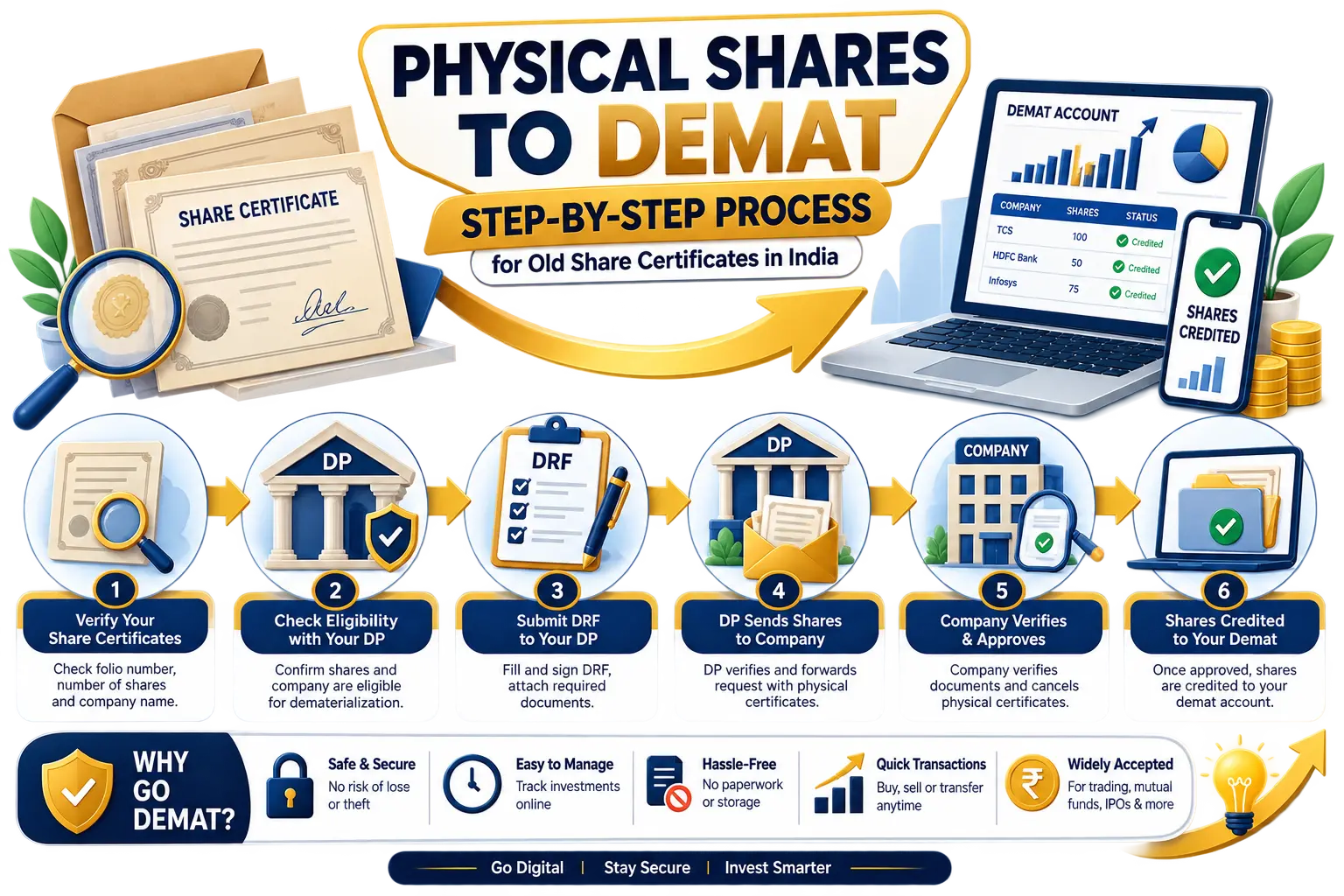
A joint demat account could also be required to dematerialize old share certificates. The ownership pattern of the physical security needs to be considered before choosing the appropriate demat account. Jointly held physical certificates should have a demat account structured in the same way.
Investors with old physical securities can find more information on our page on the dematerialisation of physical shares, along with a general introduction on what a Demat account is.
Joint Demat Accounts and Nominations: Don't Mix Them Up
Joint holding and nominations have different functions. A joint holding account identifies the persons holding the securities. Nomination is a different mechanism relevant to the transmission process in certain cases.
SEBI advises that nominations should be recorded for each individual Demat Account, with an option to provide a signed and dated declaration if the investor decides against nomination. For joint accounts, the investors should verify the current applicable provisions and the services provided by their Depository Participant.
One should not consider a family member being included as a joint holder as a nomination. The two arrangements have different ramifications.
What About Buying and Selling Securities in a Joint Demat Account?
A Demat account holds securities and trading transactions are transacted through the linked trading account. A joint Demat account does not permit that all the joint holders are entitled to transact on their own and without any consideration of the account’s instruction and broker’s guidelines, market orders of different types.
Investors should check with their broker the way joint account trading, authorizations, power of attorney or electronic authorizations, and other account specific requirements have been addressed. These provisions may differ from intermediary to intermediary, and making transactions should be avoided until these have been confirmed.
For the first time investor, it may be useful to understand the difference between the two account types in our guide on Demat account vs trading account.
Before opening a Joint Demat Account here are the things to consider.
Confirm the ownership purpose: Decide why the securities need to be jointly held.
Check the number and order of holders: Make sure the names and sequence are correct before submitting the application.
Understand the operating mode: Ask whether the account will operate jointly or under an option such as anyone of the holders or survivor, where available.
Review communication settings: Understand whether statements and other communications will go to the first holder or all holders.
Understand transmission: Ask the DP what documents and account structure will be required if one holder dies.
Check nomination requirements: Do not treat nomination and joint holding as interchangeable.
Review charges: Check the current tariff and applicable Demat, transaction and other charges before opening the account.
Keep KYC information updated: Each holder should ensure that the required details remain current.
Common Mistakes to Avoid With Joint Demat Accounts
Adding a family member as a joint holder without discussing the ownership intention.
Considering the first account holder as the only holder.
Ignoring the order of joint account ownership.
Assuming that joint accounts are operated in the same manner.
Confusing a joint holder with a nominee.
Waiting until after a holder's death to understand the transmission process.
Not verifying the recent DP terms, forms and applicable regulations.
These issues may seem small and insignificant when the account is opened, however years later when securities are sold, transferred, dematerialised, or transmitted, they can become very important.
Joint Demat Account in India: Conclusion
Having a joint Demat account in India is useful when securities need to be held jointly. However, one needs to be careful while selecting an arrangement. One needs to consider the number of holders, the order of holders, the mode of operation, the preferred mode of communication, nomination and transmission, and other such elements.
If one is a family investor, it would be better to understand the account structure before opening it rather than trying to resolve ownership issues later. If the purpose involves succession planning, disputed ownership, a significant part of the family’s assets, or complicated legal issues, it would be better to take advice from a lawyer or a tax expert in addition to contacting your Depository Participant and verifying the procedure.
Investors interested in having a Demat account can understand the Demat account opening process, provided one designs the account structure based on the actual holding of securities.
Important Investor Note
FOR EDUCATIONAL USE ONLY. NOT INVESTMENT, LEGAL, TAX, OR SUCCESSION ADVICE. demat accounts, nominations, instructions for transmission, levies, and procedures of different intermediaries may change. Investors should confirm the latest requirements with their Depository Participant and the concerned regulator or the depository prior to proceeding with any RDT activity.
Frequently Asked Questions
Can a Demat account have two holders in India?+
Yes. A Demat account can be opened jointly. SEBI investor guidance states that an individual Demat account can have up to three account holders, including one main holder and two joint holders.
Can three people have a joint Demat account?+
Yes. An individual joint Demat account can have up to three holders under the applicable framework. The names and their order should be entered correctly during account opening.
Does the first holder own more of the securities?+
Being the first holder does not by itself mean that the person owns a larger percentage of the securities. The first holder is part of the registered holding structure and may have particular communication or administrative significance.
What happens to a joint Demat account if one holder dies?+
The applicable transmission process generally allows surviving joint holders to receive the deceased holder's securities, subject to the depository's procedures, documentation and applicable legal requirements.
Is a joint Demat account the same as adding a nominee?+
No. A joint holder is part of the registered holding structure, while nomination is a separate mechanism relevant to transmission in applicable circumstances.
Can joint Demat holders operate the account independently?+
It depends on the mode of operation selected for the account and the intermediary's procedures. Some joint account arrangements may permit operation by any one holder or survivor, while others may require joint instructions.
Can jointly held physical shares be dematerialised?+
Yes, jointly held physical securities can generally be dematerialised into a Demat account reflecting the joint holding pattern, subject to the applicable depository and DP process.
Should family members open a joint Demat account for inheritance planning?+
There is no single arrangement suitable for every family. Joint holding, nomination, succession and estate planning have different implications, so complicated situations should be reviewed carefully with the relevant professionals.
Disclaimer
This article is for investor education only and does not constitute investment advice, a recommendation, or an offer to buy or sell any security.
Markets involve risk, including possible loss of capital. Please do your own due diligence or consult a registered adviser.
Research views are informational and may change without notice. Past performance is not indicative of future results.
Rules, procedures, charges and documentation requirements for Demat accounts, nomination and transmission are subject to amendments. Verify the latest position from your Depository Participant and official sources of your concern before proceeding with any action.
Research Team
InvestEdge360 Research
Content Research Desk
Insights from InvestEdge360's research desk — written to help investors learn with clarity and invest with discipline.
Ready to Open a Demat Account?
Review the Demat account opening process and understand the account structure, documentation and requirements before you apply.
Open Demat AccountRelated Articles

Was this article helpful?
🚀 Open your Demat & Trading account
- Free Account opening charges
- Free DP transaction charges ⭐
- Free premium research & market updates