
Discount Broker vs Full-Service Broker in India: Which One Is Right for You?
Compare discount and full-service brokers in India on brokerage, research, advisory, support, platforms and total value before choosing one.
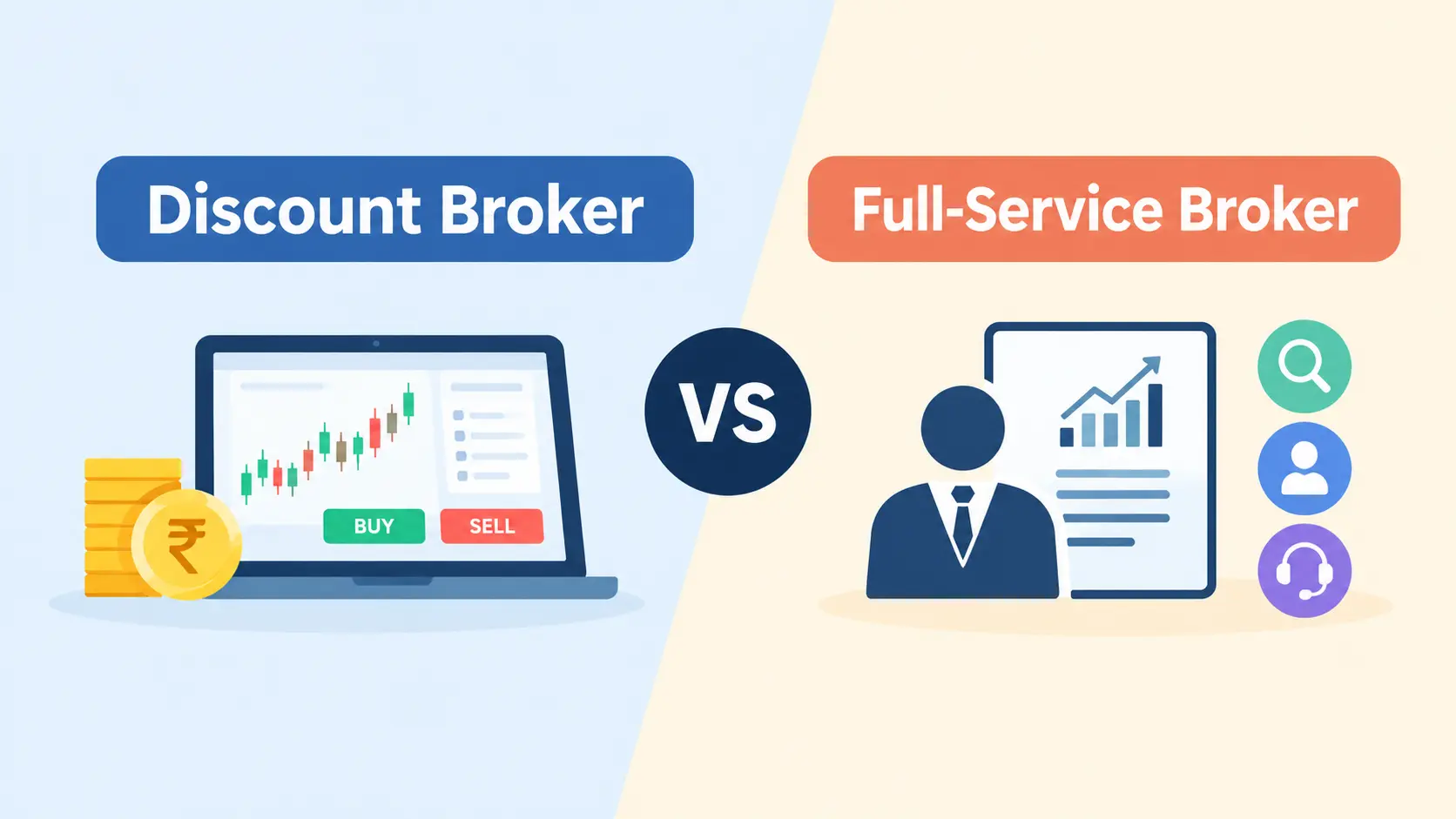
Discount broker and full-service broker comparison for Indian investors.
Summary: A practical India-focused comparison of discount and full-service brokers covering brokerage, charges, research, advisory-related services, customer support, technology, products and total value.
Key Takeaways
- Discount brokers specialize in efficient digital execution and keeping costs low.
- Full service brokers tend to include more research and offer more supportive services.
- Brokerage is just one aspect of the total expense of an investment.
- Compare the entire tariff sheet instead of focusing on the headline brokerage offerings.
- Research and advisory services should not be treated as return guarantees.
- Which broker model is best for you will depend upon your investing style and services you require.
Choosing a discount broker vs a full-service broker isn't as simple as finding the brokerage with the lowest cost. Indian investors should also consider the research, advice-related services, customer support, platform features, products available, and value for cost.
A discount broker favors digital self-execution with operational efficiency. A full-service broker integrates execution with research, market insights, assisted support, and other offerings. However, individual brokers may vary in their combination of offerings, so the pricing and services offered are more important than the label.
What Is the Difference Between a Discount Broker and a Full-Service Broker?
Discount brokers offer self-directed investment solutions through digital, online platforms. These platforms focus on being low cost and easy to use. Investors are responsible for making investment decisions and conducting the necessary research.
Full-service brokers offer more access to both the tools and the resources necessary to manage an investment. Full service brokers offer easy access to trade execution, as well as research reports, market commentaries, and relationship support. Full-service brokers also offer varying solutions and products based on an investment’s needs.
Factor | Discount Broker | Full-Service Broker |
|---|---|---|
Primary focus | Digital execution and cost efficiency | Execution plus broader service support |
Research | Often more self-directed | May include broker-provided research |
Advisory-related support | Usually less central to the model | May be available depending on the service |
Customer support | Often digital-first | May include assisted or relationship support |
Technology | Usually strongly platform-focused | Can combine digital and assisted services |
Typical investor style | Self-directed | Investors who value additional support |
These are broad characteristics rather than formal regulatory definitions. Always compare the specific broker before opening an account.
How Different Brokerage Costs Are
Different types of customers in distinct market segments incur different costs in addition to brokerage. For instance, some might have to cover the securities transaction tax, GST, various exchange-related charges, stamp duty, SEBI-related charges, and depository charges as well.
Potential clients should check the latest tariffs, instead of trusting an old advertisement with a single brokerage quote. The total cost of investment depends on the product, type of transaction and any applied charges.
For official investor information, see the SEBI Investor website and the NSE website.
Why the Lowest Brokerage Is Not Always the Lowest Total Cost
A broker may charge a lower execution rate while another broker may charge a higher rate, but provide research or assisted support or other services which adds value and therefore costs more than the first broker.
The same may be true for the former. If you do your own research and need assisted support infrequently and only want a digital trading platform, then paying for an unneeded service provide poor value.
Therefore, the true comparison should be the total cost for the services used, rather than just brokerage.
Research: A Big Deal for Most Investors
Research is one element of a full-service brokerage relationship. Each research provider offers its own set of company reports, market updates, stock opinions, and perhaps even commentary on markets or education.
Market research, access to market data and screeners, and charts along with educational tools are often offered by discount brokers. While not all discount brokers offer comprehensive research, investors should be aware that equating research quality with each brokerage category is a fallacy.
Research has no bearing on the success of an investment. While sector reports, market views and stock opinions should be considered, they should not be interpreted as guaranteed performance.
Advisory and Investment Services
Understanding the difference between research, market updates, relationship maintenance, and personalized investment recommendations is imperative for investors. Each is a separate service.
Before engaging the services of a broker that provides investment advice, understand the services, disclaimers, and the broker's status with the regulatory authorities. Just because a broker provides a service is not an indicator that all conversations with a broker are personalized investment advice.
A stock brokerage firm provides a service, and access to a market, but the responsibility for the risks of an investment is on the investor.
Everything You Need To Know About Customer Support
Customer support is important when you are having KYC issues, issues with orders, questions about your account, corporate actions, or issues with the trading platform.
Some digital-first brokers may have help centers, support tickets, chat, or email. Others may have relationship-based support or assisted support depending on the account and service.
Don't base your opinion on the presence (or lack) of a dedicated relationship manager. Consider speed of response, resolution and escalation channels, and hours of service.
In Terms Of Trading Platforms and technology
In both housing models of brokers, trading technology and a user-friendly trading platform are important as they help to place orders, track the portfolio and manage the account.
When thinking about different platforms, think about:
Experience of the mobile and web apps
Ease of order placement
Charts/Technical Analysis tools
Customizable watchlists, order, and alert tables
Visibility of your positions/holdings
Transaction history and management
Fund transfer workflow
Customer service
Platform availability
Other features don't always translate to more value. Think about the features that add value for your specific trading/investing style.
Product Range Can Change the Value Equation
Think about how you’re likely to use investment products, and compare across brokers. Most brokers offer stock market trading, initial public offerings (IPOs), mutual funds, exchange traded funds (ETFs), bonds, derivatives and access to commodities and currency trading.
Not all brokers are the same with regard to products, permissions and services. If you’re likely to use multiple parts of the market, take the time to compare offerings across the entire spectrum rather than equating equity brokers to one another.
To get a basic understanding of the structure of an account, check out our Demat account guide and Demat account vs trading account guide.
Who May Prefer a Discount Broker?
Consider a discout broker if you are looking for a do it yourself option.
You like to make your own decisions when it comes to your investments.
You like researching companies on your own.
You desire the ability to digitally trade and invest.
You check for the best brokerage deals and other associated fees.
You don’t usually rely on relationship based support.
You appreciate a tech focused investing experience.
Just because someone is a do it yourself investor, doesn’t mean every discount broker is a good option. Look at the price, platform, support and product offering.
Who May Prefer a Full Service Broker?
If you want a broader service based relationship, a full service broker may work for you.
You would like broker provided research.
You like the availability of customer support.
You would like to have all of your requested market research and commentary in one location.
You use a variety of different investments.
You don’t mind evaluating additional services and the costs associated with them.
Just because a broker is full service, doesn’t mean that broker will offer you everything you need. Take a look at what they offer.
Discount Broker vs Full-Service Broker: Practical Comparison
Your Priority | What to Compare | Possible Fit |
|---|---|---|
Cost efficiency | Brokerage and all applicable charges | Discount-oriented broker may fit |
Independent research | Platform tools and external resources | Discount-oriented may be sufficient |
Broker research | Reports, coverage and market commentary | Full-service may offer more |
Assisted support | Support and escalation channels | Full-service may offer more |
Technology | App, web platform and order workflow | Compare platforms directly |
Multiple products | Equity, IPO, MF, ETF, bonds and other segments | Compare broker by broker |
Don't Think of your Broker as an Investment
You can't tell just be looking if a brokerage has a good investment. The same goes for overpriced support and research.
Investments are complicated, and your return has a lot to do with the security you pick, market behavior, the decisions you make with your portfolio, the time you're willing to invest, your risk tolerance, and your behavior.
The right broker is not necessarily the cheapest broker. It is the broker whose costs, services, technology and support match the way you actually invest.
Things to Look into Before You Open a Demat and Trading Account
Take a look at the tariff sheet.
Check account opening and annual maintenance costs.
Compare desegment brokerage.
Find out about the transaction and depository costs.
Find out about the research and advisory services.
Check the mobile and web trading tools and resources.
See how they rank customer service and how escalations happen.
See what you can buy and which exchanges they can trade on.
Assess the disclosures about regulated services and the protection of your investment.
Check each of these again, they change.
If you are just starting to invest, check out our SIP basics guide. You can see what AMFI's Investor resources have to offer too.
What About IPOs and Long-Term Investing?
For investors who do an occasional IPO application and maintain the long-term investment position, the trading broker might not matter as much as the reliability of the account, the IPO workflow and account charges overall.
For long-term investors using mutal funds or ETFs, product availability and the platform might matter more than the brokerage on frequent stock transactions.
For active traders, the number of transactions would make the transaction costs, order workflow and the applicable statutory charges important.
Compare Brokers Based on Your Actual Behaviour
Before making a choice on a broker, imagine how you might use the trading account. Think of the trading frequency, what products you want to trade, if you want broker-provided research, how much you expect to be supported, and whether you will hold your investments for the long term.
Review these requirements of trading against available brokers. A broker that appears expensive in a general review may have valuable services for what you are seeking, and a very low-cost broker may not have what you want.
Final Takeaway
In deciding between a discount broker and a full-service broker, value for money is what matters the most. A discount broker would probably work best for investors with self-directed equity trading in mind. In contrast, full-service brokers may be more ideal for more research with a higher level of broker supported trading and other services.
There is no single best broker model. When determining which broker to use, consider tariffs, products, and platforms. Also consider the quality of research and support. Choose the broker that offers the most relevant services for your trading strategy, not necessarily the cheapest brokerage.
Frequently Asked Questions
What is the difference between a discount broker and a full-service broker?+
A discount broker generally focuses on digital execution and cost efficiency, while a full-service broker may combine execution with research, assisted support and other services.
Is a discount broker always cheaper?+
Not necessarily in every situation. Compare the complete tariff sheet, account charges and transaction-related costs for the products you use.
Is a full-service broker better for beginners?+
It may suit beginners who value research or assisted support, but being a beginner does not automatically make a full-service broker the better choice.
Do full-service brokers provide better returns?+
No. Broker type does not guarantee investment returns. Market conditions, security selection, portfolio decisions and investor behaviour affect outcomes.
Can I use a discount broker for long-term investing?+
Yes. A discount broker can be used for long-term investing if its products, platform, account structure and services meet your requirements.
What charges should I compare besides brokerage?+
Compare account charges, annual maintenance charges, statutory levies, transaction-related charges, depository charges and applicable platform or service fees.
Does a full-service broker always provide personalised investment advice?+
No. Research, market commentary, relationship support and investment advice are different services. Check the specific service, disclosures and regulatory status.
How should I choose between the two?+
Compare costs, research, advisory-related services, customer support, platform quality and product availability against the way you actually plan to invest.
Disclaimer
This article is for investor education only and does not constitute investment advice, a recommendation, or an offer to buy or sell any security.
Markets involve risk, including possible loss of capital. Please do your own due diligence or consult a registered adviser.
Research views are informational and may change without notice. Past performance is not indicative of future results.
This article is for informational purposes only. This is not individualized personal investment, financial, tax, or legal advice. Service and brokerage prices may change, as may the features of the platform, the accounts, and the services themselves. Verify the latest version of the tariff and sheets related to terms and disclosures as well as the official sources for all of the applicable statutory charges prior to investing with a specific broker and service. Notice that investing in securities includes market risks, and there is no way to guarantee returns.
Research Team
InvestEdge360 Research
Content Research Desk
Insights from InvestEdge360's research desk — written to help investors learn with clarity and invest with discipline.
Choose the Right Investing Setup
Review account features, applicable charges and available services before opening a Demat account.
Open Demat AccountRelated Articles
- Investor Education
REIT vs InvIT: What's the Difference? A Simple Guide for Indian Investors
- Investor Education
SLBM Explained: How Stock Lending and Borrowing Works in India
- Investor Education
How to Lend Shares Through SLBM in India: Step-by-Step Guide
- Investor Education
What Are Unlisted Shares? A Complete Guide for Indian Investors

Was this article helpful?
🚀 Open your Demat & Trading account
- Free Account opening charges
- Free DP transaction charges ⭐
- Free premium research & market updates