
Why Moderna Stock Exploded 177% on One Cancer Trial Result
Moderna and Merck reported positive Phase 3 results for a personalized mRNA cancer vaccine for melanoma - the first major breakthrough. Moderna's stock surged by 177% intraday and a whopping $44 billion was suddenly added to Moderna's market cap. This post explains the results from the INTerpath‑001 trial, why the market was so astonished, and the most important events and risks for investors to focus on next.
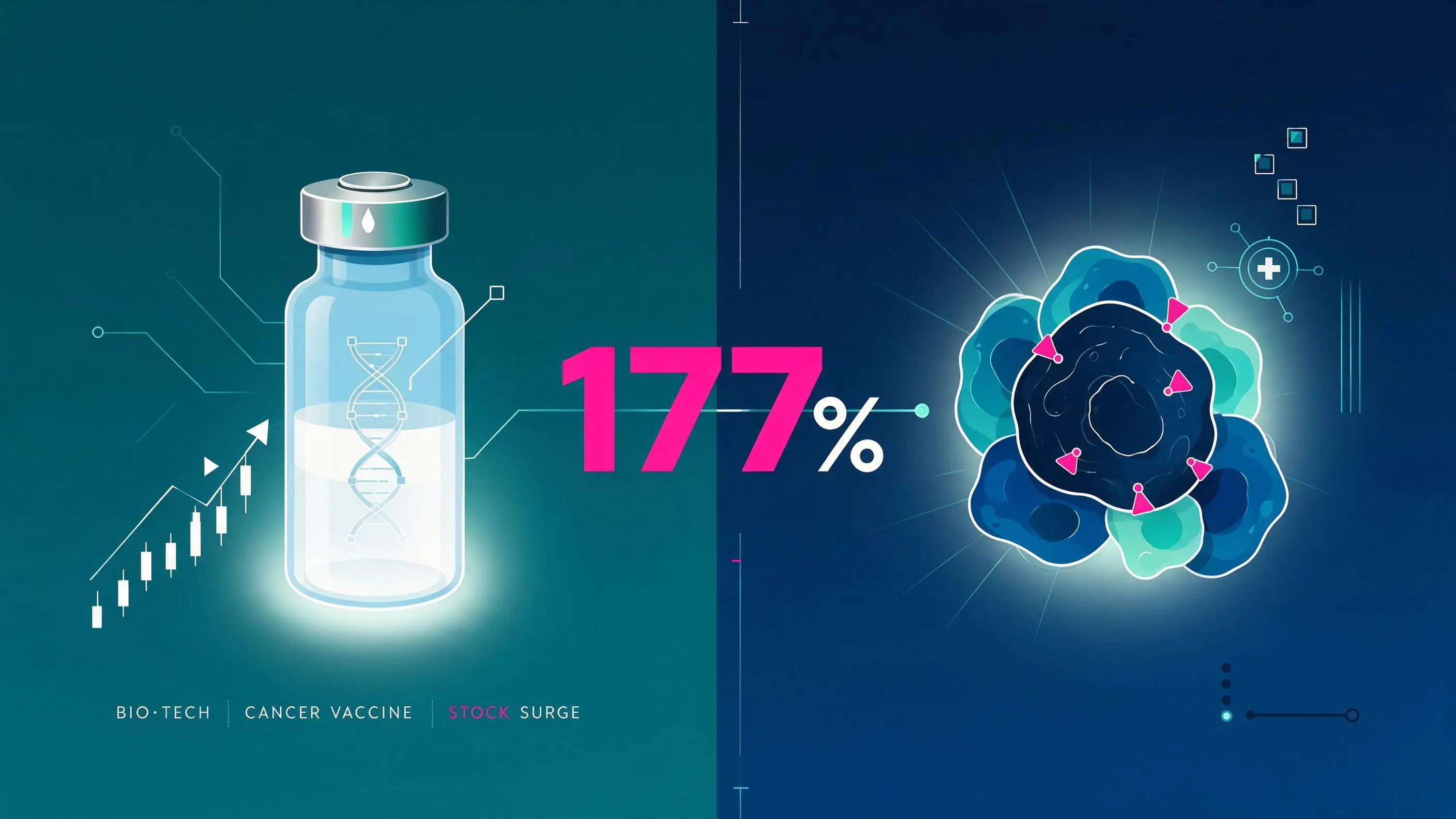
Moderna shares surged after a landmark Phase 3 melanoma vaccine win with Merck
Summary: Moderna and Merck announced positive Phase 3 results for a personalized mRNA cancer vaccine in melanoma, sending Moderna's stock up 177%. This article explains the trial, market reaction, and what investors should watch.
Key Takeaways
- Moderna and Merck have released the first major waiting Phase 3 results in treating melanoma with a personalized mRNA vaccine. This is a major development in the field.
- This is the first time any vaccine has clinched improved recurrence-free and distant metastasis-free survival against Keytruda alone. This is the first positive Phase 3 oncology vaccine.
- Moderna’s positive results sent the stock price soaring 177% and added $44 billion to Moderna’s market value. Short sellers lost about $5.5 billion of value during the price increase.
- This treatment regimen has yet to be approved. More data, further research, and more regulatory filings are required.
- For investors, this is a big positive sign for mRNA cancer research outside of vaccine research. This is a binary sell of company stock due to the nature of this type of research.
Why Moderna Stock Exploded 177% on One Cancer Trial Result
Moderna stock went up by 177% on August 19, 2026 after Moderna and Merck both released promising Phase 3 results for a personalized mRNA cancer vaccine in melanoma. This was one of the biggest one-day moves by any S&P 500 stock in the last several decades.
Most of the time, technology companies like Moderna are rarely in the news for a medical advancement. But, this story is just that... it is being described as the first major breakthrough in the development of oncology mRNAs, and the potential for a revolutionary change in cancer treatment and the creation of a separate revenue stream beyond Moderna’s existing COVID vaccine.
A simple overview of the case: INTerpath-001
The vaccine, referred to as Intismeran autogene (V940 or mRNA-4157), is administered to medically-removed Stage IIB-IV melanoma patients after surgery and prior to the administration of systemic therapy.
In the Phase III INTerpath-001 study, researchers verbally administered treatments to 1,137 subjects and compared the following treatments:
Intismeran plus Keytruda (pembrolizumab)
Keytruda alone (current standard adjuvant treatment).
At the pre-specified interim analysis, the combination treatment achieved all primary endpoints:
Recurrence-free survival (RFS): time to tumor recurrence or death.
Distant metastasis-free survival (DMFS): time to metastasis to distant organs or death.
The companies announced that the results achieved with the combination treatment demonstrated clinically significant and statistically better outcomes when compared to the treatment with Keytruda. The Keytruda treatment demonstrated statistically worse clinical outcomes. The precise hazard ratios and median survival times were not reported when the companies announced the interim results, as the independent data monitors declared the study completed.
What the cancer vaccine really means
Unlike vaccines for HPV or hepatitis B, this vaccine is not a preventative vaccine. It is a therapeutic vaccine developed specifically for each patient based on their tumor.
Here's how it works:
After the tumor has been surgically removed, it is sequenced to identify neoantigens. Neoantigens are mutations that are unique to the patient's cancer.
Machine Learning is used to identify 34 neoantigens.
Encoded in an mRNA vaccine, these neoantigens become the instructions that the vaccine uses to teach the immune system to recognize the cancer.
Keytruda is used to release the "brakes" on the T-cells.
In plain terms: Keytruda enables the T-cells to attack more aggressively, while Intismeran teaches them what to attack.
Earlier Phase 2b data had already suggested large risk reductions (about 49% lower risk of recurrence/death and 59% lower risk of distant metastasis/death vs Keytruda alone), which set the stage for this Phase 3 win.
Why the market reacted so violently
The surge of 177% can be attributed to the following three key factors:
1. The first of its kind, the late-stage proof, of an mRNA cancer vaccine
Until now, mRNA's big success story was COVID vaccines. This is the first time an mRNA cancer vaccine has succeeded in a large, late-stage trial, validating the entire approach for oncology and opening doors for similar therapies in other cancers.
Until recently, mRNA has only been known to help with the development of COVID vaccines. For the first time, a large, late-stage trial of an mRNA cancer vaccine provides proof of the concept and validates the approach for oncology, and also provides a precedent for new cancer therapies.
2. A new growth engine for Moderna
Moderna's COVID vaccines have lost value over time. A successful cancer vaccine could help Moderna develop other new cancer therapies, and also help Moderna reach its original valuation before the pandemic.
It was reported that Moderna's market cap increased some 25 billion to about 69 billion USD over the course of an hour, which equates to about 44 billion USD of newly issued value.
3. A bumper short squeeze
Many investors had bet against Moderna, expecting continued struggles. The surprise success triggered a short squeeze, with estimates of around 5.5 billion USD in one-day losses for short sellers, and year-to-date short losses on the trade rising to roughly 7.7 billion USD.
Many had it in for Moderna and placed their bets against it, assuming it would continue its struggles. After some shocking announcement successes, short sellers lost roughly $5.5 billion dollars in a day amidst a short squeeze and, year to date, the short trade on Moderna’s stock has hemorrhaged an additional $2.2 billion dollars.
Merck’s stock moved up over 10-12% as well because the regimen is built on Keytruda, its blockbuster immunotherapy.
Safety profile and regulatory next steps
Moderna and Merck gave no new updated safety concerns. In the previous reports, almost the entirety of the side effects from the vaccine were mild to moderate. While relatively fit post-surgery patients would be the expected demographic for this drug's use, these symptoms would make it an acceptable side effect profile.
Next steps include:
Reporting to an upcoming international medical meeting comprehensive data.
Communicating with the U.S. FDA and other regulatory bodies about the filing of Intismeran plus Keytruda and possible timelines for approval that could be as early as 2027.
Continuing to monitor patients for overall survival(OS) and other long horizon endpoints.
Beyond melanoma: what's in store with the rest of the pipeline?
The melanoma result is just the first of many expected. Moderna and Merck have many more follow-up trials for Intismeran and Keytruda across other cancer indications, such as:
Non-small cell lung cancer (NSCLC) - in the adjuvant setting
Bladder/kidney (renal cell) cancers - in the advanced setting
Early, or proof-of-concept, efforts in stomach (gastric) and pancreatic cancers
Currently, studies in colon cancer are ongoing with results anticipated in 2027 and in pancreatic cancer later in the decade.
Analysts view this as the potential start of a trend of personalized cancer vaccines, if melanoma success is extrapolated to the other tumor types.
How it impacts Indian Retail Investors
If you are an Indian retail investor tracking global Biotech/Healthcare stocks:
Direct exposure: Most Indian retail investors like you cannot buy US stocks directly without using an LRS-enabled Demat account/remittance route and tackling forex, taxes and compliance. Such investments should be treated as high-risk and long term. For context on account types, see our guide on the difference between trading and Demat accounts.
Indirect exposure: Some Indian mutual funds and ETFs have exposure to global healthcare/ biotech themes, but check underlying holdings; many do not hold Moderna or Merck directly.
Thematic lesson: This shows even binary outcomes of a clinical trial chaotic movement of biotech stocks where traders profit at the expense of long term holders who do not understand the trial’s full pipeline.
For most retail investors, this event should serve as an educational lesson towards evaluating the impacts of clinical trial outcomes and what the next phase of the trial indicates and how the company is valued as a result.
Risks & reality
While the potential benefits of Intismeran autogene are exciting, we must be cautious with some of the following:
As an investigational therapy: Several positive Phase 3 results do not guarantee regulatory approval and/or successful commercialization.
As a financial investment: As the manufacturing of personalized vaccines is complex and costly, this may impact their availability and reimbursement.
As a business risk: Success in melanoma does not guarantee success for lung, pancreatic, or other cancers. There are distinct biologies which will impact the challenges of tumor-specific trials.
As an investment risk: A move of 177% is setting a very high bar; even delays in regulatory filings, manufacturing, or other future trials, may result in a sharp decline.
For retail investors, this is a textbook scenario of understanding the educational value over the opportunity of chasing momentum.
Frequently Asked Questions
What exactly did Moderna and Merck announce?+
They announced positive topline results from the Phase 3 INTerpath-001 trial showing that Intismeran autogene plus Keytruda significantly improved recurrence-free survival and distant metastasis-free survival compared with Keytruda alone in high-risk melanoma patients after surgery.
Why did Moderna stock jump 177%?+
Because this is the first late-stage success for an mRNA cancer vaccine, opening a potential new growth engine beyond COVID vaccines and triggering a massive short squeeze as bearish investors rushed to cover positions.
Is the cancer vaccine approved yet?+
No. Intismeran autogene remains investigational. The companies plan to present data and engage with regulators on filing submissions, with some reports suggesting a possible approval timeline around 2027 if all goes well.
How does this vaccine actually work?+
After tumor removal, the cancer is sequenced to identify patient-specific neoantigens. A custom mRNA vaccine is made to train the immune system to recognize those targets, then given alongside Keytruda, which helps T-cells attack more effectively.
Does this only apply to melanoma?+
The positive Phase 3 data so far are for melanoma, but Moderna and Merck are running additional trials in lung, bladder, kidney, pancreatic, stomach, and colon cancers to see if the approach works elsewhere.
What are the main risks for investors?+
Regulatory approval uncertainty, manufacturing complexity and cost, the possibility that results don't replicate in other cancers, and the fact that the stock's huge move already prices in very high expectations.
Can Indian retail investors buy Moderna stock?+
Indian investors can potentially invest in U.S. stocks like Moderna under the RBI's Liberalised Remittance Scheme (LRS) via certain brokers and demat arrangements, but this involves forex, tax, and compliance complexities and should be treated as high risk.
Is this a buy the news situation?+
Not necessarily. The 177% move reflects extreme optimism. For most retail investors, this is better viewed as a case study in biotech event risk rather than a simple momentum trade, especially given the long path from Phase 3 to approval and commercialization.
Disclaimer
This article is for investor education only and does not constitute investment advice, a recommendation, or an offer to buy or sell any security.
Markets involve risk, including possible loss of capital. Please do your own due diligence or consult a registered adviser.
Research views are informational and may change without notice. Past performance is not indicative of future results.
This article is for educational purposes only and does not constitute investment advice, recommendation, or an offer to buy/sell any security. Investments in global biotech stocks involve significant risk, including clinical-trial and regulatory risk. Please consult a SEBI-registered investment adviser before making any investment decisions.
Research Team
InvestEdge360 Research
Content Research Desk
Insights from InvestEdge360's research desk — written to help investors learn with clarity and invest with discipline.
Want to track global market-moving events like this?
Open a demat account with a broker that supports international investing and stay updated with our global markets coverage.
Open Demat AccountRelated Articles
- Global Markets
How to Invest in International Funds from India: Complete Guide for Indian Investors
- Global Markets
How US Bond Yields Affect the Stock Market: India Guide
- Bonds & Fixed Income
US 10-Year Treasury Yield: 50-Year History, Chart & Key Trends
- SIP
How to Start Your First SIP in India (2026 Beginner Guide)



Was this article helpful?
🚀 Open your Demat & Trading account
- Free Account opening charges
- Free DP transaction charges ⭐
- Free premium research & market updates