
How Rising Sugar Prices Affect Indian Stocks: A Simple Guide for Investors
Rising sugar prices can have a wider impact on Indian stocks than many investors realise, influencing sugar producers, food companies, FMCG businesses and even consumer spending. In this simple guide, understand how sugar prices affect company costs, margins, earnings and stock-market sentiment.
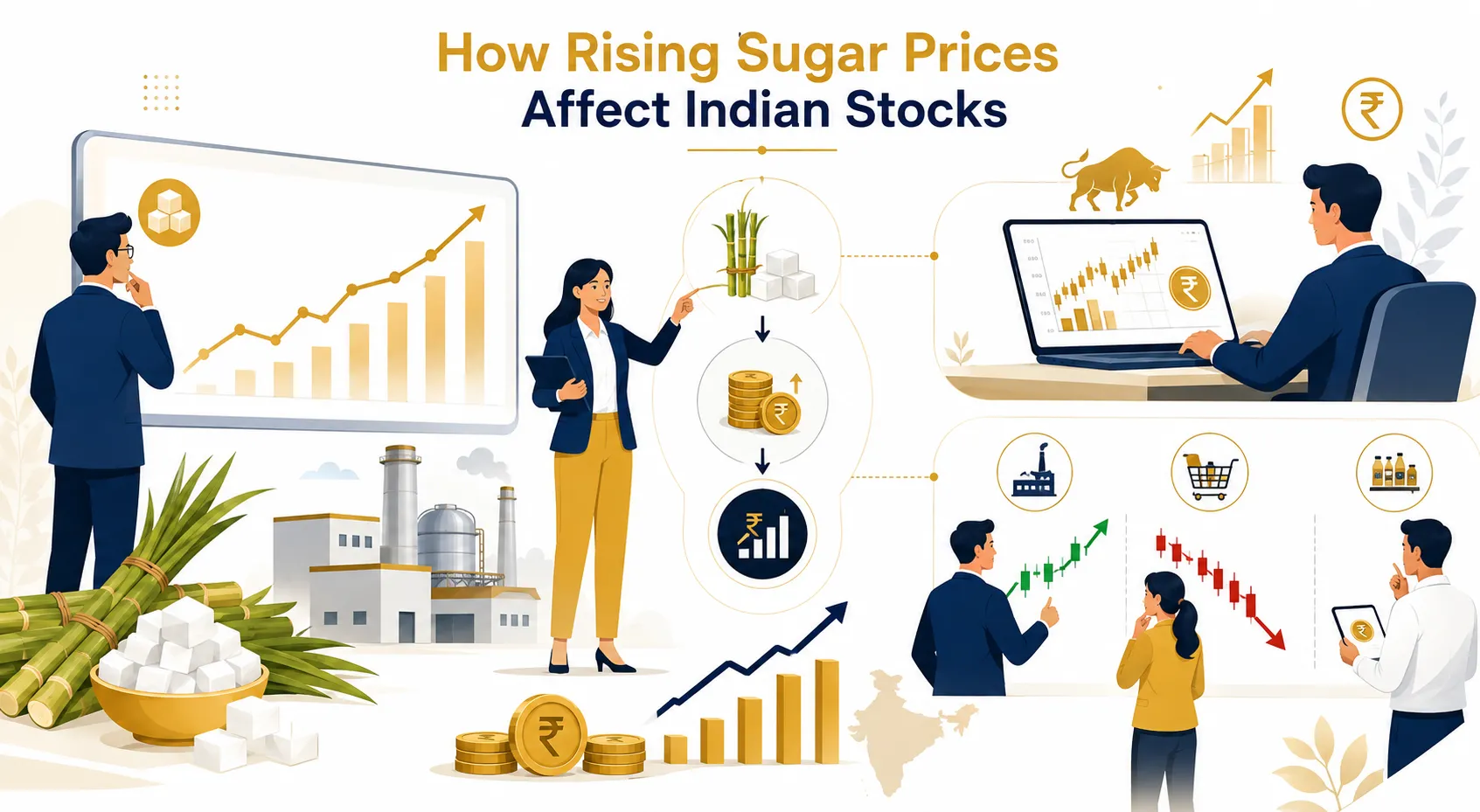
How rising sugar prices affect Indian stocks: the link between sugar, ethanol, and mill profitability
Summary: A beginner-friendly educational guide explaining how rising sugar prices affect Indian stocks — covering FRP/SAP cane costs, sugar MSP, ethanol blending economics, key listed sugar companies, and the main risks investors should understand.
Key Takeaways
- Sugar company profits depend on the gap between government-fixed cane costs (FRP/SAP) and sugar selling prices, so rising sugar prices can widen margins if cane costs don't rise proportionally.
- India's sugar Minimum Selling Price (MSP) has stayed unchanged for a long stretch even as cane costs rose, and any future MSP revision is closely watched by the market.
- Ethanol blending can create an additional demand and revenue opportunity for sugar companies, although its impact depends on government policy, ethanol pricing and company capacity.
- Key listed sugar companies Balrampur Chini, EID Parry, Triveni Engineering, Dalmia Bharat Sugar, Shree Renuka, Bajaj Hindusthan, Dhampur, Bannari Amman and Dwarikesh, differ in their fundamentals.
- The performance of sugar stocks is impacted by quality of the monsoons, the export-import policy, global sugar prices and co-generation income.
- Sugar stocks carry policy risk, cyclicality, and stock-specific dispersion, so sector-level optimism doesn't guarantee gains in every individual stock.
Sugar may seem like an everyday commodity, but changes in sugar prices can have a meaningful impact on listed sugar companies and their stock prices. To understand how rising sugar prices affect Indian stocks, and particularly how the stocks for listed sugar and ethanol companies will be affected by price changes, requires an understanding beyond the supermarket checkout of the sugar mill revenue streams, the costs to the mills, and the shifting Indian government policies. This breakdown of the dynamics will allow you to track industry news and better understand what affects stock movement.
Why Sugar Companies Are Different from Most Other Businesses
In comparison to most other companies, where input costs and selling prices can be controlled at will, Indian sugar companies operate in a highly policy-driven economy. For them, two prices are material while deciding profitability:
Cost side — cane pricing (FRP/SAP): The Central Government fixes a Fair and Remunerative Price (FRP) of sugarcane for a sugar season. In certain sugar-producing states (most notably Uttar Pradesh), a State Advised Price (SAP) also applies and is generally higher than the FRP. FRP and SAP represent the cane procurement cost side for sugar mills. Mills in such states have to pay the applicable cane price, irrespective of the sugar selling price.
Revenue side — sugar realisation and sugar MSP: On the revenue side, mills earn from the sugar selling price (sugar realisation). Separately, the government notifies a Minimum Selling Price (MSP) of sugar that mills are bound to maintain, which provides some protection from selling sugar below a notified floor. This MSP level has stayed constant for a very long time, and mill margins can get eroded when cane costs rise while sugar realisations do not keep pace.
Since cane costs are generally influenced by government policy while sugar realisations move with market conditions, stronger sugar prices can widen the gap between cane costs and selling prices. A change in the government-notified sugar MSP can also influence the economics of the sector.
How Rising Sugar Prices Impact Company Profits
If sugar mills get to sell their sugar at higher prices due to balanced supply and demand in sugar prices, firm international prices, tighter domestic supply or change in MSP, the impact on listed sugar companies will generally be as follows:
Increased revenue: Mills sell their sugar at higher prices thus increasing the revenue per tonne, if the sales volume was to remain the same.
Increased operating margins (provided costs do not increase in step): If costs of cane (FRP/SAP) do not increase, the difference of selling price over the costs would potentially increase operating margins.
Market sentiments and share price: Expected profits resulting from policy changes such as an MSP change, would lead to an improvement in the share valuations by the market, despite a lack of reported profits, indicating an expectation of future profits.
Rising sugar prices do not automatically mean every sugar stock will rise. The actual impact depends on factors such as cane costs, sugar production, inventory, ethanol revenue, government policies, debt levels and company-specific fundamentals.
One should note, the relationship isn't completely unidirectional as a quick increase in sugar prices can prompt the government to intervene through notifications restricting sugar exports, price rise, or stock limits, thus creating a cap on price increases and an adverse sentiment for the investors.
The Ethanol Angle: Why It Matters Even More Today
The sugar stocks in India have started to expand past just tracking sugar prices. Mandating the blending of ethanol into petrol in India has become a new key factor for the Indian stock market. When sugar mills make ethanol, they can generate revenue from ethanol in addition to sugar by selling it to Oil Marketing Companies (OMCs), with procurement and pricing influenced by government policy. This can diversify revenue for some sugar companies, though ethanol economics should not be treated as completely fixed or risk-free. A couple of things make this especially relevant:
Steadier Revenue Stream: Sugar revenue can spike depending on the price of sugar. Ethanol sales can offer a steadier revenue stream that is less tightly tied to sugar-price volatility than sugar sales alone.
The Blending Of Sugar And Crude Oil: Crude oil prices can influence the relative economics of ethanol as a fuel-blending option. This can affect market sentiment toward companies with meaningful ethanol exposure, although the impact also depends on government pricing and procurement policies.
For all that has happened with ethanol blending into petrol, most domestic Indian stock market analysts and investors think of sugar stocks like energy stocks. As mentioned above, blending targets, timelines, and ethanol pricing are all flexible and changeable, so do not treat ethanol blending targets set in the past as fixed. Refer to the latest Ministry of Petroleum and Natural Gas or ISMA updates.
Key Listed Sugar Stocks in India
There are a number of listed sugar and ethanol companies found on the NSE and BSE in India. The table below is for educational comparison only:
| Sugar Company | What Investors Can Examine |
|---|---|
| Balrampur Chini Mills | Sugar, ethanol and profitability |
| EID Parry India | Sugar, distillery/business mix |
| Triveni Engineering and Industries | Sugar, ethanol and other businesses |
| Dalmia Bharat Sugar and Industries | Sugar and ethanol |
| Shree Renuka Sugars | Sugar and ethanol operations |
| Bajaj Hindusthan Sugar | Sugar business and financial position |
| Dhampur Sugar Mills | Sugar, ethanol and power |
| Bannari Amman Sugars | Sugar and related businesses |
| Dwarikesh Sugar Industries | Sugar and ethanol |
Company fundamentals, ethanol capacity, cane sourcing regions, and how strong their balance sheets are vary significantly, so using the term "sugar sector" to make generalizations about stock performance is not wise. It's best to look at each individual stock and company filing. If you are just starting to learn how to do company research, our explanations about how trading and Demat accounts work is a great place to start your learning before you get started.
Other Factors That Affect Sugar Stocks
There are other things that affect how this sector's stocks perform, other than sugar prices and ethanol:
Monsoon and cane output: Sugar requires a lot of water. This means the quality of the monsoons and the cane acreage in the major cane producing states (Uttar Pradesh, Maharashtra, Karnataka) impacts how much sugar the country produces.
Export and import policy: The government changes how much it allows, and how much it restricts, sugar exports based on how much supply the country has and how much inflation there is. Any easing of these restrictions can allow more sugar to be exported, which can support domestic sugar realisations and sentiment toward sugar stocks.
Global sugar prices: How Brazil decides on how much sugar and how much ethanol they are going to produce can affect how competitive sugar exporting is, and how the sugar exporters are perceived.
Co-generation and by-products: Bagasse is a by-product of the production of sugar. It is a fuel source that many mills use, and if they produce an excess of power, they can sell it to the state's power grids.
State elections and policy timing: Government policy decisions, including cane pricing and sugar-sector measures, can become important market factors around election periods.
What Investors Must Look Out For
Policy risk: FRP, SAP, MSP, export quotas, and ethanol pricing are all government influenced. As a result, quick shifts in government policies can lead to sudden changes in profitability in the sector.
Commodity cyclicality: As a cyclical commodity, the sugar industry experiences price cycles as well as the profitability of the mills over a number of years due to surplus and deficits in production.
Weather dependency: A bad monsoon or a disease that affects crop yields can negatively impact cane volumes even if the prices are favorable.
Debt levels: Some sugar companies have built capacity (including distillery/ethanol expansion) and have a high debt load, which can increase the financial risks if the margins of the industry start to shrink.
Stock-specific dispersion: The one-month price fluctuations of the individual stocks of the sugar companies listed illustrate that performance can differ greatly for individual stocks in a rally or downturn of the industry, so optimism for the sector as a whole does not guarantee gains for the individual stocks.
It is advisable to overlook trends when chasing stocks, because all sectors eventually experience rallies and declines. While evaluating stocks, it is essential to check company balance sheets, ethanol, and sugar revenue mix, and valuations before any decision to invest is taken. For an understanding of how stock prices change in response to good and bad news at the company and sector levels, please see our guide on SIP vs lump sum investing if you are thinking of a more diversified, staggered buying of stocks instead of picking individual sector stocks.
How to Keep Up with Sugar Sector News as an Investor
You can find official updates about company filings and corporate announcements for the listed sugar companies on SEBI-regulated stock exchanges (NSE/BSE).
Follow announcements concerning the MSP (Minimum Selling Price) and export policy by the Ministry of Consumer Affairs, Food and Public Distribution, as they impact the economics of the sector.
Follow the trend of crude oil prices as there is an emerging linkage between the price of oil and the demand for ethanol.
Rather than solely relying on news headlines, you can get information on costs of mills, ethanol capacity, and debt levels by going through the company investor presentations and annual reports.
Conclusion
As is the case with most commodities, a rise in sugar prices impacts Indian stocks predominantly through the effect of higher sugar realisations on fixed cane costs. This effect, along with structural concepts like ethanol blending and rising oil prices, can widen margins for some mills, though the impact varies by company. However, this also makes sugar stocks vulnerable to varying government policies and the unpredictable nature of the monsoon. This article is not a recommendation to invest. Rather, it aims to provide you with general knowledge on the subject.
Frequently Asked Questions
Why do sugar stocks rise when sugar prices go up?+
Because sugarcane costs are largely fixed by government-set FRP and SAP prices, a rise in sugar selling prices can widen the margin between what mills pay for cane and what they earn from sugar, which tends to improve profitability and lift investor sentiment toward sugar stocks.
What is the difference between FRP, SAP, and MSP in the sugar sector?+
FRP (Fair and Remunerative Price) is the central government's minimum price for sugarcane. SAP (State Advised Price) is an often-higher price set by some states like Uttar Pradesh. MSP (Minimum Selling Price) is the floor price below which mills cannot sell sugar in the domestic market. Together, FRP/SAP set cost, while MSP influences revenue.
How does ethanol blending affect sugar company stock prices?+
Ethanol blending lets sugar mills sell cane juice, syrup, or molasses as ethanol to oil marketing companies under government-linked contracts, creating a revenue stream less tied to sugar-price swings. This diversification, and its link to crude oil prices, has become a major driver of sugar-stock sentiment in recent years.
Are sugar stocks risky investments?+
Yes, relatively so. Sugar stocks are exposed to policy risk (cane pricing, MSP, export rules), monsoon and crop variability, global commodity cycles, and in some cases high company-level debt, which can make them more volatile than broader market indices.
Do all sugar stocks move together when sugar prices rise?+
Not necessarily. While the sector often moves broadly in the same direction, individual sugar stocks can show very different percentage moves depending on company-specific factors like ethanol capacity, debt levels, cane sourcing region, and management execution.
How can I start investing in sugar sector stocks in India?+
You need an active Demat and trading account with a SEBI-registered broker to buy listed sugar company shares on the NSE or BSE, the same way you would buy any other listed stock. Research individual company fundamentals rather than investing based on sector headlines alone.
Does the government control sugar prices in India?+
The government influences sugar economics through multiple levers, including the FRP for sugarcane, state advised prices, a minimum selling price for sugar, export and import policy, and ethanol procurement pricing, making the sector more policy-sensitive than many other industries.
Disclaimer
This article is for investor education only and does not constitute investment advice, a recommendation, or an offer to buy or sell any security.
Markets involve risk, including possible loss of capital. Please do your own due diligence or consult a registered adviser.
Research views are informational and may change without notice. Past performance is not indicative of future results.
This article is for educational purposes only and does not constitute personalised investment advice or a recommendation to buy or sell any stock. Sugar-sector prices, government policies (FRP, SAP, MSP, ethanol pricing, export rules), and company fundamentals change frequently; verify current data from official sources before making investment decisions.
Research Team
InvestEdge360 Research
Content Research Desk
Insights from InvestEdge360's research desk — written to help investors learn with clarity and invest with discipline.
Ready to Research Sugar Sector Stocks?
Open a Demat account with a SEBI-registered broker to start researching and investing in listed sugar and ethanol companies.
Open Demat AccountRelated Articles



Was this article helpful?
🚀 Open your Demat & Trading account
- Free Account opening charges
- Free DP transaction charges ⭐
- Free premium research & market updates