
Physical Shares vs Demat Shares: Key Differences Explained
Compare physical and Demat shares in India: certificates, rights, transfer limits, charges, lost-share issues and the special 2026 dematerialisation window.
Summary: A comparison of physical share certificates and Demat shares covering ownership records, SEBI’s 2019 transfer rule, the 2026 special transfer window, rights of shareholders, fees, lost certificates and possible conversion routes.
Key Takeaways
- Physical and Demat shares are representations of the same ownership rights. The main difference between the two is in the form of the record that evidences ownership.
- From the 1st of April 2019, transfer of listed shares was done through the Demat form. Physical share certificates were not automatically invalidated.
- Transmission, transposition and dematerialization are different from a sale transaction.
- The special window of 5 February 2026 to 4 February 2027 allows investors to move their pre-2019 shares and claims. Upon successful transfer, the securities will be locked for a period of one year.
- Until the books of the issuer company or the registrar and transfer agent are updated, beneficial owners of physical share certificates retain the right to receive dividends and bonuses, as well as the right to vote.
- While a company is still listed, demat shares are easier to hold, trade, and transfer. They do not reduce risk of a company going defunct, being delisted or of a share price drop.
🚀 Open your Demat & Trading account
- Free Account opening charges
- Free DP transaction charges ⭐
- Free premium research & market updates
Last Reviewed: 25 November 2026. Physical shares vs demat shares refer to different ways of recording share ownership. Physical share holdings are recorded through share certificates in the name of the shareholder and in the share register of the company. Demat share holdings are maintained in an electronic format by NSDL or CDSL through a Depository Participant (DP). From a legal standpoint, ownership of the share is the same whether it is held in physical form or in demat form. However, there are differences in the way records are maintained, shares are transferred and sold. If you possess old share certificates, you can approach a Depository Participant for physical-share dematerialisation assistance to check if you are eligible to convert those shares to demat form.
Physical Shares vs Demat Shares: Differences at a Glance
Main difference between the two is in the form of the holding and its transfer mechanism. Comparison here is limited to shareholding of companies listed on an Indian stock exchange. Special rules and restrictions may apply to shareholding of unlisted, delisted, disputed and other non-standard securities.
Feature | Physical shares | Demat shares |
|---|---|---|
Holding record | Paper certificate, folio and issuer/Registrar and Transfer Agent (RTA) register | Electronic beneficial-owner balance with a depository through a DP |
Evidence | Certificate number, distinctive numbers, holder names and folio | Demat statement, Client ID/DP details and ISIN |
Listed-share sale or ordinary transfer | Must generally be converted to Demat before a new transfer | Executed through applicable market or depository transfer processes |
Settlement | No ordinary exchange delivery of new listed-share trades by handing over certificates | Electronic credit and debit under the applicable settlement system |
Safety risks | Damage, loss, forgery and document mismatch | Account-access fraud, phishing and unauthorised instruction risks |
Corporate actions | Issuer/RTA records govern entitlements and service requests | Depository-linked records simplify processing and electronic credits |
Nomination or transmission | Typically handled with issuer/RTA using prescribed documentation | Handled through DP/depository process and required legal proof |
Charges | Certificate and paperwork expenses may arise in service requests | DP maintenance, transaction and dematerialisation tariffs may apply |
Convenience | Manual verification and record updates can be time-consuming | Online statements, alerts and easier electronic transaction records |
What Are Physical Shares and Physical Share Certificates?
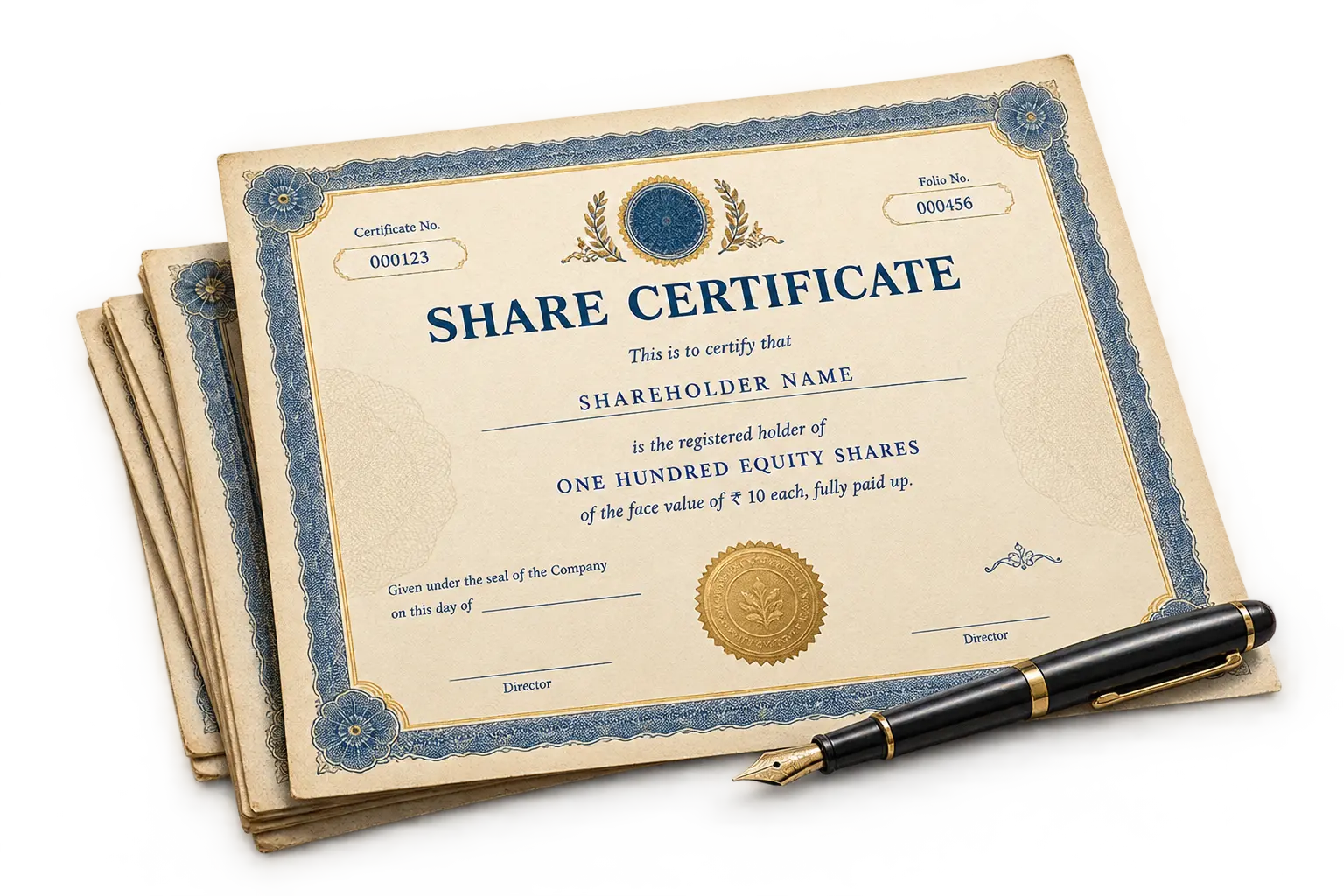
Physical share means a company or its historical registrar has issued a paper certificate to the investor evidencing share ownership and has included the name of the investor in its shareholder register. A physical share certificate specifies the name of the company, name of the registered holder, folio number, certificate number and the share quantity. Shareholders of old certificates should approach a Depository Participant to dematerialize their shares.
Physical share certificates also have a validity period. SEBI declared that when transfer of shares to a Demat account was effected, the physical share certificates would not be invalidated. A genuine physical share certificate would establish a share holding, subject to the certificate conforming to the records of the Company, considering various corporate actions, succession, discrepancies and duplicate issues. Proof of share holding is not the same as proof of legal transfer of the share.
What Are Demat Shares and How Does Electronic Ownership Work?
Shares held in the electronic form are known as Demat shares. Shares are typically evidenced by certificates held by the investor. In India, the two depositories are NSDL and CDSL. Investors open an account with a depository participant of their choice, typically a bank or a broker. Within a depository, the security is identified by its ISIN. An investor’s holding in a particular security is evidenced by the Demat account. A Demat account is an electronic account held at a depository to represent the security held by the investor.
Some advantages of holding shares in Demat form are easy, electronic transaction records and less use of paper certificates. Other benefits of dematerialising shares include smooth processing of corporate actions and transfers. Dematerialised share holdings may also be subject to fraud, and investors should therefore keep a close eye on their account, use double factor authentication, update their contact information and never sign a delivery instruction.
Can Physical Shares Be Sold in India After 2019?
SEBI clarification on physical transfers, effective 1st April 2019, states that fresh ordinary transfers of listed securities will be processed only after dematerialization. Thus, a physical share transfer post 2019 does not prevent an owner from holding on to a valid historical certificate. It is generally practise to dematerialize listed shares prior to their sale through the market route.
It is this understanding that forms the basis for the queries on the rules for transfer of physical shares 2026 and the SEBI guidelines on physical shares. Holding, transferring and inheriting shares are distinct and different transactions. Transmission changes title of the shares upon death of the holder. Transposition changes the order of joint holders. Dematerialisation of shares does not affect ownership. None of these should be construed as a sale of new shares.
Physical Shares Special Window 2026: Who Qualifies?
The circular issued by SEBI on 30th January 2026 gives the opportunity to sell physical shares which were transferred before 1st April 2019. The sale, however, is permitted only within the time window of 5th February 2026 to 4th February 2027. The circular also allows sale of previously defective applications and returned applications, provided certain conditions mentioned in the circular are satisfied.
Key requirements are original security certificates, a transfer deed executed prior to 1st April 2019, proof of purchase, KYC, a recent DP-attested Client Master List and an indemnity. A transfer request without the original certificate will not be eligible. Transfers of shares included in disputed cases and shares transferred to the Investor Education and Protection Fund (IEPF) are not eligible for this route.
Shares successfully transferred through this route will be credited in Demat form and will be locked in for a period of one year from the date of registration. They cannot be transferred, lien marked or pledged during this period. This route is only for conversion of physical shares to Demat shares and should not be confused with the conversion of ordinary physical shares held by a registered client to Demat form.
Physical Shares Dividend and Bonus Rights: Do They Change?
A shareholder’s economic and voting rights are not impacted if the shares are held in a shareholder’s name on paper. A shareholder whose shares are held in his/her name on paper remains eligible to receive dividends and other benefits declared by the company, subject to the company’s records and record dates. However, based on the type of shareholding, some shareholders may face payment and claims issues relating to the declaration of benefits. Sometimes incorrect folio information and non-compliant KYC may also prevent payment of benefits. Shareholders should communicate with the issuing company through the Record Transfer Agent (RTA) to resolve any such issues.
Demat holdings simplify the identification and crediting of corporate actions. Payment of benefits, however, still takes place through the process followed by the company. Entitlement to stock splits and bonuses is based on the shares held by an investor and not the method used to hold the shares.
Example: 100 Physical Shares vs 100 Electronic Shares
Let us say Anil and Meera both own 100 shares of the same listed company. Anil holds 100 registered physical shares. Meera holds 100 shares in her Demat account. Assuming no price, dividend or return is applicable in this example. Both Anil and Meera may be entitled to any dividend or bonus shares declared by the company, based on record-date ownership of shares, subject to company’s records and applicable rules.
Now, let’s assume both wish to sell their shares. Meera can sell her shares using the standard process followed by the depository and the stock exchange where her shares are listed, and settle the sale through her brokers. Anil would first have to verify his certificate, and complete the process of dematerialization of the shares before they can be transferred and sold on the stock exchange. The reason physical shares are compared with electronic shares is more from an operational perspective. Physical shares are not likely to provide a better return than electronic shares.
How to Convert Physical Shares into Demat: Brief Overview
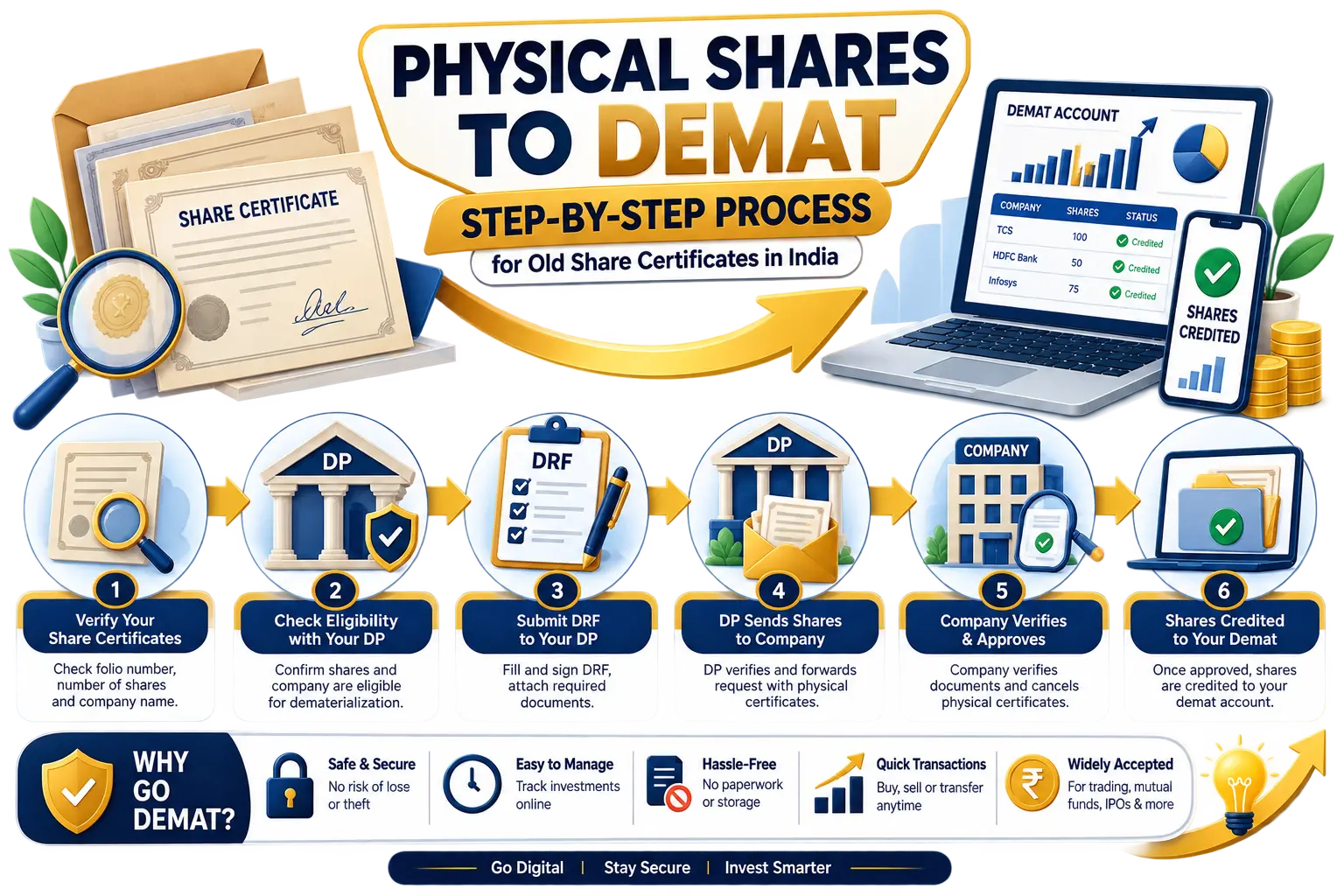
In order to dematerialize physical shares, it should be confirmed that the company record corresponds to a security with a valid ISIN. An investor holding shares in the registered name opens a Demat account in the same name, verifies his PAN and KYC and provides bank details. He/she then completes a Dematerialization Request Form (DRF) along with the share certificates. The Demat account is matched with the company records and the shares are transferred to the Demat account.
The order and names of joint holders is important. If joint holders are in different positions in each entry, a transposition cum dematerialisation process may be necessary. Changing names or deleting names from the share certificate is not a simple rearrangement of names. Please see the separate guide on physical shares to Demat for details on documentation and procedures for share conversion. Users with joint physical shares may refer to joint physical share dematerialisation for details.
When opening a demat account for physical shares, check if the depository participant (DP) accepts share certificates in physical form and charges any fees for processing the same. Opening a Demat account does not help authenticate old share certificates or prove ownership of shares.
What If an Old Physical Share Certificate Is Lost or Has a Mismatch?
If a physical share certificate is lost, damaged, in an old company name or linked to a deceased holder, the investor should first identify the present issuer and its RTA. Other common complications include an unrecorded surname change, mismatched signatures, mergers, an inactive company, a closed folio or a shareholding transferred to an unclaimed or IEPF-related account. These cases do not all follow one procedure.
For a physical share certificate lost case, recovery and dematerialisation can require investor-service forms, identity verification, indemnity or succession documentation, depending on circumstances. The new 2026 pre-2019-transfer special window requires original certificates, so it should not be presented as the solution to every missing-certificate claim. Investors dealing with incomplete or disputed historical holdings can explore physical share recovery and document assistance before choosing the appropriate process.
Physical Shares vs Demat Shares Charges and Practical Risks
Costs are not identical for every issuer or DP. Physical holdings can involve courier and document costs, replacement-related paperwork, notarisation, verification or other lawful service expenses. Demat holdings may involve account maintenance, transaction-debit charges, Demat request fees and any trading brokerage. A useful comparison is the total cost of a needed transaction, including record correction, possible taxes and the current DP tariff, rather than assuming physical holdings are always free or Demat is always cheaper.
Physical documents face loss, damage and fraud risk; electronic accounts face phishing and unauthorised instruction risk. No format protects a shareholder from a company's business losses, delisting or a fall in market value. Dematerialisation also does not guarantee that an unlisted or suspended share will become freely tradable or that an RTA will accept mismatched records without additional evidence.
Which Format Makes Sense for Existing Shareholders?
Check your objective: If you only want to retain an old registered holding, first establish validity, issuer status and records. Do not assume the paper itself became illegal in 2019.
Check tradability: If you want to sell eligible listed shares, the normal market route generally requires Demat holdings.
Check the name and folio: Match every registered holder, share count, corporate-action history and ISIN before beginning conversion.
Check special circumstances: Pre-2019 executed transfers, inheritance, joint holdings and lost certificates need different documentation and may involve restrictions.
Check costs and risk: Ask the DP and RTA for current requirements and written charges, and safeguard both physical papers and electronic account credentials.
Bottom line: Physical shares and Demat shares can represent the same economic ownership, but electronic holdings are generally more practical for listed-share transfers and account records. If you hold old physical shares in India, confirm the holding's status first; choose the normal conversion, transmission, correction or special-window route only when it fits your actual circumstances.
Frequently Asked Questions
What is the difference between physical shares and Demat shares?+
Physical shares are evidenced by paper certificates and issuer/RTA records; Demat shares are recorded electronically through NSDL or CDSL via a Depository Participant. The form and transfer process differ, while the underlying shareholder rights may be comparable.
Are physical share certificates still valid in India in 2026?+
SEBI did not prohibit investors from continuing to hold physical shares after 1 April 2019. A particular certificate must still be authentic and match the issuer/RTA records, including relevant corporate actions or disputes.
Can physical shares be sold in India without Demat conversion?+
For ordinary transfers of listed shares after 1 April 2019, the normal process requires dematerialisation before transfer. Exceptions and special procedures differ for transmission, transposition and qualifying historical transfers.
What is the physical shares special window in 2026?+
SEBI opened a limited route from 5 February 2026 to 4 February 2027 for qualifying physical-security purchases or transfers executed before 1 April 2019. The circular requires original certificates and other documents; successful transfers are credited to Demat with a one-year lock-in.
Do physical shareholders lose dividend or bonus rights?+
Not simply because a holding is physical. Entitlements depend on registered ownership and record dates, while payment or claims may be delayed by missing or incorrect bank, contact, KYC or folio details.
What if the physical share certificate is lost?+
Approach the current company or RTA to verify the holding and the applicable lost-certificate/investor-service process. Replacement or direct Demat credit usually requires verification and documentation; do not assume the special pre-2019-transfer window covers a missing original certificate.
Do Demat shares always cost less than physical shares?+
No. Demat accounts can carry maintenance, debit, brokerage and conversion fees, while physical certificates can involve delivery, verification or recovery expenses. Compare the actual DP tariff and the service request rather than assuming either format is always free.
How do I convert old physical shares into a Demat account?+
Verify issuer status, certificate details, ISIN and registered ownership, arrange the matching Demat account and required KYC, then submit the prescribed Dematerialisation Request Form and certificates through your DP where applicable. The issuer/RTA must confirm the request before electronic credit.
Disclaimer
This article is for educational purposes and does not provide any legal advice, nor does it confirm the validity of any share certificate, or assure a request for a service will be approved by an RTA/DP. Dematerialisation of shares does not guarantee market value of the shares. InvestEdge360 is operated by Vijayvargiya Financial Services, a business partner of Motilal Oswal Financial Services Ltd. It is not the official website of Motilal Oswal. InvestEdge360 does not operate as a depository, Depository Participant, Registrar or regulatory authority. Confirm the process with the issuing company of the share, RTA and DP.
Research Team
InvestEdge360 Research
Content Research Desk
Insights from InvestEdge360's research desk — written to help investors learn with clarity and invest with discipline.
Still Holding Old Physical Share Certificates?
Understand certificate verification, ownership and KYC checks, and the applicable route to convert eligible physical shares into Demat form. Explore dematerialisation-related assistance through InvestEdge360.
Explore Share DematerialisationRelated Articles

Was this article helpful?