
How to Invest in Bonds in India: A Step-by-Step Guide for Beginners
Learn how to invest in bonds in India, compare government and corporate bonds, place an order, and understand interest, maturity, liquidity and risks.
Summary: Investing in Bonds in India involves understanding the issuer, the structure of the bond, the coupon, maturity, price, and the type of risk the investment carries. Investors can take various routes to purchase different types of bonds, each having its own eligibility, account, order and settlement process. It is important to compare credit quality, liquidity and interest rate risk and costs, and consider tax implications, before investing. Verify details stated in the offering documents.
Key Takeaways
- Bonds are debt instruments where the payment terms are decided by the issuer and the specific bond issue.
- Government securities and Corporate bonds are different on the basis of the issuer and the credit exposure. Market behavior and the process to purchase bonds also vary.
- Coupon is not synonymous to yield or realized return. Return is dependent on a number of factors including price, costs, taxes, and reinvestment.
- Bonds, including corporate bonds, carry the risk of default. Bonds also carry the risk of market value loss.
- Verify the terms, route, settlement, costs and the rules before placing an order.
For the first time investor, the question “How to invest in bonds in India?” makes sense when considering the alternative options available, like equities, mutual funds, bank deposits, etc. A bond is essentially a debt instrument. Here, an entity (issuer) borrows money from an investor and agrees to pay back in the stipulated time, with an interest (coupon) payment. There are certain terms, conditions and covenants, including the right to prepay or buy back the bond, that must be adhered to by the issuer, and defined in the contract. The purchase process of a bond is different for a government security, a corporate bond, a new issue and a bond that is traded in the market.
Researching bonds for your portfolio? Before you pick a bond, evaluate its issuer, terms, price and costs. bond investment information and access options page is one place where you can start your research.
Last updated: October 2026. Bond availability, prices, yields, rules, charges and tax treatment can change. Verify current information in official notices, offer documents and platform disclosures before placing an order. This guide is educational and does not recommend a particular bond or allocation.
What is a bond?
A bond is essentially an instrument of borrowing. The government of India, state governments, public sector entities, banks and companies can issue bonds. When an investor purchases a bond, the investor lends money to the issuer. As consideration for the loan, the issuer is obligated to pay interest (coupon) and repay the principal, on the due date (bond maturity).
Not all bonds pay a coupon. Some bonds, like U.S. Treasury bills, are issued at a discount, and the full face amount is paid at maturity. There are many irregularities that can be found among bonds. Some have floating rates, irregular payment schedules, or have embedded options, like call or put, or contain arbitrary repayment conditions.
A bond's face value, issue price, and market price, are all distinct concepts. Face value, is the value stipulated on the bond. Issue price is the price at the time of the first issuance. Market price is the value at which a particular bond trades in the secondary market. Market price is not necessarily face value, or issue price. A bond can be traded at a discount to face value, or issued value, or at a premium to face value. The price can change even if the issuer is making scheduled payments.
Government bonds and corporate bonds: what is the difference?
Government securities
Government Securities (G-Secs) are government debt instruments which have a maturity period and are issued by the Government of India. G-Secs also include short-term debt instruments which are known as Treasury Bills. State Government debt instruments are known as State Development Loans (SDLs). Investors and institutions use government securities to manage their income exposure. The features and characteristics of G-Secs vary according to the issuance.
Generally, people think that government debt instruments are risk-free. However, that does not mean that their market price cannot fall. An investor may sell a longer-term security before maturity. From then on, changes in the prevailing market interest rates will determine the security's sale price. The same is true for State government securities. State government securities also have their own considerations as an issuer and in the market. State government securities should be treated separately from Central government securities.
Corporate bonds
Corporate Bonds are issued by companies to raise funds. Corporate bonds may have certain conditions and covenants. Some bonds may be secured, while others may not be secured. Investors may be treated differently in case of financial defaults by the issuer of a secured bond or an unsecured bond.
With corporate bonds, investors face issuer credit risk, which is the risk that the issuer delays, reduces or entirely fails to make a payment. A quoted higher yield could reflect greater credit risk. Weaker liquidity or longer maturities could also play a role. Other factors may affect the yield of a corporate bond. A credit rating is an opinion on the credit risk of a bond, and isn’t a prediction that payments will be made or a guarantee on the price of the bond.
Other bond structures
Floating rate bonds, perpetual and subordinated bonds, and call and put options on bonds are structures that investors should be aware of. Secured and unsecured bonds are also encountered. A label by itself doesn’t give an adequate description of a bond. Terms and conditions should always be read to understand how a bond ranks among other obligations and if interest is changeable.
For a broader introduction, read guide explaining bonds in India. To compare different structures, see the main types of bonds available to Indian investors.
Step 1: Clarify why you are considering bonds
Know your purpose before researching headline yields. Investors consider bonds for various reasons, including income, diversification, or to meet an expected future cash flow need. Each purpose dictates a different set of characteristics regarding maturity, credit quality, liquidity and cash flow.
For instance, the money that is required to be set aside for a planned future expense requires an investment of a different nature than the money that is to be set aside for several years. A bond that matures after the planned expense may result in an investor experiencing price fluctuation risk.
Consider your emergency fund, existing debt, the other investment, and your risk tolerance before investing. Bonds are not the same as a bank savings account, and an exchange-traded bond may not be easy to sell at a fair price when you need the money.
Step 2: Choose the type of bond to research
Once the purpose is defined, other restrictions may come into play. One may be to research only government securities. Others may include credit quality, maturity, callability, liquidity, payment features, etc. A corporate bond may offer an attractive coupon, but may require a detailed credit analysis. Short-term bonds, in general, may reduce the interest-rate risk as compared to long-term bonds, but may have other risks.
Upon assessing candidates, consider the issuer, instrument type, maturity, coupon structure and payment dates, credit rating (where applicable), security or seniority, call or put features, trading venue and minimum investment to determine what the investment actually is.
How to Invest in Bonds in India: The Main Ways to Buy
Route A: Government securities through RBI Retail Direct
RBI Retail Direct enables select retail investors to purchase government securities via the procedures, processes and conditions specified by RBI Retail Direct from time to time. The instruments and order processes may be different for each market segment and security. Investors are advised to go through the current information on RBI Retail Direct before opening or using an account.
Government securities may be sold in the primary or the secondary market, based on the security and the features offered by the market segment. In a primary auction, the price or yield is determined by the auction process and the bid method used. In the secondary market, a buyer transacts at the market price, which may be above or below the face value.
Also consider the supported instruments, the minimum bid or transaction size, the settlement and payment processes, and any other procedures which may vary based on the auction or security offered. Also know that just because a security is offered for sale by RBI Retail Direct at a particular point in time, it does not mean all securities are available for sale through all routes at all times.
Route B: Bonds through a broker or exchange
There are some listed debt securities that can be traded through supported brokers and/or exchanges. The exact process may vary depending on your intermediary and the security. You should confirm that the bond is listed, is available for retail trading through the platform, and is eligible for your account before using this route.
Not all exchange access enables active trading. Bonds may have very few bids and/or offers. A displayed quote may not be available for the quantity you want to trade. You should check the order book and look at trading and settlement volumes. If there is very little liquidity, you may have to take a less favorable price or may not be able to trade at all.
Route C: A new corporate bond issue
Corporate debt may be offered through a public issue or other permitted offerings. You should review the offer document, information memorandum, and/or other material carefully rather than just rely on an advertisement, summary, or description posted by an online platform.
You should review the terms to determine the type of debt, its ranking, coupon and payment schedule, maturity, provisions for redemption, reasons for early redemption, covenants, the use of proceeds, and any conditions that could affect payment. Look at the allotment process, closing date and other information provided by the official issue materials. The information may change and/or be unavailable at times.
Step 3: Check whether you need a Demat and trading account
The account requirement depends on the purchase route and instrument. Generally, bonds held in dematerialised form require an appropriate securities account and supporting arrangements. A route designed for direct access to government securities may have a different account process from buying listed corporate debt through a broker.
If the selected bond requires a dematerialised account, make sure your account is active, that the relevant segment or product access is switched on, and the security can be held in that account. Consider account charges, transaction fees and other costs before proceeding. Just because an account is opened, it doesn't mean that every bond can be bought through it.
For information about Demat account opening, investors can go through the information available separately. Consider account opening and purchase of bond as different processes. Account opening does not mean the particular bond is purchase worthy.
Step 4: Read the bond's key terms before placing an order
Issuer and repayment capacity
Determine the legal issuer and assess its ability to satisfy its obligations. In the case of corporate debt, review the financial statements and consider the debt and cash flow levels, business risks, industry trends, rating reports and terms of the issue. A rating can be one input, but consider the date of the rating, the rationale, agency, and any updates.
Coupon and payment dates
Confirm whether the coupon is fixed, floating, zero-coupon or of other structure. Verify the face-amount, reference benchmark (if applicable), reset frequency, payment frequency, and the record and payment dates. Floating-rate coupons change according to a prescribed formula. A zero-coupon instrument provides no periodic interest and is issued at a discount to its redemption value.
Maturity and redemption terms
Confirm the maturity date and the amount, if any, due at maturity, subject to the issuer’s performance of its obligations. Determine whether the issuer can require the redemption of the bonds prior to their maturity (callability). Also, determine whether the bond provides a put to the holder (putable) at specified terms.
Security, seniority and covenants
For corporate bonds, examine whether the bond is secured, unsecured, senior or subordinated. Security does not assure full recovery in a default. The asset value and other claims determine legal rights and the recovery process. Consider covenants carefully to understand the issuer's obligations or restrictions.
Price, yield and accrued interest
Evaluate the price in relation to the bond’s cash flows. Yield to maturity and other yield measures make certain assumptions (e.g., scheduled payments, payments are made, bond is held to maturity, etc.) about the bond. Assumptions impact the estimated yield and maturity date. The realized yield may differ for a number of reasons, including default, taxes, or a sale before maturity.
Net prices quoted in the market may not include accrued interest; the settlement amount may include it. Determine whether the platform includes accrued interest in the price. Review brokerage, custody and other fees. Understand minimum trade sizes.
Step 5: Compare the bond with alternatives
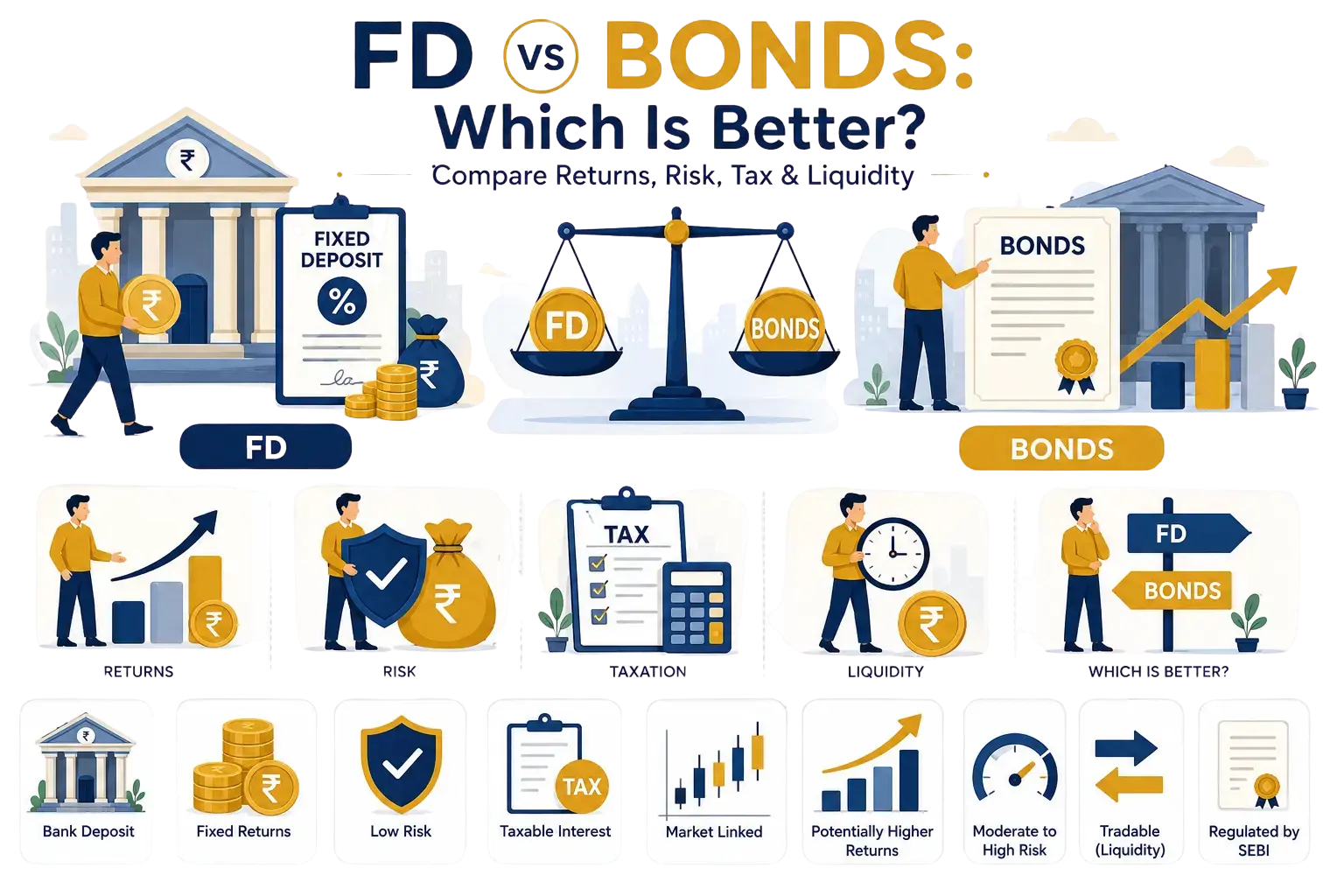
Bonds and bank deposits have different structures. A bank deposit is a claim on a bank, and may be subject to applicable deposit insurance rules and limits. Bonds are debt securities, and the risks associated with them are determined by the issuer, the instrument and the market. Deposit insurance has no bearing on the risk of bonds that are called “fixed income” securities.
In our FD-vs-bonds comparison, we explain to investors the importance of assessing liquidity, credit risk, and the terms of the investment, instead of comparing simple interest rates.
Step 6: Place the order using the chosen route
The actual order process may vary, but a diligent investor can refer to the same checklist. Sign on to the official platform or intermediary, and using the name and/or identifier, select the security. Check that the selected security matches the one that was researched; similarly named securities may differ in terms and features, and particularly in their maturity.
Enter the quantity or the amount to be invested according to the platform rules. Review the order type, price, yield, total payable amount, accrued interest if any, fees, and settlement date and payment instructions. The price at which a market order will be executed may be different from the last displayed price, especially if the market is illiquid. A limit order may not get executed.
Before confirming, check your understanding by re-reading key terms, ensure the trade is within your available funds and intended holding plan. Keep the order confirmation, contract note, or trade record, allotment information and associated issue documents. If your order is not executed or if your application is not allotted, follow the platform's process for checking status and funds.
Step 7: Understand what happens after buying
Receiving interest
If a bond pays a coupon, then that interest is paid according to the terms of that bond. The amount paid and when it’s paid is determined by the coupon and the face value of the bond. Of course, there may also be rules around when the issuer pays that interest (record dates). Generally, the terms of the bonds are stated in plain English and can be found on the bond documents or if available, on the issuer’s website. Confirm how the issuer makes payment and the history of payments, as payments may be taxable.
Selling before maturity
A bond can always be sold if there is a market and a buyer. The price at which a bond can be sold depends on the credit quality of the bond, its maturity, yield and liquidity of the market. The price at which a bond can be sold can be above or below the price paid to purchase the bond.
Bond prices and interest rates generally move in opposite directions. When interest rates go up, the price of existing bonds go down and when interest rates go down, the price of existing bonds go up. This relationship is generally more pronounced for longer-term bonds. Because of this, an investment-grade bond can show a loss if sold before maturity.
Understand the major risks before investing
Credit or default risk
When a bond issuer fails to pay the interest or principal when due, there is a default. When analyzing corporate debt, be sure to review the issuer, rating and rating rationale, security, seniority, financial position, and issue terms. Although concentration in issuers may be reduced through diversification, this will not eliminate the risk of default.
Interest-rate risk
When interest rates increase, bond prices decrease. The longer the maturity of a bond, the greater the impact on price from a change in interest rates. For bonds with a fixed rate of return, the investor is locked in for the life of the bond and may be subject to risks associated with the issuer, reinvestment, and inflation.
Liquidity risk
Some bonds may be difficult to sell, especially if there is limited trading, wide bid-ask spreads, or illiquidity in the market. Be sure to review recent prices and trading activity to ascertain the liquidity of a security.
Tax and transaction costs
Tax can affect the net result, and costs can reduce the return implied by a quoted yield. The treatment of interest, capital gains and different bond structures may vary under current tax rules. Brokerage, exchange charges, platform fees, accrued interest and other costs should be considered. Verify current details with official sources and, where necessary, a qualified tax professional.
Common beginner mistakes
Looking only for the highest yield: This may signal credit, liquidity or structural risk.
Thinking that the coupon is equivalent to the total return: The total return is impacted by costs, the purchase price and the investor’s ability to reinvest the proceeds.
Believing that every bond is guaranteed: Bondholders must evaluate the issuer, as well as the legal terms of the instrument.
Neglecting the maturity date: A cash flow can’t be met by a long-term bond.
Not reviewing the offer document: Review the offer document, as some summaries may omit important details, risk and provisions.
Official information to consult
For government securities and retail access, start with the Reserve Bank of India and its current government-securities and Retail Direct information. For information relating to securities markets, including investor protection and the entities regulating market intermediaries, see SEBI. For information relating to debt securities that are listed on the exchanges, review the relevant exchange’s current information pertaining to the debt market, including NSE materials, as appropriate. The bond market regulates access to and use of official issue documents and materials. Please refer to the official issue document or the issuer’s disclosure for the information you need on the bond you are analyzing.
These resources are starting points, and may not be current or adequate for more in depth analysis of terms of individual securities. Terms and conditions may change. Check the current information available at the time of application or order.
Before you proceed: a practical bond-investing checklist
Do I understand the issuer and its repayment capacity?
Have I confirmed the terms of the bond, i.e. the coupon, payment schedule, maturity, and callability?
Have I reviewed the credit rating and understand the rationale, if provided?
Have I identified the security, if any, and whether it is senior, subordinated, callable or puttable?
What price, yield, and accrued interest, am I comparing? What are the minimum purchase requirements? What are the other costs, if any?
Could I hold the bond for the desired period? What are the consequences of selling the bond before maturity?
What is the current market liquidity for the bond? What are the settlement requirements? Are there any other account restrictions?
What are the tax and record keeping consequences?
Have I confirmed that the issuer, information, and payment instructions on the platform are legitimate?
After performing these checks, the investors may want to review the available information on the bond investing page, and see if it is consistent with the official information and make an independent assessment.
Conclusion: invest only after understanding the bond
Investing in bonds in India involves a lot more than clicking on an order button after finding a coupon. Beginners have to study the issuer's credit worthiness, cash flow terms, price and yield, maturity, credit quality, liquidity, costs, and the route through which the security is bought and held. Government securities and corporate bonds have different risk profiles and the buying process varies for supported retail-access platforms and trades in the secondary market as well as for primary issues.
Bonds can be a part of a broader investment plan, but that does not mean bonds are always safe and liquid enough to be used for all plans and goals. Not all the terms and conditions are the same for all bonds and claims made in bond advertisements are not always accurate. For a holistic review of the plan, interested readers can look at the financial advisor resources available on InvestEdge360. This article provides a basic level financial education to investors and is not individualized tax, legal or investment advice.
Frequently Asked Questions
How can a beginner invest in bonds in India?+
A beginner can first identify the bond type and purpose, read the issue terms, compare price and yield, check risks and costs, and then use an eligible route such as a supported government-securities platform, broker or permitted issue process. The exact steps and account requirements depend on the bond.
What is the difference between government bonds and corporate bonds?+
Government bonds are issued by a government, while corporate bonds are issued by companies or other entities. Corporate bonds involve issuer credit risk and may have different security, ranking and covenants. Government securities can still fluctuate in market price, especially if sold before maturity.
Do bonds guarantee returns?+
No general statement that bonds guarantee returns is appropriate. Payments depend on the instrument's legal terms and the issuer meeting its obligations. Market prices can fall, and corporate issuers may default. Read the specific bond's terms and risks.
Can I sell a bond before maturity?+
Some bonds can be sold before maturity through a supported market or platform, but an active buyer may not be available. The sale price can be higher or lower than the purchase price because of interest rates, credit conditions, liquidity and other factors.
What should I check before buying a corporate bond?+
Review the issuer, financial position, rating and rating rationale, coupon, maturity, payment schedule, security, seniority, covenants, call or put features, price, yield, liquidity, costs and tax considerations. A rating is an opinion, not a guarantee.
Can I buy government securities directly as a retail investor?+
Eligible retail investors may access government securities through supported routes, including RBI Retail Direct, subject to current registration, eligibility and transaction procedures. Check the RBI's current official information for available instruments and steps.
Is a bond's coupon rate the same as its yield?+
No. The coupon is the stated interest rate applied to the bond's specified face value. Yield reflects the price paid and the expected cash flows under particular assumptions. A bond bought above or below face value can have a yield different from its coupon.
How are bond interest and gains taxed in India?+
Tax treatment depends on the bond type, income, holding period, transaction and law in force. Interest and any gain or loss on sale or redemption may have different treatment. Check current official tax guidance and seek qualified tax advice for instrument-specific circumstances.
Disclaimer
Bonds carry risks including issuer default, interest-rate movements, liquidity, reinvestment, inflation, tax and transaction costs. This content is general investor education and is not personalised investment, tax or legal advice. Verify current rules, product terms, availability and charges through official sources and the relevant issue documents.
Research Team
InvestEdge360 Research
Content Research Desk
Insights from InvestEdge360's research desk — written to help investors learn with clarity and invest with discipline.
Explore Demat account options
Review Demat account information if the bond route you are researching requires securities to be held in dematerialised form.
Open Demat AccountRelated Articles

Was this article helpful?
🚀 Open your Demat & Trading account
- Free Account opening charges
- Free DP transaction charges ⭐
- Free premium research & market updates