
FD vs Bonds: Which Is Better? Compare Returns, Risk, Tax & Liquidity
Learn how each of the below work and make your choice based on your financial goals, risk tolerance and time horizon. Compare returns, safety, liquidity and taxes related to FDs and bonds.
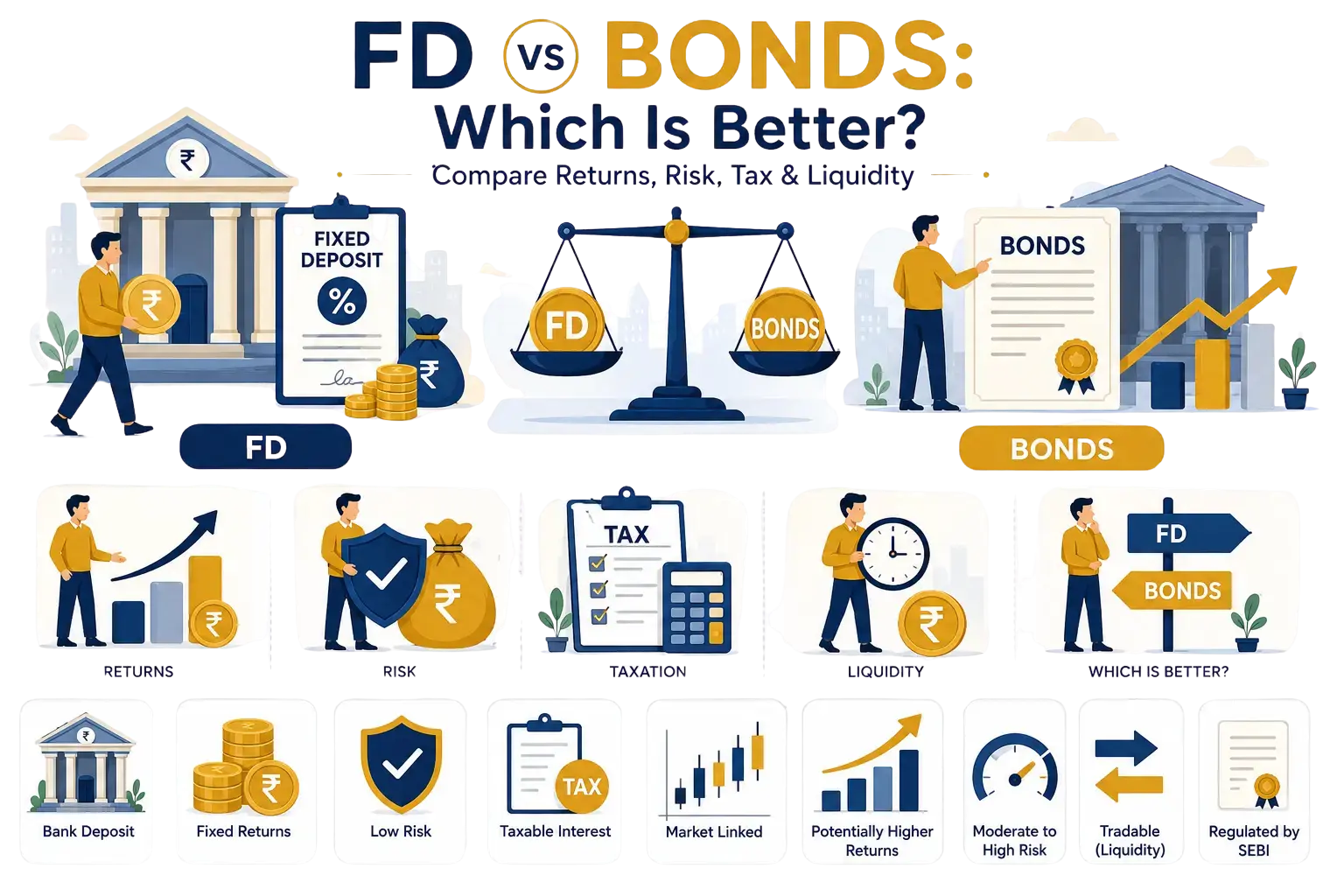
FD vs Bonds: comparing returns, risk, taxation and liquidity for Indian investors
Summary: Risks vs. returns on fixed deposits vs. bonds in India, including DICGC and sovereign safety, credit risk, TDS, capital-gains tax, and liquidity, so beginners can select fixed-income options according to their selected risks and balanced with their tolerance to risk in order to reach their financial objectives.
Key Takeaways
- Up to ₹5 lakhs of bank deposit interest is insured by the DICGC per bank per depositor. Neither FDs of NBFCs nor Post Office Time Deposits are insured by DICGC. The GoI backs the latter.
- Although G-Secs, SDLs, and T-Bills enjoy government backing, their prices may still change if they are sold before maturity.
- Investors may earn higher returns by investing in Corporate and NBFC bonds, though these bonds also have issuer credit and liquidity risks even if ratings are available.
- The interest income from FDs and the coupon income from bonds are subject to income tax at applicable slab rates. Listed demat bonds are not automatically exempt from TDS.
- Listed bonds sold before maturity may create capital gains or losses, while FDs do not create market-linked capital gains.
- Choose based on safety, tax treatment, liquidity, horizon, and portfolio role — not only the headline interest rate.
Indian investors have several options when it comes to fixed-income investments, namely FDs and bonds, but there are factors regarding safety, returns, liquidity, complexity, taxation, and more that make them distinct. Different investors, based on their investment needs, risk, and time value of money preference, choose between FDs and Bonds. This article explains the differences between FDs and bonds to Bangalore, India-based first-time investors, in a language they can understand.
What Is a Fixed Deposit (FD)?
A fixed deposit is money placed with a bank, small finance bank, post office, or NBFC for a fixed tenure at a pre-agreed interest rate. Interest may be paid at maturity or at regular intervals such as monthly or quarterly, depending on the product.
Safety is not the same for every FD:
DICGC insures eligible bank deposits up to ₹5 lakh per depositor per bank, including principal and accrued interest, held in the same right and capacity.
Deposits across branches of the same bank are aggregated for this ₹5 lakh limit.
Small finance bank deposits are also subject to the same DICGC insurance cap where eligible.
NBFC fixed deposits are not covered by DICGC insurance.
Post Office Time Deposits have Government of India backing; they should not be described as DICGC-insured.
DICGC is a deposit insurance corporation linked to the banking system supervised by the RBI. That does not mean the RBI backs every FD or that protection is unlimited.
What Are Bonds?
When you purchase a bond, you are providing credit to a bond issuer. These issuers can be the Government of India, a state government, one of the public sector undertakings, or a private firm (even through an NCD). As per the contract agreement, the issuer is obligated to pay interest (coupon) in a timely manner and return the principal at maturity.
Key distinctions for beginners:
Treasury Bills are short-term Government of India bills. They are not typically defined as a coupon bond.
G-Secs, SDLs, and Treasury Bills have the backing of the Government of India.
While they may have the backing of the Government of India, even the best credit securities are vulnerable to changes in interest rates and may see their market prices deteriorate.
Corporate bonds and NBFC bonds have issuer-specific credit risk.
Credit ratings are useful indicators, but they are not guarantees of repayment.
Government securities can be accessed through channels such as RBI Retail Direct. Some bonds are listed and may trade on the NSE and BSE, but listing does not mean every bond is easy to sell at a preferred price.
Listed bonds can be offered for sale before maturity. Still, the ability to sell and the price received depend on market liquidity, buyer demand, interest-rate movements, and the issuer’s credit profile.
FD vs Bonds: Quick Comparison Table
Factor | Fixed Deposit (FD) | Bonds |
|---|---|---|
Typical Returns | Fixed rate for the selected tenure. Varies by bank, small finance bank, NBFC, deposit size, and tenure. | Government securities usually offer lower yields relative to lower-risk corporate debt. Corporate/NBFC bond yields may be higher because of additional credit risk. Higher yield is not a guaranteed better return. |
Safety | Eligible bank deposits have DICGC cover up to ₹5 lakh per depositor per bank. Post Office Time Deposits have Government of India backing. NBFC FDs are not DICGC-insured. | G-Secs, T-Bills, and SDLs have sovereign credit backing. Corporate and NBFC bonds carry issuer credit risk. Bond ratings are indicators, not guarantees. |
Interest Taxation | Interest is generally taxable at the investor’s slab rate. TDS threshold for eligible bank/co-operative bank/post-office interest: ₹50,000 for non-senior citizens and ₹1 lakh for senior citizens. | Coupon interest is generally taxable at the investor’s slab rate. TDS may apply under Section 193, subject to thresholds, exemptions, and the nature of the security. Do not assume all listed demat bonds are TDS-free. |
Capital Gains | No market-linked capital gain or loss. Premature withdrawal can reduce the effective interest earned or involve a penalty. | Listed bonds sold before maturity may create capital gains or losses. Eligible listed bonds held for more than 12 months can receive long-term capital-gains treatment. Unlisted bonds and unlisted debentures need special caution because of Section 50AA treatment. |
Liquidity | Premature withdrawal may be allowed but can involve a penalty or lower interest rate. Terms vary by institution. | Listed bonds may be sold before maturity, but sale depends on actual market liquidity and price. Unlisted bonds can be difficult to sell before maturity. |
Minimum Investment | Usually low and varies by institution. | Depends on the bond issue, face value, platform, and route of investment. There is no universal minimum. |
Returns: FD vs Bonds
FD returns are typically fixed for the chosen tenure and vary by the institution, deposit size, and tenure. Small finance banks may offer higher rates than large banks, but investors should still understand the institution and the applicable insurance or backing rules.
Bond returns depend on the instrument. Government securities usually offer lower yields relative to lower-risk corporate debt. Corporate and NBFC bonds may offer higher yields because investors take additional credit risk. A higher coupon or yield should never be treated as a guaranteed better outcome than an FD.
FD rates and bond yields change with market and policy conditions, so compare current offers for the exact product before investing.
Risk: FD vs Bonds
Risk is where FDs and bonds diverge most clearly:
Eligible bank FDs have DICGC insurance up to ₹5 lakh per depositor per bank for deposits held in the same right and capacity. Amounts above that limit depend on the bank’s own financial strength.
NBFC FDs are not covered by DICGC insurance.
Post Office Time Deposits have Government of India backing and should not be described as DICGC-insured.
G-Secs, SDLs, and Treasury Bills carry sovereign credit backing, but market value can still move with interest rates if sold before maturity.
Corporate and NBFC bonds carry issuer-specific credit risk. Credit ratings from agencies can help with assessment, but they are not repayment guarantees.
Simplicity and consistency of capital drive initial investments into eligible bank FDs or Post Office Time Deposits. Before investing in corporate or NBFC bonds, investors must analyze the issuer’s quality, rating, and liquidity.
Taxation: Fixed Deposits vs Bonds
The tax on interest income from FDs and bonds is generally at income tax slab rates. Tax treatment on bonds is important for several reasons, including TDS and the treatment at the time of selling the bond/ redeeming it or on maturity.
FD interest and TDS
TDS (Tax Deducted at Source) will apply to interest earned on bank fixed deposits (FDs), cooperative bank FDs, and post office time deposits if the interest earned in a particular financial year is greater than ₹50,000 for normal citizens and ₹1 lakh for senior citizens. This is the applicable limit, and interest income will be subject to tax on the relevant income tax slab.
Bond coupon interest and TDS
Just because listed bonds are held in demat form does not mean they will not be subject to TDS. Interest on securities is generally covered under Section 193, subject to specific exceptions and the nature of the security. For this comparison, the outstanding interest of a resident investor in a financial year is ₹10,000. Interest on Central Government/ State Government securities may attract TDS, but may be exempt from TDS under specific provisions.
TDS is not the final tax liability. Investors must report taxable interest income while filing their income tax returns.
Capital gains on bonds
An FD does not generate market-linked capital gains because it is not traded in the market. A listed bond, however, can generate a capital gain or loss if it is sold before maturity.
The minimum holding period for listed securities (other than units) to qualify as long-term is one year. For eligible listed bonds that will be traded after 23 July 2024, long-term capital gains will attract a tax of 12.5% without indexation. Short-term capital gains will be added to total income and taxed at the applicable Tax slabs.
Important exception for unlisted bonds
For unlisted bonds, unlisted debentures, and market-linked debentures, there are different provisions. For such securities, the gains from transfer, redemption, or maturity will be considered as short-term capital gains, irrespective of the holding period. An investor should check the tax provisions on the instruments offered for investment before investing.
Tax disclaimer
Several factors, including the type of bond, its listing status, transfer date, the issuer’s status, investor status, and regulations, determine tax provisions. As each of the above-stated factors may have an impact on the tax provisions, the investor should assess the tax provisions on the Department of Income Tax site before making any investment/tax decisions.
Liquidity: FD vs Bonds
Many FDs charge penalty fees or impose low-interest rates on premature withdrawals. Termination conditions differ from banks, Post Office products, and NBFCs.
Listed bonds can be cashed in before maturity, but there can be a significant market liquidity discount. The marketDemand and interest rates weighed against the credit profile of the issuer will signal the selling price. Unlisted bonds are even more illiquid, and it can be even more difficult to sell them before maturity.
If access to immediate cash is important, check premature withdrawal rules for FDs versus liquidity in the bond market, rather than thinking either will definitely provide cash with zero cost.
Which Might Suit You: FD or Bonds?
Bank FDs/Post Office Time Deposits serve investors who prefer simplicity, low risk, and more predictable returns.
Investors looking for sovereign credit with a market price risk before maturity may prefer Government Securities.
Investors looking to assess credit risk in quality corporate bonds may prefer unlisted bonds.
NBFC and lower-rated corporate bonds should never be offered as alternatives to FDs on the basis of safety.
Investors requiring access to cash may need to compare premature withdrawal rules for FDs versus the actual bond market.
Investors should never choose a bond only for a higher coupon rate.
Many investors use both these products in their fixed income portfolio, and for listed bonds, our how to open a Demat account online in India guide may help.
Conclusion
Fixed-income portfolios benefit from having a combination of FDs and bonds. While both instruments serve different functions, each contributes to an overall investment mix. For instance, Post Office Time Deposits and FDs offer a maturity value that is more predictable and may therefore be more palatable for the less sophisticated investor. Sovereign government securities may offer a comparable maturity and credit backing but often are subject to fluctuation in market value prior to maturity. Corporate and NBFC bonds may offer higher yields but at the cost of increased credit and liquidity risk. When comparing investment yields, safety, quality of the issuer, taxation, liquidity, the length of the investment, and how the investment fits in your overall financial plan are equally important.
This article is for educational purposes only and is not investment, tax, or legal advice. Interest rates, bond yields, tax provisions, TDS thresholds, and market conditions can change. Verify current information through official sources such as RBI, DICGC, SEBI, India Post, and the Income Tax Department before making an investment decision. For regulatory context, also refer to SEBI and other official sources before investing.
Frequently Asked Questions
Are bonds safer than fixed deposits in India?+
Government securities carry sovereign credit backing, while eligible bank deposits have DICGC insurance up to ₹5 lakh per depositor per bank. Corporate and NBFC bonds carry issuer credit risk.
Is TDS deducted on bond interest?+
TDS can apply to interest on securities under Section 193, subject to thresholds, exemptions, and the nature of the security. Do not assume that a listed demat bond is automatically TDS-free.
Are NBFC fixed deposits covered by DICGC insurance?+
No. DICGC insurance does not cover NBFC deposits.
Can I sell a bond before maturity?+
Listed bonds may be sold before maturity, but a sale depends on market liquidity, available buyers, interest-rate movements, and the bond’s market price.
Is FD interest tax-free?+
No. FD interest is generally taxable at the investor’s income-tax slab rate. TDS thresholds do not make the interest tax-free.
Disclaimer
This article is for investor education only and does not constitute investment advice, a recommendation, or an offer to buy or sell any security.
Markets involve risk, including possible loss of capital. Please do your own due diligence or consult a registered adviser.
Research views are informational and may change without notice. Past performance is not indicative of future results.
Risks vs. returns on fixed deposits vs. bonds in India, including DICGC and sovereign safety, credit risk, TDS, capital gains tax, and liquidity, so beginners can select fixed-income options according to their selected risks and balance them with their tolerance for risk in order to reach their financial objectives.
Research Team
InvestEdge360 Research
Content Research Desk
Insights from InvestEdge360's research desk — written to help investors learn with clarity and invest with discipline.
Ready to Explore Fixed-Income Investing?
Open a Demat account with a SEBI-registered broker to start exploring listed bonds alongside your fixed deposits.
Open Demat AccountRelated Articles
- Demat Account
How to Open a Demat Account Online in India: A Complete Beginner's Guide (2026)
- Demat Account
Difference Between Trading and Demat Accounts: A Beginner's Guide for Indian Investors
- Mutual Funds
SIP vs Lumpsum: Which Is Better for Your Investment Goals?
- Investor Education
REIT vs InvIT: What's the Difference? A Simple Guide for Indian Investors



Was this article helpful?
🚀 Open your Demat & Trading account
- Free Account opening charges
- Free DP transaction charges ⭐
- Free premium research & market updates