
What Are Bonds? A Complete Guide to Bonds in India
Learn what bonds are, how bonds in India work, how investors earn interest, and how to assess yield, maturity, credit risk, liquidity and returns.
Summary: A comprehensive beginner-friendly guide explaining bonds in India, how debt securities work, major bond types, coupon and yield, maturity, pricing, credit and liquidity risks, investment routes, taxation considerations and a practical checklist for evaluating bonds.
Key Takeaways
- To raise funds, entities may sell bonds, which are considered debt securities.
- Yield and coupon are different from each other and must not be used interchangeably.
- Prices of bonds may rise or fall due to changes in creditworthiness, market perception, and liquidity.
- Credit risk of corporate bonds is greater than that of government bonds.
- A higher coupon rate may not ensure a better investment.
- While determining the quality of an issue, potential investors should consider yield, creditworthiness, risk, maturity, liquidity, taxation and other relevant factors.
Bonds in India are debt instruments issued by the Central Government, State Governments, and Corporates. When an investor purchases a bond, it means that the investor has extended a debt to the issuer of the bond. The debt is repayable on the maturity of the bond along with an agreed coupon. Bonds can be considered as a part of a well-diversified investment portfolio. However, the presence of bonds in a portfolio, does not necessarily imply that the portfolio is free from risk.
For an investor, understanding bonds involves assessing several factors. This includes price, yield, maturity, quality, liquidity, interest-rate level and environment, tax status, and issuer's ability and intention to honor obligations. This guide explains what are bonds, how they work in India, the major types, how investors earn returns and what to check before investing.
For a broader understanding of asset allocation, investors can also explore our fundamental analysis of stocks guide and compare fixed-income investing with other market instruments before making an investment decision.
What Are Bonds in India?
A bond is a form of debt. When an entity wishes to raise funds through a bond, also known as a ‘borrowing’ or ‘issuance’ of bond, it enters into an agreement whereby it accepts to pay back the principal and also accrue interest on the principal to the bond holder(s).
Bonds are issued by Central and State Governments of India, banks, financial institutions, public sector and private sector entities of India.
The BSE debt-market educational material describes the debt market as comprising government securities and corporate bonds, with instruments including coupon-bearing bonds, zero-coupon securities, Treasury Bills, floating-rate bonds and debentures.
A simple example
Consider a bond issued with a face value of ₹1,000 and a coupon rate of 8% per year. If the bond makes coupon payments annually, the investor is entitled to receive ₹80 each year. To receive the coupon, the bond issuer has to satisfy its obligation. Upon the bond’s Ludhiana, maturity, the issuer has to repay the principal to the investor as specified in the security.
Bonds are issued at a price of ₹1,000, however they are often bought and sold at a price that is not ₹1,000 in the secondary market. If a bond is sold at less than ₹1,000, the effective yield to the investor will be more than the coupon rate. The relationship between coupon, bond price and yield is one of the most important concepts in bond investing.
How Do Bonds Work?
The basic bond lifecycle can be understood in five stages:
Issuance: A loan is raised by an eligible borrower (bond issuer).
Investment: The loan is raised by selling debt securities (bonds) to the general public (bond investors).
Interest or other cash flows: The issuer makes payments according to the bond's terms.
Secondary-market trading: Where the security is listed or otherwise transferable, investors may be able to sell before maturity, subject to market availability and applicable rules.
Maturity or redemption: The issuer repays the principal according to the security's terms, assuming there is no default or restructuring.
Not all bonds are identical. For example, a bond can be issued at a discount to its face value. The bond can also specify that the coupon payment will be tied to some reference rate. It is important for a bond investor to understand the terms of the bond before investing in it.
If you want to explore available bond investment options, you can also review our bond investment options page.
Who Issues Bonds in India?
The entity issuing a debt security has a great impact on the credit risk and the intent of the borrowing. Investors will encounter the following:
Central Government: The Central Government borrows through the issue of Government Securities.
State Governments: State Governments borrow by raising State Development Loans and other permitted Securities.
Public-sector entities: Certain public sector/ public sector undertakings enterprises may also borrow by raising debt securities.
Banks and financial institutions: Banks and Financial Institutions may borrow by raising debts securities.
NBFCs: Non-banking Finance Companies may borrow through debentures and bonds.
Companies: Companies may raise funds by the issue of bonds or non-convertible securities.
Government securities are usually risk free. Corporate bonds typically reflect the creditworthiness of the issuing company.
Types of Bonds in India
1. Government Bonds
Government bonds, that is, debt securities issued by the Central or a State Government, are also included in government securities. Government securities form the basis for pricing in the money and capital markets, and are, therefore, extremely important in the securities market.
Interested persons may be able to purchase certain Government securities as retail buyers, through the RBI’s Retail Direct scheme, subject to the conditions and securities made available from time to time by the RBI. The RBI website provides further details.
2. Treasury Bills
Treasury Bills are short-term date-to-maturity Government securities which are issued at a discount and are redeemed at face value. As such, from the viewpoint of an investor, T-bills represent a claim on the Government for face value, and the discount is the effective yield.
3. Corporate Bonds
Corporate bonds represent debt obligations of Companies and other similar Eligible Entities. Government securities, on the other hand, represent debt obligations of the Central Government or a State Government. While Corporate Bonds carry a higher yield compared to Government Bonds, there may be risks relating to credit worthiness and liquidity.
SEBI has published an Investor Education and Protection Fund (IEPF) documentation that discusses the various kinds of risks that are pertinent to the fixed income securities.
4. Non-Convertible Debentures
Non Convertible Debentures (NCDs) are debt instruments which, upon issue, are not convertible to equity, are of different maturities and may be secured or unsecured.
5. Floating-Rate Bonds
In general, the interest rates on floating-rate bonds can vary and do not remain constant over the life of the bond. Floating-rate bonds have several advantages, including less risk of interest rate changes.
6. Zero-Coupon Bonds
Zero-coupon bonds are issued at a deep discount to their face value and will be redeemed at face value. Therefore, the return is realized by the difference of face value at time of maturity and the discounted issue price.
7. Tax-Related or Special-Purpose Bonds
Various local and foreign governments, as well as eligible agencies, may issue special purpose securities. Investors should understand the features of a security before making an investment decision and should not assume a bond is tax-free solely because it is a fixed income security.
Key Bond Terms Every Beginner Should Know
Term | Meaning |
|---|---|
Face Value | The nominal value specified for the bond, often used to determine coupon payments and redemption terms. |
Issue Price | The price at which the bond is originally offered to investors. |
Market Price | The price at which a bond may trade in the secondary market. |
Coupon Rate | The stated interest rate applied to the bond's relevant principal or face value according to its terms. |
Maturity | The date or period when the bond is scheduled to be redeemed according to its terms. |
Yield | A measure of the return implied by the bond's price, cash flows and maturity assumptions. |
Credit Rating | An assessment by a rating agency of the issuer or security's creditworthiness under the applicable rating framework. |
Duration | A measure used to assess a bond's sensitivity to changes in interest rates. |
Liquidity | How easily the bond can be bought or sold without a significant price impact. |
Coupon Rate vs Bond Yield
A common error made by novice fixed-income investors is to consider the coupon rate and bond yield to be the same. This is not the case.
If a bond is issued at a face value of ₹1,000, and is able to accumulate an annual coupon of ₹80, then the coupon rate for that bond will be 8%. However, if an investor purchases this bond for ₹950, what will be the yield for this investor? And what about an investor who purchased it for ₹1,050?
In the case of bonds, there is an inverse relationship between the price and the yield. Therefore, if the market yields increase, bond prices will fall. And if the market yields decrease, bond prices will increase. However, there are other factors which will also impact the price of a bond, including the time of maturity, and the credit worthiness of the issuer. Fixed income investments carry the risk of changes in interest rates, inflation and other macroeconomic factors.
Based on the relationships mentioned above, it can be concluded that bond prices and yields also have an inverse relationship.
How Do Investors Earn Returns From Bonds?
Bond returns can come from more than one source:
Coupon income: Periodic interest payments where the bond has a coupon.
Capital gain or loss: If the bond is sold before maturity at a price higher or lower than the purchase price.
Discount-to-redemption return: Relevant for securities where the issue or purchase price is below the amount payable at maturity.
The return actually achieved depends on the purchase price, cash flows received, sale price if sold before maturity, transaction costs, taxes and the issuer's ability to meet its obligations.
Bond Price and Interest Rates: Why Prices Move
Movements in interest rates affect prices of already issued bonds. For instance, if interest rates decline and a new bond is issued at a higher coupon than a previously issued bond, the older bond would be less attractive. Therefore, its price would decline until it yields a value competitive with newly issued bonds.
The decline in interest rates would have a positive effect on the price of previously issued bonds, if those bonds have a coupon above the new, lower, interest rates.
Ceteris paribus, longer term bonds are more affected by changes in interest rates than shorter term bonds. Thus, an investor who purchased a bond and needs to sell it prior to the maturity date, may not be certain of getting back the amount invested.
Credit Risk: Can a Bond Issuer Default?
Yes. When a borrowing obligation is issued, the health of the issuer becomes relevant. Credit risk is the risk that the issuer doesn't make either interest or principal payments.
There are differences in the credit risk of sovereign and corporate bonds. Within the corporate bond market, there are a multitude of credit qualities. Sometimes, a higher coupon would compensate for credit and/or liquidity risk.
There are many aspects of the credit analysis of a bond that should be analyzed along with the credit rating. These would include the financial condition of the issuer, leverage, and cash flow. The reason for the rating, and the covenants and conditions of the issuance should be analyzed along with the security, if any, that is pledged.
SEBI's investor education resources state that there are other risks to a bond investor besides actual default, including changes in the perception of credit quality.
Liquidity Risk in Bonds
While many large company bonds are very liquid, the same can’t be said for smaller company or low-credit-quality bonds. In the case of less liquid bonds, it can be very difficult to sell the bond and, if sellers must rely on a buyers’ market, they may have to accept a price below their asking price (or yield) to be liquid.
Of course, the greater the liquidity risk, the less attractive a high coupon will be. Investors need to look at a bond’s effective yield rather than just a bond’s coupon.
When considering an investment, an investor needs to look at where the bond is traded, the recent trading activity, the bid/ask spread, and whether there are restrictions on the sale of the bond or if the bond can be callable.
Are Bonds Safe?
It is more accurate to say that bonds have a different risk profile from equities rather than calling all bonds safe. Government securities generally have lower credit risk than corporate bonds, but bond prices can still fluctuate when interest rates change. Corporate bonds add issuer-specific credit risk, and some securities can also have meaningful liquidity risk.
SEBI's investor education material identifies interest-rate, credit, liquidity and reinvestment risks among the risks associated with fixed-income securities.
A bond's stated interest rate should never be considered in isolation. The investor should assess the issuer, maturity, price, yield, credit quality, liquidity, security structure and applicable taxes together.
Government Bonds vs Corporate Bonds
Factor | Government Bonds | Corporate Bonds |
|---|---|---|
Issuer | Government or eligible government authority | Company, NBFC, bank or other eligible entity |
Credit Risk | Generally lower sovereign credit risk | Depends on the issuer and security structure |
Potential Yield | Often lower than comparable higher-risk corporate debt | Can be higher depending on credit and liquidity risk |
Liquidity | Can be relatively strong for actively traded securities | Varies significantly by security |
Interest-Rate Risk | Present, especially for longer maturities | Present and combined with issuer-specific risks |
Due Diligence | Focus on maturity, yield and rate sensitivity | Also requires detailed credit and issuer analysis |
How to Invest in Bonds in India
How you make the investment depends upon where the bond is traded and the type of bond.
Identify the security: Determine the type of bond, who issued it, when it matures, what the coupon is, and when the payments are made.
Review the documents: Look through the offer document and other disclosures issued by the company.
Check the yield: Look at what the bond is traded for and determine what the expected cash flows will be.
Assess risk: Review credit rating, issuer financials, security/collateral, covenants, liquidity and maturity.
Choose an eligible route: Depending on the security, this could include an applicable exchange, broker, RBI Retail Direct route for eligible government securities, or another regulated platform.
Complete the transaction: Follow the platform's application, payment and settlement process.
Track the investment: Monitor coupon payments, maturity, issuer developments and market value.
The RBI has information on the Retail Direct initiative. The information and the terms and conditions for retail participation in government securities are periodically updated. Prospective investors are encouraged to review the information prior to making an investment.
More information on the debt markets can be found on the RBI web site or other stock exchanges.
Primary Market vs Secondary Market for Bonds
In the primary market, the investor purchases a security from the issuer at the time of the offering. The proceeds of the sale are received by the issuer.
The secondary market allows investors to buy and sell securities among themselves. No funds change hands to the issuer in a secondary market transaction. The price of the security in the secondary market may be different from the price in the primary market, depending upon changes in general market conditions and the demand and supply of the security in the market.
What Should You Check Before Investing in a Bond?
A practical bond-investment checklist can reduce the chance of focusing only on the advertised coupon.
Issuer: Who is borrowing the money?
Purpose: Why is the issuer raising funds?
Coupon: How much interest is specified and how frequently is it paid?
Yield: What return does the purchase price imply?
Maturity: When is principal scheduled to be repaid?
Credit rating: What is the current rating and what are the key rating factors?
Financial health: Can the issuer generate sufficient cash flow to service debt?
Security: Is the bond secured, unsecured, subordinated or otherwise structured?
Liquidity: How easily could you sell before maturity?
Interest-rate sensitivity: How much could the market value change if yields move?
Taxation: How will interest and any capital gain or loss be taxed under the rules applicable to you?
Costs: Are there brokerage, platform, transaction, settlement or other applicable charges?
Bond Taxation in India
Tax treatment of bonds varies based on the type of bond, nature of income, holding period, transaction structure and the tax laws applicable during the year of the transaction. Treatment for taxation of interest income and capital gains from sale of debt instruments may be different.
It is important for the investors to evaluate after tax returns from the bonds, considering that coupon income from bonds may not be equivalent to after tax income. Investors must look into the applicable tax laws and take the advice of a tax accountant where necessary. The Income Tax Act may be relied upon for information on current laws and rules.
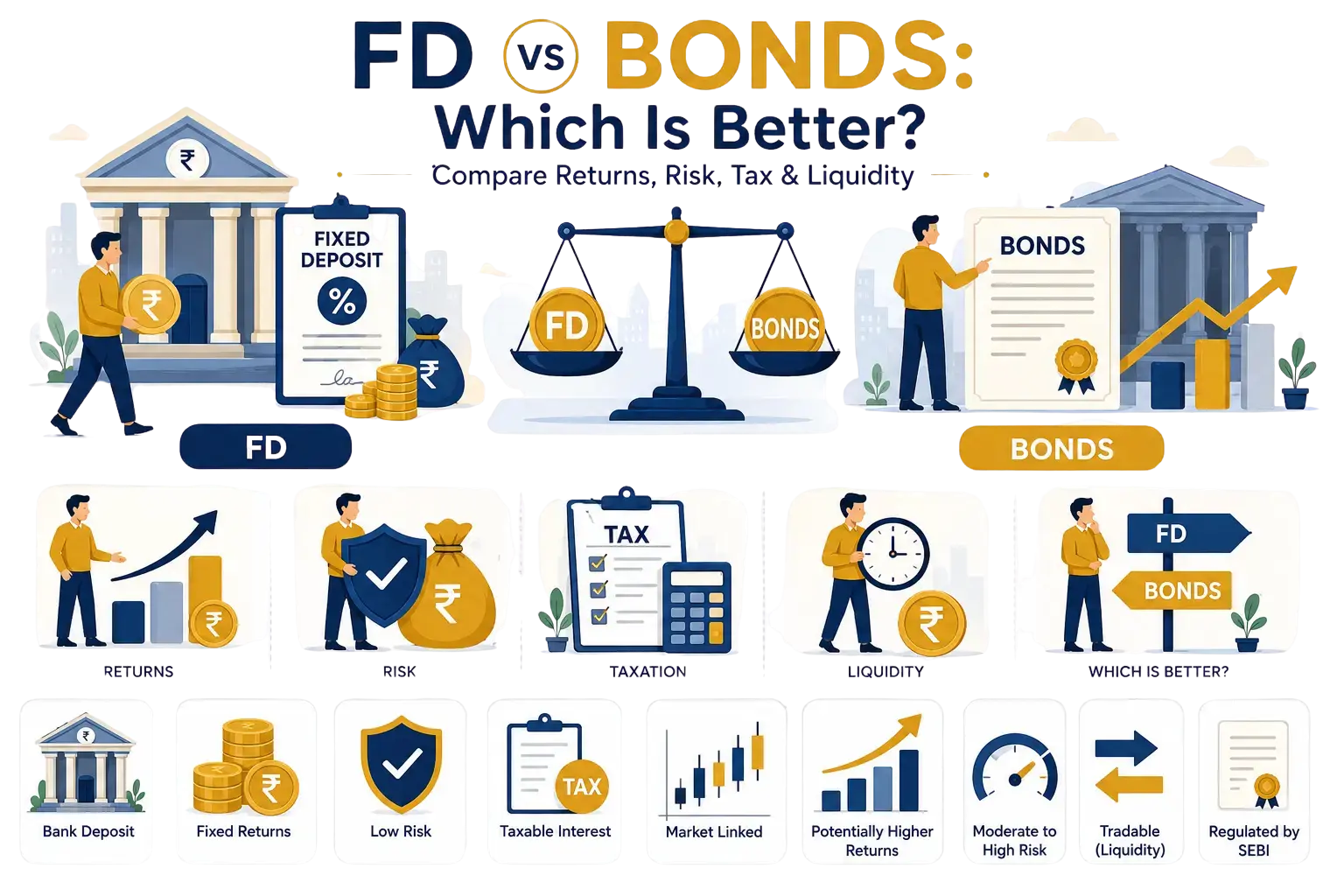
Bonds vs Fixed Deposits vs Equity
Factor | Bonds | Bank Fixed Deposits | Equity Shares |
|---|---|---|---|
Nature | Debt security | Bank deposit | Ownership in a company |
Return Structure | Coupon and/or price movement | Interest | Dividends and capital appreciation |
Market Price Risk | Yes, especially before maturity | Generally no exchange-market price fluctuation | Yes, generally higher price volatility |
Credit Risk | Depends on issuer | Depends on bank and applicable deposit framework | Company business and market risks |
Liquidity | Varies by security | Subject to deposit terms and premature withdrawal conditions | Generally high for actively traded listed shares |
These instruments serve different purposes. Comparing them solely on the basis of advertised return can be misleading because risk, liquidity, taxation and investment horizon differ.
Common Mistakes Beginners Make With Bonds
Chasing the highest coupon: A higher coupon can reflect higher credit or liquidity risk.
Ignoring purchase price: Coupon rate alone does not tell you the effective yield.
Assuming bonds cannot lose value: Market prices can fall before maturity.
Ignoring maturity: A long maturity can increase sensitivity to interest-rate movements.
Skipping issuer research: Corporate debt requires issuer-level due diligence.
Ignoring liquidity: A security may not be easy to sell at the desired price.
Assuming ratings are guarantees: Ratings are opinions within a defined framework and can change.
Ignoring taxation: Gross coupon and net post-tax return can differ.
Where Bonds Fit in a Diversified Portfolio
Bonds can be used for objectives such as generating scheduled cash flows, managing portfolio volatility, matching assets with future liabilities or diversifying away from equity exposure. The appropriate mix depends on an investor's time horizon, cash-flow needs, risk tolerance and broader financial plan.
Investors considering equity alongside fixed income can explore our equity trading account and stock investment resources guide to understand how equity and debt analysis differ.
Conclusion: Know the Bond Before Knowing the Yield
Bonds in India offer various fixed income investment opportunities. However, investors should go beyond determining the interest level of the bonds and evaluate other factors. These include the issuer, the coupon, the after-market yield, the tax effects, the maturity, the market risks, the liquidity, and the purpose of the investor.
Government Securities and Corporate Bonds have distinction in their nature and hence one should evaluate them separately. Bonds that seem attractive on the basis of their stated yield may have several risks that are not evident on the face of it. Before making any investment decision, investor should evaluate the risks that are inherent in the security and also have a clear understanding of the investor’s capital at risk.
The goal of this publication is to educate the investor; it does not provide any investment, tax or financial advice. There are several risks that are inherent in the securities markets and fixed income markets. Availability and terms of securities are determined by markets and may change. Tax and other regulations may impact an investment decision. Investors should evaluate and determine for themselves the risks before taking any investment decision.
Frequently Asked Questions
What are bonds in simple terms?+
Bonds are debt securities through which an issuer raises money from investors and agrees to make interest or other payments and repay principal according to the security's terms.
Are bonds safe in India?+
Not all bonds have the same risk. Government securities generally have lower credit risk, while corporate bonds can carry issuer-specific credit risk. Interest-rate and liquidity risks can also affect bond investments.
How do bonds generate returns?+
Bond returns can come from coupon payments, a capital gain or loss when selling before maturity, or the difference between purchase price and redemption value for applicable securities.
What is the difference between coupon and yield?+
The coupon is the stated interest payment under the bond's terms. Yield reflects the return implied by the bond's price and expected cash flows, so it can differ from the coupon rate.
Can I sell a bond before maturity?+
Some bonds can be sold before maturity through an applicable secondary-market mechanism, but liquidity is not guaranteed and the selling price can be above or below the purchase price.
Why do bond prices fall when interest rates rise?+
When newly issued bonds offer higher yields, existing fixed-rate bonds can become relatively less attractive. Their market prices may fall so their yields become more competitive.
Are corporate bonds riskier than government bonds?+
Generally, corporate bonds have greater issuer-specific credit risk than sovereign government securities. However, risk varies substantially across issuers and individual securities.
Is a high coupon bond always better?+
No. A high coupon can reflect higher credit, liquidity or structural risk. Investors should compare yield, credit quality, maturity, liquidity, security structure and taxation.
How can beginners start investing in bonds?+
Beginners should understand the issuer, maturity, coupon, yield, credit profile, liquidity and tax treatment first, and then use an eligible regulated investment route for the specific security.
Do bonds need a Demat account?+
Many listed or electronically held bonds can be held in Demat form, but requirements vary by security and investment route. Investors should verify the applicable process before investing.
Disclaimer
This article is for investor education only and does not constitute investment advice, a recommendation, or an offer to buy or sell any security.
Markets involve risk, including possible loss of capital. Please do your own due diligence or consult a registered adviser.
Research views are informational and may change without notice. Past performance is not indicative of future results.
This is for educational and research use only. It is neither investment nor financial nor taxation advice. Investing in bonds and other fixed income securities constitutes credit, interest rate, liquidity, market, reinvestment and other risks. The availability and pricing of securities may be impacted by the prevailing legislation and regulations. Invest at your own risk.
Research Team
InvestEdge360 Research
Content Research Desk
Insights from InvestEdge360's research desk — written to help investors learn with clarity and invest with discipline.
Explore Indian Bonds
Explore bond-related investment information and understand the key factors to evaluate before considering a fixed-income security.
Explore Indian BondsRelated Articles

Was this article helpful?
🚀 Open your Demat & Trading account
- Free Account opening charges
- Free DP transaction charges ⭐
- Free premium research & market updates