
Types of Bonds in India: Government, Corporate, Tax-Free & More Explained
Explore the types of bonds in India, including government securities, Treasury bills, corporate, tax-free and floating-rate bonds. Compare risks, returns, maturity and taxation before evaluating bond investments.
Summary: This guide explains the main types of bonds in India including Central Government securities, Treasury bills, State Development Loans, corporate and public sector bonds, tax-free bonds, fixed and floating rate bonds, zero-coupon bonds, secured and unsecured bonds, call and put options, convertible bonds, municipal bonds and Sovereign Gold Bonds. This guide explains their structures, credit risk, interest rate risk, liquidity risk, reinvestment risk and the applicable taxes on them. Before assessing a security, an investor should evaluate the issuer, the terms of the issue, the yield, the maturity, the trading liquidity and the applicable taxes.
Key Takeaways
- Bonds can be divided into classes based on their issuers, maturities, interest structures, security, and special features. These classes can overlap.
- Central Government Securities, State Development Loan Issues and corporate bonds have different issuer obligations and risks.
- Coupon and yield are not the same. Investors need to consider price, cash-flow timing, maturity, costs, taxes, and other considerations to analyze the outcome.
- Tax-exempt status depends on the law and the issue. Not all bonds are tax-exempt.
- Risks include credit, interest-rate, liquidity, reinvestment, and inflation.
- Make sure you understand the terms of a bond being issued, including rating and maturity, and check market liquidity and tax rules to help assess the risk of the bond.
Learning about the different types of bonds in India enables an investor to evaluate fixed-income securities and apprehend the means by which governments and other organizations in the industry raise funds. Bonds are issued by different entities and groups and vary in terms of interest, principal repayment, saleability and the risks undertaken by the investor.
Bonds issued by the Government of India differ from those issued by the State Governments, Government organizations and companies. Some pay a fixed coupon, others pay a floating rate coupon and still others do not pay any coupon at all.
Bonds, like other securities, are not all identical and are not risk-free. Even a bond which assures a constant coupon carries certain risks. The issuer may become financially distressed, and the bond may trade at a discount.
There are numerous variations of bonds available to an Indian investor and understanding the difference between government and corporate bonds is of prime importance. This document helps in understanding the various types of bonds, their issuers and the key aspects to consider when evaluating a particular bond.
If you are thinking of invest in bonds in India, professional guidance and research will help you make the right choices. Knowledge of the various categories of bonds, the risks involved, the maturity period, and expected returns will help the investor frame a more adequate and well balanced investment strategy.
What Are Bonds?
Bonds are debt instruments under which an issuer gets a loan for a particular period and under specified repayment terms. When an investor buys a bond, he/she becomes a creditor of the issuer rather than an owner of the business.
Bonds have a face value and a coupon (interest) rate. The face value is repaid to the creditor at the maturity of the bond, and coupon payments (interests) are paid at pre-decided intervals. The maturity of a bond can be anywhere from a few months to 30 years.
For example, suppose a company issues a five-year, ₹1,000 face value bond with a 7% annual coupon. The scheduled interest payment would be ₹70, which is calculated and paid on the face value. This illustration is only for explanatory purposes and is neither an actual bond issue nor the yield of the investor. Several other factors can impact the actual yield, e.g. the price paid, transaction costs, taxes and the issuer’s ability to pay, etc.
If you want to understand bonds in greater detail, including the factors that affect their prices and how they compare to each other, check out What Are Bonds? A Complete Guide to Bonds in India.
Types of Bonds in India: Main Classification
Bonds can be classified in many ways. Classification by issuer explains who owes the money; classification by interest structure explains how the payments are calculated; and classification by special features explains how the bond can be repaid or converted.
By issuer: Central and State Government securities, public sector and corporate bonds and municipal bonds.
By maturity: Short and long term bonds and debentures.
By interest structure: Fixed-rate bonds, floating-rate bonds and zero-coupon instruments.
By security: Secured and unsecured bonds.
By special feature: Callable and puttable, and convertible and non-convertible bonds.
By tax treatment: Taxable bonds and qualifying tax-exempt or tax-free bonds, subject to the specific issue's terms and applicable law.
These classifications can be intersecting. A corporate bond can be secured, fixed-rate, callable and listed. Investors should consider the full terms and conditions of a security rather than rely on the classification to explain all features and risks of the security.
Government Bonds in India
Government securities are debt instruments issued by the Central or State Governments to raise funds to finance their activities and operations. The Central Government securities are referred to as G-Secs, while the State Government securities are known as State Development Loans (SDLs).
All government securities are not suitable for all types of investors. Some have a comparatively low credit risk, but that does not mean they are risk free. An investor should evaluate whether the securities are suited for him/her from the viewpoint of the maturity period, the prevailing market conditions and the liquidity of the securities.
Central Government dated securities
Central government dated securities usually have an original maturity of one year or more. Many pay interest periodically and the form of the interest payment is determined by the issue. Some issues contain multiple maturities allowing investors to compare securities with different time horizons.
While some investors purchase securities based on the coupon rate, more sophisticated investors purchase based on the yield available in the market. The yield may be different from the coupon rate if the investor pays above or below face value for the security. After the purchase, the price of the security may be affected by changes in interest rates and expectations in the market.
State Development Loans (SDLs)
State Development Loans are debt instruments issued by state governments to raise money. The obligation of the state government to repay SDLs creates a difference from comparable securities issued by the center, especially in the case of states which do not repay their loans on time. Each issue has different terms, maturity, and yield and investors should perform an analysis rather than comparing all government securities to one another.
How retail investors can invest in government securities:
Retail investors can invest in government securities through various means. Retail investors can go through channels such as the RBI Retail Direct platform or other market intermediaries as permitted by the RBI. The investments and the processes, account and transactional, depend on the channel and the current regulations. Investors are advised to check with the channel before opening an account or placing a trade.
2. Treasury Bills (T-Bills)
Treasury Bills are short-term, discounted, government securities issued by the Central Government. These securities are issued at a discount to the face value and are redeemed at face value at maturity. The gross return is the difference between the purchase price and the face value, less taxes and costs to the investor if held to maturity.
The maturity of Treasury Bills is generally less than one year. Common maturities have been 91 days, 182 days and 364 days. However, the maturities offered by the government may vary and investors are encouraged to consult the issuance calendar.
As T-Bills do not pay any coupons, comparing T-Bills and coupon-bearing bonds by looking at the coupon rate is irrelevant. The T-Bills’ yield to maturity should be compared against the other securities.
Because T-Bills do not pay any coupons, a profit may not be realized at maturity if sold in the secondary market. Tax treatment and transaction costs should also be considered. Short-term cash management is one of the common reasons for investing in T-Bills.
3. Corporate Bonds
Corporate bonds are a type of debt instrument issued by companies for various financing needs such as operation and expansion. The issuers can be banks and financial institutions as well. Due to the varied nature of issuers and purposes, the terms and risks of corporate bonds can be very different.
Issuers of corporate bonds will need to set the coupons of the bonds. These coupons can differ from those of government securities of the same or comparable maturities. This difference can be attributed to several factors. Sometimes a higher quoted yield of a corporate bond can indicate that it is a less risky opportunity than others in the market.
Listed and unlisted corporate bonds
Listed bonds can be traded on a stock exchange. Listing a bond can improve its access to information and a market for trading, but this does not guarantee trading liquidity. An investor can still find it difficult to find a counterparty to trade with.
The opposite is true for unlisted bonds. Unlisted bonds may have restrictions on how they can be traded or sold, and the pricing and settlement of the trades may be difficult. Investors should make sure they understand these aspects beforehand.
What to review before evaluating a corporate bond
Issuer financial position:Analyze the issuer’s leverage, cash flows, interest coverage and ability to repay debt, and the schedule of debt repayments.
Credit rating: Credit ratings are opinions and can change. Understand what the rating encompasses and why the rating agency has given the rating. Ratings do not guarantee repayment.
Security and ranking: Ensure the bond is not subordinated. Check if the bond is secured and, if so, what are the securing assets. Where is the bond ranked relative to the other debt issued by the company?
Payment terms: Verify the coupon, payment frequency, maturity date, redemption terms and any early-repayment options.
Liquidity: Review recent trading volume and what the bond would likely sell for.
Documentation: Review the offer document, information memorandum and disclosures for the specific bond offering.
4. Public-Sector Bonds
Public-sector bonds may be issued by public-sector undertakings, government companies or other public-sector entities. Such entities may be operating in various sectors such as infrastructure, energy, transport or finance.
A public-sector issuer is not always the same as the Central Government. The obligation to repay is with the legal issuer, and it is in the terms of the bond. Government shareholding or public-sector status is not always an unconditional sovereign guarantee. It may be so only if it is clearly mentioned in the issue documentation.
From a prudent investor’s perspective, the label of a public-sector bond is not adequate to analyze the investment merits. Investors have to consider the financial strength of the issuer, credit rating (if any), maturity, liquidity, and the security and guarantee provisions, if any.
5. Tax-Free Bonds
In the context of India, Tax-free bonds means bonds in which the interest is exempt from tax. This is not the case for all government and corporate bonds. The tax exemption is in the light of the specific provisions of the statute and the investor’s situation.
Familiar tax-free bonds were issued in the past by eligible public sector or infrastructure-related issuers. Certain of these bonds still exist and are traded in the secondary market. The absence of discussion on older tax-free bonds does not mean that these are not offered for issue in the market.
What to check when evaluating a tax-free bond
Make sure you check the issuer and exact security identifier.
Determine if the interest qualifies for the tax treatment stated by reviewing the issue terms.
Check the remaining maturity, coupon schedule and current market price.
Look at the recent trades and potential obstacles in liquidating the bond prior to maturity.
Check the yield after accounting for purchase cost, taxes and risk.
Verify the current tax rules with an appropriately qualified tax professional if necessary.
In general, tax-free interest means that tax-free status extends to sale proceeds and gains from the sale of the bonds. The tax treatment of interest, proceeds and gains can be different. Verify treatment of the specific security to be invested in and to be issued in a financial year before making the investment.
6. Fixed-Rate Bonds
An issuer of a fixed-rate bond agrees to pay the same amount of coupon (interest) per period over the life of the bond. For example, a 6.5% annual coupon bond with a face value of ₹1,000 will pay ₹65 if issued and paid by the issuer.
A fixed coupon does not imply a fixed price for the bond. If the interest rates rise, a fixed-rate bond will become less attractive and decrease in price. The opposite happens if interest rates decrease.
Because the principal is returned upon maturity of the bond, investors face credit risk for the period they hold the bond. They also face inflation risk and opportunity cost.
A sale of a bond before its maturity date may result in a capital gain or loss for the investor.
7. Floating-Rate Bonds
The interest payments on floating-rate bonds vary according to a benchmark. These bonds can be issued by the government or by a corporation. The structures of government and corporate floating-rate bonds can differ in reset dates, caps and floors, and other conditions.
A floating rate coupon provides less sensitivity to changes in the level of interest rates compared to a fixed rate bond, but doesn’t entirely remove the risk. The price of the bond is determined by the expectations of the market, liquidity, and the issuer’s creditworthiness.
The formula used to determine the coupon and the criteria that allow the issuer to adjust payments over the life of the bond should be analyzed prior to making a decision on the investment. The terms of the contract, and not market conditions, ultimately determine payments.
8. Zero-Coupon Bonds
Zero-coupon bonds don’t pay periodic interest. Instead, they are issued or purchased at prices that are less than the face amount, and the difference represents the investor’s return if the issuer pays off the principal at maturity.
Treasury bills are an example of discount-based, short-term, government debt instruments. The term zero-coupon bond is also used to describe debt instruments of various issuers, terms to maturity, and risks. Therefore, it’s important to assess the general characteristics of the instrument and the credit quality of the issuer, separately.
Since no interest payments are made, the investor must consider maturity. The value of a zero-coupon bond can be significantly impacted by changes in interest rates. Additionally, the investor should consider the tax consequences of the instrument.
9. Secured and Unsecured Bonds
Secured bonds
Secured bonds, as described in the issue documents, are backed by some form of collateral. If the issuer defaults, the security may entitle the bondholders to certain collateral, again, depending on the legal and competing claims and the enforcement processes.
Security does not mean full and timely repayment. The collateral may be inadequate and/or difficult to realize. Investors need to understand the charges created, the nature of the security, and the rank of the charge as well as the conditions under which the security is enforceable.
Unsecured bonds
Unsecured bonds, as the name indicates, have no secured collateral backing them up. Repayment of such bonds is dependent upon the issuer’s ability to meet its obligations and the bond holder’s legal remedies available under the terms of the issue and the applicable laws.
Being unsecured doesn’t necessarily mean being riskier than secured bonds. Consideration has to be given to the financial condition of the issuer, the ranking of the claim, the protections (if any) in the contract, the maturity of the bond, and other provisions, to name a few. Review the full credit profile rather than relying on secured or unsecured classification, in isolation.
10. Callable and Puttable Bonds
A callable bond gives the issuer an option to buy back the bond at a specified call price, on a call date, prior to the maturity of the bond. An issuer might choose to exercise a call option, if it is able to raise funds at a lower cost, i.e. due to a decline in interest rates.
An option given to the bond holder to demand the issuer to buy back the bond at a specified price, on a put date, is called a put option. Put options may offer an exit opportunity, but may not necessarily provide an unrestricted call on cash.
Review all the provisions relating to calls and puts, and figure out what it means to the yield. Do not take for granted that the final (i.e. uncalled or unput) maturity of the bond is the date it will remain outstanding.
11. Convertible and Non-Convertible Bonds
Some bonds contain provisions that allow the bond holders to convert the bond to equity under specified conditions. Factors that impact the value of such bonds include the credit worthiness of the issuer as well as the conversion terms. These include the conversion price, ratio and the time within which the conversion can occur.
NCDs do not contain any such conversion provisions and therefore do not impact the value of the bonds in the manner described above. They can be issued by eligible companies and financial institutions. Other features of NCDs may include the type of security, the maturity, the coupon and the credit rating of the bonds.
Nor does the presence of the terms discussed above, ensure that the security is suitable for the investor. It is important to look at the issue documents, if any, in addition to the rights attached to the instruments, the repayment schedule and the risks associated with the investment.
12. Municipal Bonds
Bonds issued by eligible local urban bodies and municipalities to raise funds for public projects and infrastructure are called municipal bonds. Regulations governing such issues vary from place to place.
While evaluating such issues, it is important to examine the financial position of the issuer, the source of repayment, the kind of security, if any, provided, the credit rating of the bonds and the liquidity of the market. A municipal bond, by itself, does not indicate that the central or state government stands behind the issuer of the bond.
13. Sovereign Gold Bonds: Unique Class of Government Securities
Sovereign Gold Bonds (SGBs) provide gold-linked exposure in a bond-like structure. Unlike conventional fixed-income bonds, the redemption value for SGBs is determined by the applicable gold price framework as opposed to being fixed.
SGBs that have been historically issued carry issue-specific terms for interest, maturity, redemption and transfer. The availability of new subscriptions and the subsequent trading of outstanding securities can differ. As such, before assuming that a new issue is available or that secondary-market pricing reflects the redemption value, investors should confirm the current official position and the terms of the security in question.
SGBs should not be confused with other fixed-rate government bonds, Treasury Bills or corporate bonds. The consideration for gold price risk and the price at which an outstanding security is purchased or sold necessitate the consideration of a different set of factors.
Types of Bonds in India: Comparison Table
Bond category | Issuer or structure | Interest or return structure | Key considerations |
|---|---|---|---|
Central government dated securities | Central Government | Often periodic coupon; terms vary | Interest-rate sensitivity, maturity and market price |
State Development Loans | State governments | Issue-specific coupon terms | Yield, liquidity and state-specific issue terms |
Treasury bills | Central Government | Generally issued at a discount and redeemed at face value | Short maturity, purchase price and yield |
Corporate bonds | Companies and eligible institutions | Fixed, floating or other stated structure | Credit risk, security, liquidity and documentation |
Public-sector bonds | Public-sector entities | Depends on the issue | Issuer identity, guarantees if any and credit profile |
Tax-free bonds | Eligible issuers and qualifying issues | Issue-specific coupon with applicable interest tax treatment | Confirm exemption, price, maturity and current availability |
Fixed-rate bonds | Various issuers | Coupon specified in advance | Market-price changes and reinvestment risk |
Floating-rate bonds | Various issuers | Coupon resets by a specified formula | Benchmark, spread, reset dates and credit risk |
Zero-coupon bonds | Various issuers | No periodic coupon; return comes from price difference | Maturity value, price sensitivity and tax treatment |
Secured bonds | Various issuers | As specified in the terms | Collateral, ranking and enforceability |
Convertible bonds | Eligible issuers | Debt terms plus conversion feature | Conversion terms and equity-related exposure |
Municipal bonds | Eligible municipal entities | Issue-specific terms | Repayment source, issuer finances and liquidity |
This table is a high-level overview, not a rating or ranking. The risks and cash flows of two bonds in the same category can differ substantially.
How to Compare Bond Returns
irst, understand the difference between the coupon rate and the yield. The coupon rate is fairly straight forward and is calculated using the face value and the stated interest rate. The yield accounts for the price paid for the bond as well as the expected cash flows.
For example, a bond with a face value of ₹1,000 with an annual coupon of ₹70 has a coupon rate of 7%. However, if the bond was purchased for ₹950, the coupon rate is actually less than 7%. To get the exact yield, one must perform a full yield calculation accounting for the timing of payments, redemption value, maturity, and other relevant factors. This example is very simplified and does not include taxes, other costs, or other cash flows.
When looking at an issue, one must look at the quoted yields to maturity (if available), quoted yields to call (in the case of callable securities), and the payment schedule. It is also important to look at the assumptions behind the quoted yields. A quoted yield is not the expected or guaranteed return. Risks such as default, early redemption, costs, taxes, and sale before maturity can effect the actual return.
Risks to Understand Before Evaluating Bonds
Credit risk
Credit risk is the risk that the issuer of the debt does not pay back the principal or interest. This is more applicable to corporate and other non-sovereign debt. Credit ratings can help analyze credit risk, but they are not guarantees and may change with the conditions of the issuer.
Interest-rate risk
Bonds' prices fluctuate inversely with market rates. With rising rates, the prices of existing fixed rate bonds decline; the opposite is true with falling rates. Long-term bonds are more interest-rate risk sensitive than short-term bonds, although the degree of sensitivity varies with the cash flows of the bond and other attributes.
Liquidity risk
This is the inability to promptly sell a security at a reasonable price. A bond can be listed, but not actively traded. You may need to hold the bond until maturity. Consider the terms of the trade, the bid-ask spread and the level of trading.
Reinvestment risk
This is the risk that the income from a bond (or other security) will be reinvested at a lower rate. This is of particular concern with short-term bonds, where the bond coupon is less than the prevailing market interest rates.
Inflation and purchasing-power risk
Inflation can decrease the purchasing power of future coupon payments or of the principal. A positive nominal return does not ensure that purchasing power has been preserved.
Call, legal and structure-related risks
Investors need to be aware of the provisions of a bond that could affect prepayment (i.e. calls), as well as the junior nature of a bond claim (i.e. subordinated). Cash flows and the potential recovery in the event of default, depend on the economic situation at the time and the specific provisions of the bond.
Tax Treatment of Bonds in India
Tax treatment varies based on the security and the tax rules for the given financial year. Interest from most bonds is taxable. Certain securities are notified by the government which may qualify for specific exemptions. Exemptions may also be given in case of capital gains. However, rules governing the exemptions may be different from those for interest.
Do not confuse government bonds with tax-free bonds. Not all securities described as tax-free bonds result in tax-free gains. Tax treatment of the bond including TDS and reporting of interest or gains may vary based on the terms and conditions of the issue and the investor.
Before investing, review the terms and conditions of the issue and consult with an income tax professional. This article is for general information only. Individual tax advice is not provided.
How to Evaluate a Bond Before Investing
Determine the Legal Issuer: Confirm whether the obligation is of the Central Government, a State Government, a company, a public-sector entity or other organization.
Read the complete terms. Check face value, purchase price, coupon, payment dates, maturity, redemption terms and any call, put or conversion features.
Assess credit quality. Look at face value, purchase price, coupon, payment dates, maturity, redemption terms, call, put and conversion features.
Understand the yield. Consider the cash flows of the instrument and evaluate the yield against that cash flow.
Check liquidity and exit options. Consider if the bond is traded, how active the trading is, if the buyer of the bond will have difficulties in exiting the bond, if the bond has a relatively long time to maturity.
Check taxes and costs. Consider the brokers’ fees or costs of the trading platform, the bid-ask spread, other costs of transacting, and applicable taxes.
Match maturity to your needs. Consider the time when you’d need the money and the maturity or early exiting options of the bond.
Verify current information. Consult recent issuance documents, trading information, rating reports, and eligibility or taxation information.
Most of the above analysis would help the investors to determine the appropriate bond for them; however, no one of the above factors would help them to definitely arrive at such conclusion. Other factors would be investor’s tolerance to risk, the liquidity required, the portfolio composition, the investment horizon, etc.
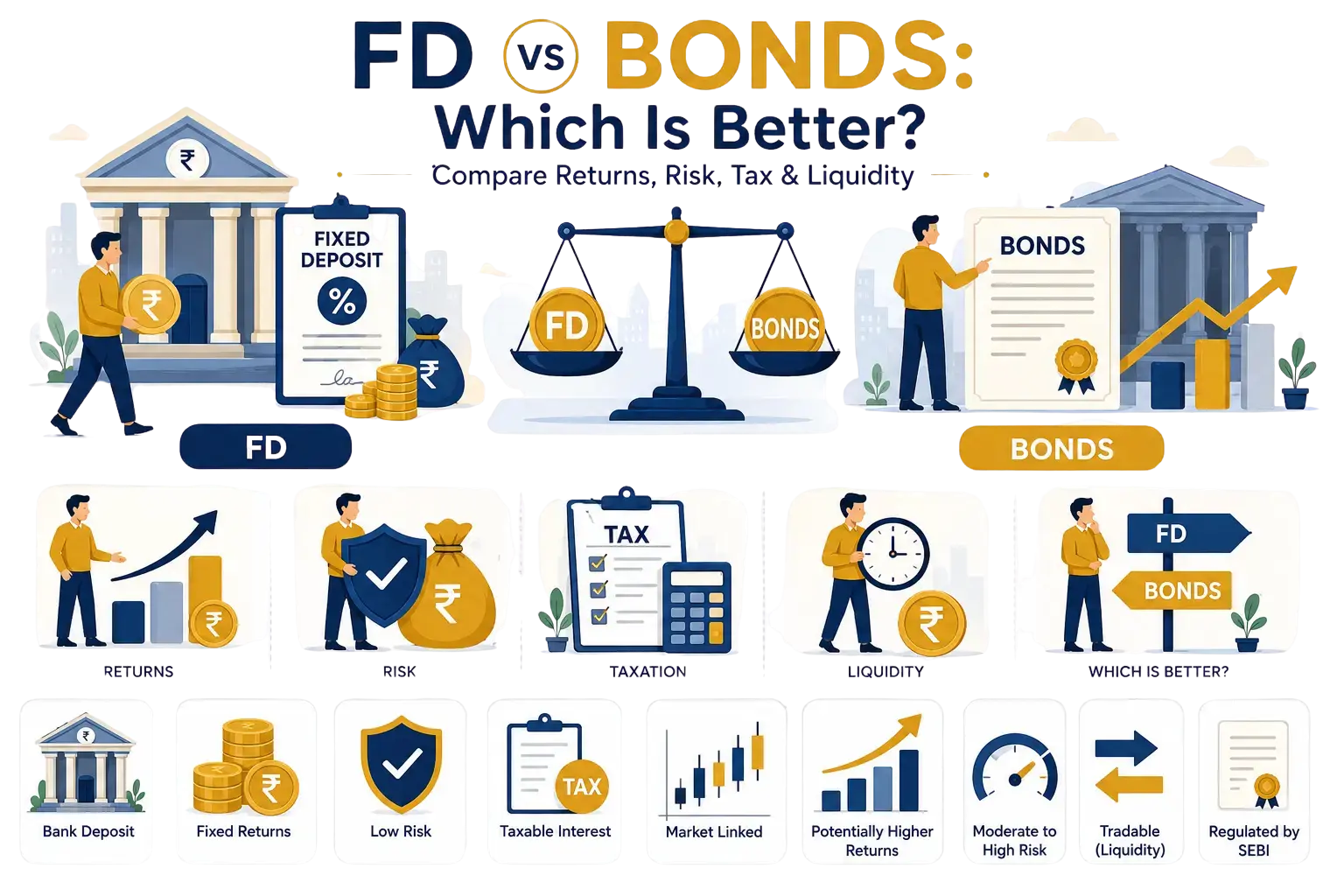
Government Bonds vs Corporate Bonds vs Fixed Deposits
There are differences in the legal structures, risks, and liquidity of government bonds, corporate bonds, and fixed deposits. Government securities are obligations of the relevant government issuers. The repayment capacity of a corporation, and the terms of its obligation, govern a corporate bond. Fixed deposits are deposits, governed by their terms and conditions, in a bank or eligible financial institution.
Interests rates do not fully describe these financial products. Other aspects to consider include credit exposure, deposit insurance and its limits, if any, maturity, premature withdrawal, marketability, taxation, and the timing of availability of funds. Bonds that can be sold in the market may be sold at a loss; and fixed deposits may have withdrawal conditions, and penalties for early withdrawal.
For a detailed analysis, refer to the article, Bonds vs FD: Key Differences.
Where Can Investors Find Reliable Bond Information?
Whenever possible, use primary and official sources. RBI materials, like the ones on the Retail Direct platform, explain government securities. SEBI has educational materials for investors on different types of bonds, and investing risks. For a listed security, the stock exchange disclosures and the company’s issue documents, rating-agency justifications, and financial information are resources. For tax questions, check the Income Tax Department’s materials.
Review the date of an article, quote rates, or offer documents. The information on bond availability, rates, prices, ratings, tax provisions, and issues terms can change. Promotional offers may state a high coupon rate as an equivalent return; however, there is a high risk of loss, and the bond may be difficult to sell.
Conclusion
The types of bonds in India take several forms including, but not limited to, Central Government securities, Treasury bills, state government securities, corporate bonds, tax-free bonds, and other bonds with features such as different interest or repayment schedules. Each classification of bond has its own structure, and within that classification, two bonds can differ in terms of credit risk, liquidity, maturity, and after-tax return.
Consider the issuer of the bond and evaluate the cash flows. Analyze credit risk and interest rate risk. Consider liquidity and early redemption options. Look at the yield of the bond and consider any taxes that may apply. Government securities can be comparatively less risky, but can still be impacted by interest rate risk. Corporate bonds can have varying yields, but carry credit risk of the issuer.
Frequently Asked Questions
What are the main types of bonds in India?+
Major categories include Central Government dated securities, Treasury bills, State Development Loans, corporate bonds, public-sector bonds, tax-free bonds, fixed-rate bonds, floating-rate bonds, zero-coupon bonds, secured bonds, convertible bonds and municipal bonds. Categories can overlap because they describe different features.
Are government bonds in India risk-free?+
Central Government securities are generally associated with comparatively low domestic-currency credit risk, but they are not free from every risk. Prices can fluctuate with interest rates, and an early sale may result in a loss. State government securities have their own issuer and market considerations.
What is the difference between a Treasury bill and a government bond?+
Treasury bills are short-term Central Government securities generally issued at a discount and redeemed at face value. Dated government securities generally have original maturities of one year or more and often pay periodic coupons.
Are corporate bonds safer than shares?+
Corporate bonds and shares have different legal rights and risk profiles. Bondholders generally have contractual claims for interest and principal, while shareholders hold equity ownership. Corporate bonds can still default or lose market value.
Are tax-free bonds currently available for fresh investment?+
Availability depends on current issuance activity. Many commonly discussed Indian tax-free bonds were issued in earlier periods, and some outstanding issues may trade in the secondary market. Verify current official announcements before assuming a fresh issue is available.
Is interest from every government bond tax-free?+
No. Government issuance does not by itself make interest tax-free. Treatment depends on the specific security, applicable statutory provisions and the investor's circumstances.
What is the difference between fixed-rate and floating-rate bonds?+
A fixed-rate bond generally pays a coupon specified in its terms, while a floating-rate bond resets its coupon according to a stated benchmark or formula. Floating-rate bonds still carry credit, liquidity and market-price risks.
Can I sell a bond before maturity?+
Some bonds can be sold in the secondary market, subject to the security's terms and applicable rules. Trading may be limited, and the sale price can be below the purchase price. Some instruments may have transfer restrictions or limited exit options.
What does a bond's credit rating mean?+
A credit rating is a rating agency's opinion about credit risk under its methodology. Ratings can change and do not guarantee payment. Review the rating rationale, issuer finances, security arrangements and latest disclosures.
What should beginners check before evaluating a bond?+
Identify the issuer, read the issue terms, understand the coupon and yield, review credit quality and liquidity, check maturity and early-redemption provisions, consider taxes and transaction costs, and verify current information from reliable sources.
Disclaimer
The information contained in this document is for general educational and informational purposes only, and should not be construed as financial, investment, tax or legal advice. Bonds and debt securities carry risks such as credit or default risk, interest rate risk, liquidity risk, reinvestment risk and inflation risk. There is no guarantee of the return of investment. Credit ratings are opinions, which may vary, and are subject to change. Product availability and issue terms can change. Contact a professional if you need assistance or have questions.
Research Team
InvestEdge360 Research
Content Research Desk
Insights from InvestEdge360's research desk — written to help investors learn with clarity and invest with discipline.
Explore Bond Investment Options
Learn about bond categories and compare the key features, risks, maturity and tax considerations before evaluating a fixed-income security.
Explore Bond OptionsRelated Articles

Was this article helpful?
🚀 Open your Demat & Trading account
- Free Account opening charges
- Free DP transaction charges ⭐
- Free premium research & market updates