
Government Bonds in India: Types, Returns, Risks & How to Invest
Learn how India’s government bonds work, compare T-Bills, G-Secs and SDLs, calculate yields, understand risks and buy through RBI Retail Direct.
Summary: This beginner-level guide to the Indian government securities (G-Secs) market focuses on treasury bills, dated G-Secs and State Development Loans (SDLs) and Sovereign Green Bonds. It describes how to calculate 1 lakh (₹100,000) and examples of interest-rate and liquidity risks. It provides an overview of the RBI Retail Direct and Broker routes.
Key Takeaways
- Treasury Bills, dated G-Secs and SDLs, are the major categories of government bonds in India. Sovereign Green Bonds are of the central government of India.
- A coupon rate is not an assured purchase yield. Yield to maturity takes into account the price, the remaining maturity and the timing of the cash flows.
- Through RBI Retail Direct, you can open a separate RDG account and participate in eligible non-competitive auctions, if you wish, without the need to have a Demat account.
- The primary auction face-value minimum eligible for Retail Direct is ₹10,000, subject to the conditions set by the RBI and the securities.
- Even if the issuer default risk is low, there are several other risks such as, market price and inflation risks, and liquidity and reinvestment risks, if you sell the bonds prior to maturity.
- Consider RBI notifications, the all-in costs, the tax implications and your holding period, before you choose a security to invest in.
🚀 Open your Demat & Trading account
- Free Account opening charges
- Free DP transaction charges ⭐
- Free premium research & market updates
Last updated: November 20, 2026. Government bonds in India are debt securities issued by the Central Government or State Government to raise funds by borrowing from the investor. Investment opportunities with shorter terms can be met by investing in Treasury Bills, while dated Government Securities and State Development Loan have longer terms and different cash-flow patterns. Fixed income investors can explore investment opportunities in Indian government securities by using InvestEdge360, and compare eligible securities on RBI Retail Direct. While issuer default risk is ruled out with the government backing, prices of the bonds can fall if the bonds are traded in an active secondary market before maturity.
Government Bonds in India: What Are They and How Do They Work?
When you purchase a government security (G-Sec), you lend money to the government for a particular time period. Depending on the instrument, at the time of maturity you may get back your principal, or get a lump sum of the difference between the purchase price and the face value of the security. The RBI conducts auctions for the government securities, and manages government debt operations. Bid/Ask prices for G-Secs are generally not fixed by the RBI.
The term “government bonds” is generally synonymous with interest-bearing, dated government securities. Other government securities, like Treasury Bills, also fall into the broader category of government securities. When evaluating government securities, one should examine the issuer, the residual maturity, the coupon structure, the yield to maturity (YTM), liquidity, expected holding period and the price, not just the quoted interest.
Types of Government Bonds and Securities in India
Instrument | Issuer | Usual structure | How investors earn | Main point to check |
|---|---|---|---|---|
Treasury Bills (T-Bills) | Government of India | 91, 182 or 364 days; zero coupon | Purchase discount versus redemption at face value | Purchase price and maturity date |
Dated G-Secs | Government of India | Fixed or floating coupons; multiple maturities | Coupon payments plus any price difference | YTM and interest-rate sensitivity |
State Development Loans (SDLs) | Individual State Governments | Dated, coupon-bearing securities | Coupon payments and any change in market price | Issuer, maturity and trading liquidity |
Sovereign Green Bonds (SGrBs) | Government of India | Dated government securities linked to eligible green expenditure | Coupon and market-price movements | Issue terms, yield and available liquidity |
Treasury Bills: Short-Term Government Borrowing
Treasury bills are used to borrow money in the short term (up to a year) and do not make any coupon payments. Bills are sold at a discount, and the nominal difference is realized at maturity. For example, if a bill with a face value of ₹1,00,000 was bought for a price of ₹97,000, the nominal difference would be ₹3,000. There are many variables that affect the true yield of a bill, such as costs, taxes, and the bill’s actual days to maturity.
Dated G-Secs: Interest-Paying Central Government Bonds
G-Secs are issued by the Central Government and bear a coupon that is payable either semi-annually or annually. There are also G-Secs that have floating rate coupons. The resale value of a security is not affected by a coupon that is fixed. Longer duration securities usually show larger price changes if the market yields change.
State Development Loans and Sovereign Green Bonds
SDLs are bonds issued by state governments. Compare their yields and maturities to central G-Secs and consider their trading volume and bid-ask spread. An apparently low yield could mean it is difficult to trade.
Sovereign Green Bonds (SGBs) are Government of India securities related to financing eligible green projects. They remain debt instruments whose investor returns depend on the bond terms and market conditions. They are not Sovereign Gold Bonds (SGBs): SGB prices and yields are linked to gold and have a different investment purpose. Do not assume fresh SGB subscriptions are open, merely because older SGBs are tradeable.
For information on corporate, public-sector and government debt securities in India, please read types of bonds in India.
Government Bond Returns: Coupon Rate vs Current Yield vs YTM
These terms answer different questions. Coupon rate is expressed as an annual interest rate with respect to a bond’s face value. Current yield, on the other hand, is the annual interest expressed as a percentage of the cash flow you actually receive. Yield to maturity, on the other hand, is the annualized rate of return you would receive if you purchased the bond at the current price, hold on to it until maturity and receive the scheduled cash flows. The realized result can obviously differ if you sell the bond before maturity, or if you reinvest the coupon at a different interest rate.
₹1 Lakh Government Bond Example
Assume a hypothetical fixed-coupon G-Sec has a ₹1,00,000 face value and a 7% annual coupon. This means the bond will pay ₹7,000 as coupons each year. For an investor who purchased this bond for ₹1,00,000, the coupons will be 7% of the purchase price. However, if the investor bought the bond for ₹1,05,000, the coupons will still be ₹7,000 but the current yield will come out to be approximately 6.67% (ask your friend if they understand why). The investor’s capital will be returned for ₹1,00,000 at the time of maturity. The 5,000 rupee premium will affect the yield to maturity. The exact yield to maturity will depend on the remaining time to maturity, when the coupons are paid, and the liquidity of the security.
A security that has a coupon of 7% will not always provide a yield to maturity of 7%. Find the platform’s quoted prices. Some quoted prices will include the accrued interest while others will be a true estimate of the yield to maturity.
How to Check Government Bond Yields in 2026
There is no uniform interest rate for all government securities. A 91-day T-Bill, a 5-year G-Sec and a long-dated State Development Loan will have different yields on the same day. There are many factors that will impact the price of a government security, including the outlook of the RBI’s monetary policy, the expected inflation, the demand, time to maturity, and the liquidity of the security.
RBI's indicative issuance calendar for the period from October 2026 to March 2027, includes dated central government securities and sovereign green bonds. The calendar provides information about securities that are expected to be auctioned off. Actual yields may vary. The auction amounts, individual issues, and dates may change from those shown in the calendar. It is important to check the latest RBI auction notices and/or review actual RBI auctions or market quotes to obtain the most current figures before making an investment decision.
How to Invest in Government Bonds Through RBI Retail Direct
RBI Retail Direct lets eligible individuals open a Retail Direct Gilt (RDG) account to participate in selected primary auctions and to transact through the secondary-market facility. An ordinary NSDL/CDSL Demat account is not compulsory for this route. The RBI says RDG account opening and maintenance are free, although applicable payment gateway charges can arise.
Choose a time horizon. Decide whether your objective is short-term liquidity, scheduled income or a multi-year maturity.
Prepare account details. Have PAN, a rupee savings bank account, valid mobile number, email, identification and KYC documentation available. Verify current eligibility on the RBI portal.
Register for Retail Direct. Complete the online RDG application, KYC, bank verification and nomination requirements through the official portal.
Check the auction notice. Compare security type, maturity, minimum bid, auction window and expected payment arrangements before submitting anything.
Place a non-competitive primary-auction bid. Enter the face-value amount rather than choosing your own yield. For eligible T-Bills, dated G-Secs and SDLs, the standard minimum is ₹10,000 face value and typically multiples of ₹10,000, subject to applicable rules.
Fund the application. Follow the portal's instructions before the cutoff. An upfront indicative price or refundable markup may differ from the final allotment amount; the markup is not an RBI fee.
Review allotment and holdings. After the auction, inspect the security credited to your RDG account and note its coupon dates and maturity. If you may need an early exit, review the secondary-market quotes instead of assuming immediate sale at face value.
Non-competitive bidding simplifies the process by letting retail investors specify an amount without selecting their own price or yield. The final allotment price is derived from the auction results. Allotment can be partial where the non-competitive allocation is oversubscribed, so treat the bid as an application rather than a completed investment.
Can You Buy Government Securities Through a Broker?
Certain government securities are also available via exchange or intermediary routes apart from RBI Retail Direct. The account, security inventory, settlement, and charges, however, vary with brokers and trading platforms. Investors, who already use a trading platform, can evaluate their Demat and trading account arrangements to consider the exchange-based route, and an RDG account, which does not require a Demat account.
For a general walkthrough covering other types of bonds apart from G-Secs, read how to invest in bonds in India. Before selecting an intermediary, evaluate its displayed executed-price estimates, fees, two-way quotes, custody arrangements, and customer support. Not all bonds issued through a particular platform are government bonds.
What Are the Risks of Government Bonds in India?
Risk | What can happen | Practical check |
|---|---|---|
Interest-rate risk | Existing fixed-coupon bond prices may fall when market yields rise. | Compare residual maturity and possible early-sale needs. |
Liquidity risk | A buyer may be unavailable at a convenient price, especially in less-traded issues. | Review bid-ask spread and trading activity. |
Inflation risk | Purchasing-power growth can be lower than nominal coupon income. | Evaluate after-tax returns against inflation expectations. |
Reinvestment risk | Future coupons or maturing T-Bills might have to be reinvested at lower rates. | Align cash-flow dates with planned expenses. |
Tax and cost risk | Tax liability, accrued interest and transaction costs can lower net returns. | Review security-specific tax and settlement treatment. |
Government securities carry very low domestic-currency issuer-default risk in the sovereign debt market. That does not make a quoted market value stable or the investment suitable for every emergency-fund requirement. A bond held to its scheduled maturity has different exposure from a bond sold unexpectedly after market yields have risen.
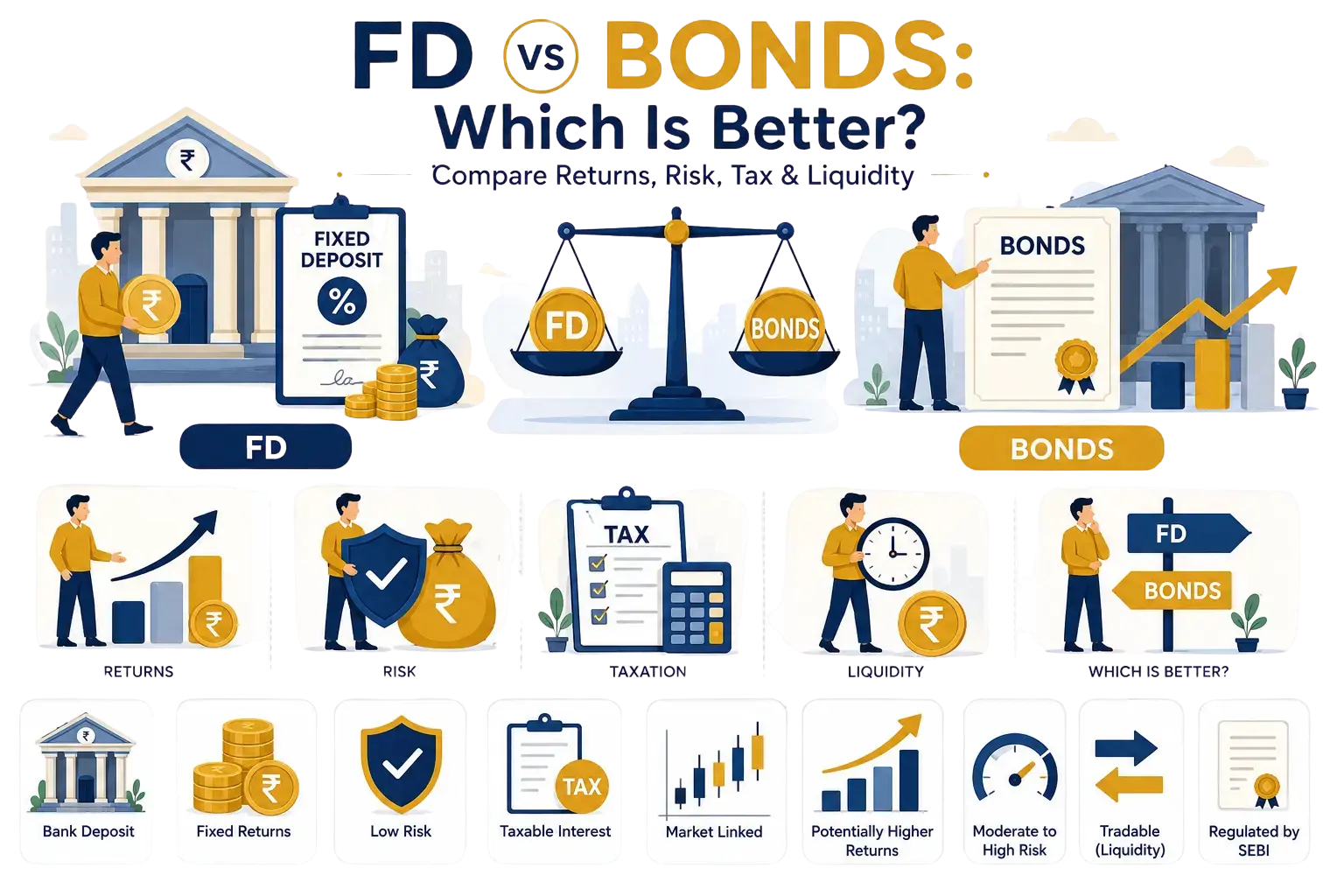
Government Bonds vs Fixed Deposits: Which Should You Compare?
A fixed deposit is a contracted deposit with a specified rate of interest for a fixed term with a bank. It may be prepaid or withdrawn (with conditions) before maturity. A government security may be sold at a discount to its face value and the buyer has the right to sell it at any time before maturity. The security is issued at the discretion of the government. A deposit is insured.
For a more complete comparison of taxation and liquidity for fixed income planning, read fixed deposits versus bonds in India. Deposit insurance, redeemability, and other features depend on the conditions of the issue. A sensible comparison should consider a fixed-coupon bond and its after-tax yield, and not just its face value.
How Are Government Bonds Taxed in India?
Are the Interests on Taxable Government Securities Income? Yes, they are. You must consider the tax treatment of capital gains or losses on the sale of a security. T-Bills are discount instruments and therefore require specific treatment. How the provisions of the Income Tax Act are applied will depend on the terms of the security, its listing and status, the details of the transaction, and the circumstances of the investor, and the provisions of the Act in force for the tax year.
Do not assume that the interest income on all government securities is tax-free. Or that the tax treatment of T-Bills, Sovereign Gold Bonds, dated securities, and special tax-favored instruments are all the same. You must maintain proof of purchase, auction allotment, interest payments, sale, and redemptions. A tax professional may review your actual computations before it is filed.
Which Government Security Might Fit Your Goal?
Investor objective | Security to research | Key question |
|---|---|---|
Money needed within one year | T-Bills with matching maturity | Will you hold until redemption? |
Periodic income over several years | Dated G-Secs or SDLs | Does the coupon calendar fit your cash needs? |
Long investment horizon | Longer-dated G-Secs | Could price volatility disrupt a planned exit? |
Interest in government green expenditure | Sovereign Green Bonds where available | Are the maturity and yield suitable independently of the green label? |
These are research starting points, not personal recommendations. A short-duration instrument can be unsuitable if its maturity precedes a large payment you need later; a long-duration bond can be unsuitable if you may need to sell next month.
Government Bond Investment Checklist Before You Buy
Find out if the issuer is the central/state government or some other PSU/corporate entity.
Find the specific security, ISIN, face value, coupon terms and redeem date.
Compare the market price and YTM and not just the coupon.
Find out if you are participating in a primary auction or buying from a tertiary market.
Find out the account route, minimum investment, transaction charges and settlement time.
Find out how easy it is to sell the bond before maturity and how would changes in interest rates affect the bond price.
Find out the expected taxes and cash flows and how do they relate to your financial goals.
Use official notices and confirmations and not promotional notices.
The decision is not simply whether government bonds are safe. It is whether the specific security, price, maturity and investment route fit the purpose of your money. Comparing those details first can help you evaluate bonds alongside deposits and other fixed-income choices without assuming a particular return or effortless early exit.
Frequently Asked Questions
What is the minimum investment in government bonds through RBI Retail Direct?+
For eligible non-competitive primary auctions of Treasury Bills, dated Government of India securities and State Development Loans, the standard minimum bid is ₹10,000 face value, usually in ₹10,000 multiples. Auction and platform conditions should be checked before applying.
Do I need a Demat account to buy government bonds through RBI Retail Direct?+
No. Eligible individuals can use a separate Retail Direct Gilt (RDG) account with RBI. A normal NSDL/CDSL Demat account may be involved in certain exchange or broker-based routes but is not a prerequisite for RBI Retail Direct.
What is the difference between a government bond coupon and its yield?+
The coupon is calculated on the bond’s face value. Current yield compares coupon income with the actual purchase price, while yield to maturity also considers remaining cash flows, maturity and the price paid.
Are government bonds in India completely risk free?+
Sovereign securities have very low domestic-currency issuer-default risk, but a bond’s resale price can fall when market yields rise. Inflation, reinvestment and liquidity risks also matter.
How do Treasury Bills pay returns?+
T-Bills normally do not make regular coupon payments. They are purchased at a discount and redeemed at face value on maturity. The difference, adjusted for the time held and applicable costs or taxes, determines the return.
Can I sell a government security before maturity?+
Eligible marketable securities may be sold in the secondary market, including through the Retail Direct facility. The actual sale depends on available bids and current prices, which may be above or below the amount paid.
Are government bond returns tax-free in India?+
Not generally. Interest and gains may be taxable under applicable rules; the treatment differs by instrument and transaction. Investors should check the tax year, bond terms and their own filing position.
Are Sovereign Green Bonds the same as Sovereign Gold Bonds?+
No. Sovereign Green Bonds are government debt securities related to eligible green expenditure, with bond coupons and market-price exposure. Sovereign Gold Bonds are gold-linked instruments with different terms and risks.
Disclaimer
This article is for general education and is not personal investment or tax advice. Government securities carry market-price, interest-rate, liquidity and inflation risks, and taxes depend on individual circumstances. InvestEdge360 is operated by Vijayvargiya Financial Services, an Authorized Business Partner of Motilal Oswal Financial Services Ltd. This is not the official Motilal Oswal website. InvestEdge360 does not issue government securities or operate RBI Retail Direct. Verify actual availability, terms and suitability with the relevant issuer, platform and professional adviser.
Research Team
InvestEdge360 Research
Content Research Desk
Insights from InvestEdge360's research desk — written to help investors learn with clarity and invest with discipline.
Exploring Government Bonds and Fixed-Income Options?
Compare government securities, maturity dates, yields and risks. Explore bond-investment information and available assistance through InvestEdge360 before deciding on an investment route.
Explore Bond Investment OptionsRelated Articles

Was this article helpful?