
STCG vs LTCG Tax on Shares in India (2026): Examples
Understand short-term and long-term capital gains tax on shares in India, including the latest tax rates, holding-period rules, exemptions and practical calculation examples.
Summary: Learn how STCG and LTCG tax on shares works in India in 2026. Compare the 20% and 12.5% tax rates, understand the ₹1.25 lakh LTCG threshold and see examples of tax on selling shares.
Key Takeaways
- STCG Tax Rate: Short-term capital gains on qualifying listed equity shares are taxed at 20%, plus applicable surcharge and cess.
- LTCG Tax Rate: Long-term gains on qualifying listed equity shares exceeding ₹1.25 lakh annually are taxed at 12.5%.
- Holding Period Matters: Listed equity shares held for up to 12 months are short-term; shares held for more than 12 months are long-term.
- ₹1.25 Lakh Annual Threshold: The threshold applies to aggregate qualifying long-term capital gains, not separately to each stock.
- Tax Is Calculated on Gains: Capital gains tax is calculated on eligible profits after applicable costs, adjustments and loss set-offs, not on the entire sale value.
- Different Assets, Different Rules: Unlisted shares, debt funds, intraday trading and F&O transactions may have different tax treatment.
Introduction
You invested in a stock, its price increased, and now you’re considering selling it. Before placing the sell order, you might have a question: how much tax will I pay on the profit?
How Capital Gains Tax will be applicable on shares sold in India is a bit complicated. It depends on the period for which shares were held, whether they meet the required conditions, and the amount of capital gains realized.
In the case of delivery-based investments in listed equity shares, profits are classified as Short-Term Capital Gains (STCG) or Long-Term Capital Gains (LTCG).
From a tax point of view, the distinction between STCG and LTCG is very important. So investors who trade in shares using Demat and trading accounts should be aware of these concepts.
In this article, STCG and LTCG on shares in India for the year 2026 are discussed with a comparison table, worked-out examples, rules for capital loss, and FAQs.
What Is Capital Gains Tax on Shares?
This discussion focuses on capital gains tax, which applies to profits on the sale of capital assets, such as shares held in an investment portfolio.
When an investor sells shares at a price in excess of their eligible acquisition cost and allowable expenses, the difference may be a taxable capital gain.
For example:
Purchase value of shares: ₹1,00,000
Sale value of shares: ₹1,40,000
Capital gain before expenses: ₹40,000
The ₹40,000 profit may be classified as STCG or LTCG depending on the holding period.
If the shares were held for six months, the profit would generally be short-term. If they were held for more than twelve months, it would generally qualify as long-term.
This distinction affects the applicable tax rate and availability of the long-term equity capital gains threshold.
Investors exploring direct stock investment in India should understand these tax implications alongside market risks, investment costs and portfolio objectives.
STCG vs LTCG Tax on Shares: Key Differences
The most important differences are the holding period, tax rate, and treatment of the annual LTCG threshold.
Particulars | Short-Term Capital Gains (STCG) | Long-Term Capital Gains (LTCG) |
|---|---|---|
Meaning | Profit from shares held for a shorter period | Profit from shares held beyond the long-term threshold |
Listed equity holding period | Up to 12 months | More than 12 months |
Applicable headline tax rate | 20% | 12.5% |
₹1.25 lakh annual threshold | Not available | Available for qualifying aggregate gains |
Additional taxes | Surcharge and cess, where applicable | Surcharge and cess, where applicable |
Relevant provision under Income-tax Act, 2025 | Section 196 | Section 198 |
Primary use | Classifying gains from shorter-term investments | Classifying gains from longer-term investments |
Important: These rates are applicable only to qualifying transactions in listed equity shares and other specified securities, subject to Securities Transaction Tax (STT) and other conditions. These are not general rates for all share transactions.
What Is Short-Term Capital Gains Tax on Shares?
Short-term capital gains are charged when a capital asset is sold before it qualifies as a long-term asset.
For listed equity shares in India, if a capital asset is held for less than 12 months, it is considered as a short-term capital asset.
STCG Tax Rate on Shares in 2026
For equity transactions covered under Section 196 of the Income-tax Act, 2025, the short-term capital gains tax is charged at:
20% on the short-term capital gains, plus surcharge and health and education cess.
This concessional rate is available only if the conditions for charging the securities transaction tax (STT) are satisfied.
This concessional rate is applicable from July 23, 2024, and is provided in the 2026 Act.
Example: STCG Tax on ₹80,000 Profit
Suppose an investor purchases listed equity shares and sells them after eight months.
Particulars | Amount |
|---|---|
Purchase value | ₹2,00,000 |
Sale value | ₹2,80,000 |
Holding period | 8 months |
Short-term capital gain | ₹80,000 |
STCG tax at 20% | ₹16,000 |
Health and education cess at 4% | ₹640 |
Illustrative total tax | ₹16,640 |
The example assumes the gain qualifies for the special tax rate, there are no deductible transaction expenses or eligible loss adjustments, and surcharge is not applicable.
For an investor with eligible STCG of ₹80,000, the calculated tax in this simplified example is ₹16,640, including cess.
Actual tax liability may differ depending on residential status, other income, available basic-exemption adjustments and other circumstances.
What Is Long-Term Capital Gains Tax on Shares?
Once the holding period required to qualify for the long-term capital gains tax treatment is satisfied, a capital gain that may arise upon the sale of the shares is referred to as a long-term capital gain.
The holding period requirement for listed equity shares is generally satisfied if the shares are held for more than 12 months.
LTCG Tax Rate on Shares in 2026
As per section 198 of the Income-tax Act, 2025, qualifying long-term capital gains from listed equity shares and other specified investments are chargeable to tax at the rate of:
12.5% on aggregate qualifying LTCG exceeding ₹1.25 lakh in a year, and
The ₹1.25 lakh limit is relevant because qualifying aggregate LTCG up to that amount is exempt from the special LTCG tax.
However, this ₹1.25 lakh limit is not a separate allowance for each stock, transaction, broker account or family member.
Example: LTCG Tax on ₹2 Lakh Profit
Suppose an investor holds listed equity shares for 18 months.
Particulars | Amount |
|---|---|
Purchase value | ₹3,00,000 |
Sale value | ₹5,00,000 |
Holding period | 18 months |
Long-term capital gain | ₹2,00,000 |
Annual LTCG threshold | ₹1,25,000 |
Taxable LTCG | ₹75,000 |
LTCG tax at 12.5% | ₹9,375 |
Health and education cess at 4% | ₹375 |
Illustrative total tax | ₹9,750 |
In this example, the investor's total qualifying LTCG for the tax year is assumed to be ₹2 lakh.
After applying the ₹1.25 lakh threshold, tax is calculated on ₹75,000.
The illustrative liability is ₹9,750, including 4% cess and excluding any applicable surcharge.
How Does the ₹1.25 Lakh LTCG Threshold Work?
One common question among Indian stock investors is:
Is long-term capital gain on shares tax-free up to ₹1.25 lakh?
Under the special long-term equity capital gains provision, tax is calculated on qualifying aggregate gains exceeding ₹1.25 lakh in a tax year.
The threshold applies to the combined qualifying long-term gains covered by the relevant provision, including eligible listed equity shares and specified equity-oriented fund units.
Example: LTCG From Two Stocks
Suppose an investor sells two different stocks after holding each for more than 12 months.
Investment | Long-term gain |
|---|---|
Stock A | ₹90,000 |
Stock B | ₹85,000 |
Total LTCG | ₹1,75,000 |
Annual threshold | ₹1,25,000 |
Taxable LTCG | ₹50,000 |
LTCG tax at 12.5% | ₹6,250 |
Cess at 4% | ₹250 |
Illustrative total tax | ₹6,500 |
The investor cannot claim ₹1.25 lakh separately against Stock A and Stock B.
Instead, the threshold is applied to aggregate qualifying LTCG.
This is why investors should examine their combined capital gains during the relevant tax year rather than calculate each sale independently.
How to Calculate STCG and LTCG Tax on Shares
The general calculation is done on capital gains as opposed to the total value of shares sold.
Step 1: Determine the Sale Value
This is the total money received from the sale of shares.
Step 2: Determine the Acquisition Cost
This is the eligible purchase price of the shares based on special rules that may apply.
Step 3: Deduct Eligible Expenses
Certain expenses incurred wholly and exclusively in connection with the transfer, such as eligible brokerage charges, may be deductible.
However, Securities Transaction Tax (STT) is not deductible while computing capital gains.
Step 4: Determine the Holding Period
Based on the holding period, the capital gain may be classified as either short-term or long-term.
Step 5: Apply Eligible Loss Adjustments
Capital losses may be set off against capital gains, provided special rules are satisfied.
Step 6: Calculate the Applicable Tax
The applicable tax, annual LTCG threshold, and surcharge and cess must be considered.
Basic Capital Gains Formula
Capital Gain = Sale Consideration − Eligible Acquisition Cost − Allowable Transfer Expenses
Simplified STCG Tax Formula
STCG Tax = Taxable STCG × 20%
For qualifying listed-equity transactions under the special provision, add applicable surcharge and cess.
Simplified LTCG Tax Formula
LTCG Tax = (Aggregate Qualifying LTCG − ₹1,25,000) × 12.5%
This simplified formula is applicable when the aggregate of the qualifying LTCG is more than ₹1,25,000.
Special rules and other tax provisions are assumed to have been complied with prior to arriving at the aggregate LTCG.
Real cases may require additional adjustments.
Tax on Shares Sold Before vs After One Year
Many investors search for tax implications when selling shares before or after one year.
Consider two scenarios involving the same ₹1 lakh profit.
Particulars | Scenario A | Scenario B |
|---|---|---|
Holding period | 8 months | 18 months |
Capital gain | ₹1,00,000 | ₹1,00,000 |
Classification | STCG | LTCG |
Headline rate | 20% | 12.5% |
Annual LTCG threshold | Not applicable | Available |
Illustrative tax before cess | ₹20,000 | ₹0* |
Assumes the ₹1 lakh is the investor's only qualifying LTCG for the year, with no relevant adjustments. The STCG illustration assumes no basic-exemption adjustment or other relief is available.
The comparison illustrates why the holding period matters.
However, investors should not make a buy or sell decision solely to achieve a particular tax outcome. Market volatility, liquidity requirements, and the possibility of investment losses also matter.
How Are Capital Losses Adjusted Against Gains?
Not every share transaction produces a profit.
If an investor sells shares below their eligible acquisition cost, the result may be a capital loss.
Indian tax rules distinguish between:
Short-Term Capital Loss (STCL)
Long-Term Capital Loss (LTCL)
Short-Term Capital Loss
An eligible short-term capital loss can generally be set off against short-term or long-term capital gains.
Long-Term Capital Loss
An eligible long-term capital loss can generally be set off only against long-term capital gains.
Loss type | Set off against STCG? | Set off against LTCG? |
|---|---|---|
Short-term capital loss | Yes | Yes |
Long-term capital loss | No | Yes |
Can Capital Losses Be Carried Forward?
Eligible capital losses that can’t be fully offset can be carried forward to the next eight years.
Deadlines to file the return and other legal requirements should be adhered to.
Ordinarily, capital losses cannot be used to reduce salary income or bank interest income.
A complete record of capital gains and losses should be maintained, as losses can affect the taxable gain.
Does the Tax Apply to the Entire Sale Value?
No, the tax is levied on the taxable capital gain and not on the entire sale proceeds of the shares.
For example, an investor buys shares for ₹5 lakh and later sells them for ₹5.6 lakh.
The capital gain would be ₹60,000 before allowable expenses and adjustments.
The capital gains tax will be charged on the ₹60,000 and not on the ₹5.6 lakh sale proceeds of the shares.
If the investment meets the requirements for the long-term equity provisions and the investor’s aggregate qualifying LTCG is within the annual ₹1.25 lakh limit, the special LTCG tax would be nil.
Still, reporting obligations may apply based on the investor’s tax situation.
Are STCG and LTCG Tax Rules the Same for Mutual Funds and ETFs?
All market-linked investments do not receive the same capital gains tax treatment.
Certain equity-oriented mutual funds and equity ETFs can fall under the provisions of Equity Funds and benefit from Equity capital gains tax treatment.
The treatment, however, would depend upon the type of fund, nature of the underlying investments, and the applicable statutory provisions, definitions, and the dates of acquisition or redemption.
As a result, the tax treatment of debt-oriented mutual funds may be different from that of an equivalent equity-oriented fund.
It is always advisable to mutual fund investment in India to check the tax treatment of a specific fund rather than to presume that all mutual funds are treated the same way as listed equity shares for the purpose of short-term and long-term capital gains.
Is Capital Gains Tax Different for Unlisted Shares?
Yes. Unlisted shares may have a different holding-period classification and tax treatment.
For example:
Feature | Listed Equity Shares | Unlisted Shares |
|---|---|---|
General long-term threshold | More than 12 months | More than 24 months |
Qualifying short-term tax | Special 20% rate where conditions are met | Generally applicable slab rates for investors holding them as capital assets |
General long-term rate | 12.5% on qualifying gains above ₹1.25 lakh | Generally 12.5%, subject to applicable provisions |
₹1.25 lakh equity LTCG threshold | Available for qualifying gains | Generally not available |
Additional rules can apply to particular transactions, investors and unlisted securities.
Therefore, the listed-equity tax calculation examples in this article should not be used without adjustment for pre-IPO or other unlisted shares.
Important Rules Investors Should Know in 2026
There are other rules that also need to be considered while calculating the actual tax liability.
1. Securities Transaction Tax Conditions
There are special equity capital gains rates that will be applicable in the presence of the Securities Transaction Tax (STT).
Long-term equity capital gains are chargeable to STT in the hands of the transferor, in the absence of any prescribed exceptions.
2. FIFO Method for Demat Securities
Where securities which are eligible for the benefit of the equity capital gains are held in demat form, the FIFO method would apply for identifying the securities which are deemed to be sold.
This is relevant where an investor holds the same equity stock on different days at different prices.
3. Special Cost Rules for Older Investments
Some securities which were acquired prior to 01 Feb 2018 may be eligible for ‘grandfathering’ based on their fair market value as on 31 Jan 2018.
Investors who hold older portfolios should not presume that the original cost of acquisition, in all cases, will be considered for calculating the capital gains.
4. Basic Exemption Limit
Some resident individuals and Hindu undivided families may be able to adjust their unused basic-exemption limit against specified capital gains.
The examples included in this document do not assume that such adjustments are available.
5. Tax Filing and Documentation
Taxpayers are required to maintain accurate transaction statements and supporting documents which show the following: (i) purchase of the asset; (ii) sale of the asset; (iii) contract notes; and (iv) eligible expenditure incurred in relation to the asset.
The income tax return forms which will be applicable will be based on the nature of the income and the resident status of the taxpayer.
6. Income-tax Act, 2025
The Income-tax Act, 2025, was enacted on 01 Apr 2026.
For Tax Year 2026-27, the relevant special rate provisions for qualifying short-term capital gains are found in Section 196, and the relevant provisions for qualifying long-term capital gains are found in Section 198.
Older educational materials may reference Sections 111A and 112A of the Income-tax Act, 1961.
For the relevant year, investors should utilize the provisions that are applicable to them.
Common Mistakes When Calculating Tax on Shares
While computing capital gains tax, a number of misconceptions may lead to erroneous estimates.
Applying the ₹1.25 lakh threshold separately to every stock: The limit is applicable to the aggregate of qualifying gains of that particular year.
Assuming every short-term gain is taxed at 20%: Special rates are applicable only if the specified conditions are satisfied.
Using the total sale value as the taxable amount: For the purposes of tax, only the capital gain is taxed and not the sale consideration.
Ignoring capital losses: As per the provisions of set-off, the capital loss may reduce the capital gain and thereby the taxable value.
Deducting STT from capital gains: The STT is generally not an expense while computing capital gains.
Treating intraday or F&O profits as ordinary delivery-based equity capital gains: The F&O and Intraday trades may fall under the ambit of business income and not equity capital gains.
Ignoring the acquisition date: The holding period and the applicable cost basis may affect the nature of the gains.
Avoiding the above-mentioned mistakes will help investors compute their correct tax liability.
How Can Investors Plan Share Transactions With Tax Awareness?
Understanding capital gains taxation is an important part of evaluating investment outcomes.
Before selling a share, investors can consider:
The intended investment holding period
Unrealised gains or losses
Applicable capital gains classification
Other realised gains during the tax year
Eligible capital losses
Transaction expenses
Liquidity needs and market risks
For investors maintaining a delivery-based equity portfolio, accurate Demat and trading account records can make it easier to review transaction history and prepare information for tax filing.
If you are starting your stock market investment journey, you can explore equity trading account options and understand the facilities available for buying and selling listed securities.
Tax considerations should support an investment plan, not replace independent evaluation of the underlying investment
Conclusion: Understanding STCG vs LTCG Tax on Shares
In the context of India, the distinction between STCG and LTCG tax on shares in India is largely based on the type of investment, the duration of holding, and the taxation rules governing such.
With regard to 2026, the general rule is that short-term capital gains from qualifying listed equities will be taxed at 20%, whereas any excess aggregate amount of qualifying long-term capital gains in excess of ₹1.25 lakh per annum will be taxed at 12.5%.
There may, however, be variations due to various factors including eligible losses, cost of acquisition and basic-exemption adjustments among others.
Knowledge of the above guidelines helps in understanding the effects of the taxation laws on the returns earned from such transactions.
Explore Stock Market Investment Options
While taxes form a crucial aspect of investing in the stock market, there is more that an investor must know. These include the characteristics of the trading account and the various investment products, research facilities, transaction charges, and the risk factors involved.
If you wish to learn more about your equity investment opportunities, you can use the information provided by InvestEdge360 about stock investment services, Demat account opening, and available trading facilities through InvestEdge360.
Official Sources and References
Frequently Asked Questions
What is the STCG tax rate on shares in India in 2026?+
The special short-term capital gains tax rate is 20% for qualifying listed equity transactions, plus applicable surcharge and cess. Different rates may apply when the required conditions are not satisfied.
What is the LTCG tax rate on shares in 2026?+
For qualifying listed equity investments, aggregate long-term capital gains exceeding ₹1.25 lakh during a tax year are generally taxable at 12.5%, plus applicable surcharge and cess.
Is ₹1.25 lakh LTCG tax-free every year?+
The annual threshold applies to aggregate qualifying long-term capital gains covered by the specified provision. It is not available separately for every stock or transaction.
What happens if I sell shares within one year?+
For listed equity shares held for not more than 12 months, the profit is generally classified as a short-term capital gain. The applicable tax depends on whether the transaction qualifies for the special rate.
What happens if I sell shares after one year?+
Listed equity shares held for more than 12 months generally qualify as long-term capital assets. Eligible long-term gains may receive the ₹1.25 lakh annual threshold before the 12.5% special rate applies.
How much tax applies to ₹2 lakh LTCG on shares?+
Assuming ₹2 lakh is the investor's total qualifying LTCG for the year, the amount exceeding ₹1.25 lakh is ₹75,000. At 12.5%, the tax is ₹9,375. Including 4% cess, the illustrative amount is ₹9,750, excluding surcharge and other applicable adjustments.
Is capital gains tax calculated on the total money received from selling shares?+
No. It is generally calculated on the eligible gain after deducting allowable costs and expenses, subject to applicable adjustments.
Can short-term capital losses reduce long-term capital gains?+
Yes. Eligible short-term capital losses can generally be set off against short-term or long-term capital gains. Long-term capital losses can generally be set off only against long-term gains.
Do I pay capital gains tax if I sell shares at a loss?+
A sale resulting in an eligible capital loss does not itself generate a taxable capital gain. The loss may be available for set-off or carry-forward under applicable rules.
Does the 12.5% LTCG tax rate apply to unlisted shares?+
Long-term gains on unlisted shares may generally be subject to a 12.5% rate under the applicable provisions, but unlisted shares have different holding-period and eligibility rules. The ₹1.25 lakh special equity threshold generally does not apply.
Are intraday trading profits taxed as STCG?+
Generally, intraday equity trading without delivery is treated as speculative business activity rather than an ordinary delivery-based capital investment. The applicable tax treatment depends on the facts.
Is capital gains tax the same under the old and new income-tax regimes?+
The specified capital gains rates are generally special rates rather than ordinary slab rates. However, the selected regime, other income and applicable statutory adjustments can affect overall tax liability.
Disclaimer
This article is for general educational purposes only and does not constitute investment, accounting, legal or tax advice. Calculations are simplified illustrations, not individual tax assessments. The actual tax payable may depend on residential status, other income, eligible losses, exemptions, acquisition dates, surcharge, cess and other statutory conditions. Investors should verify current tax provisions and consult a qualified chartered accountant or tax professional before filing returns or taking tax-related decisions. Securities-market investments are subject to market risks.
Research Team
InvestEdge360 Research Team
Financial Research & Investment Education
Insights from InvestEdge360's research desk — written to help investors learn with clarity and invest with discipline.
Related Articles
- Mutual Funds
SIP vs Lumpsum: Which Is Better for Your Investment Goals?
- Investor Education
How to Buy Unlisted Shares in India: Step-by-Step Guide
- Mutual Funds
How Do Mutual Funds Work in India? A Beginner's Guide
- Demat Account
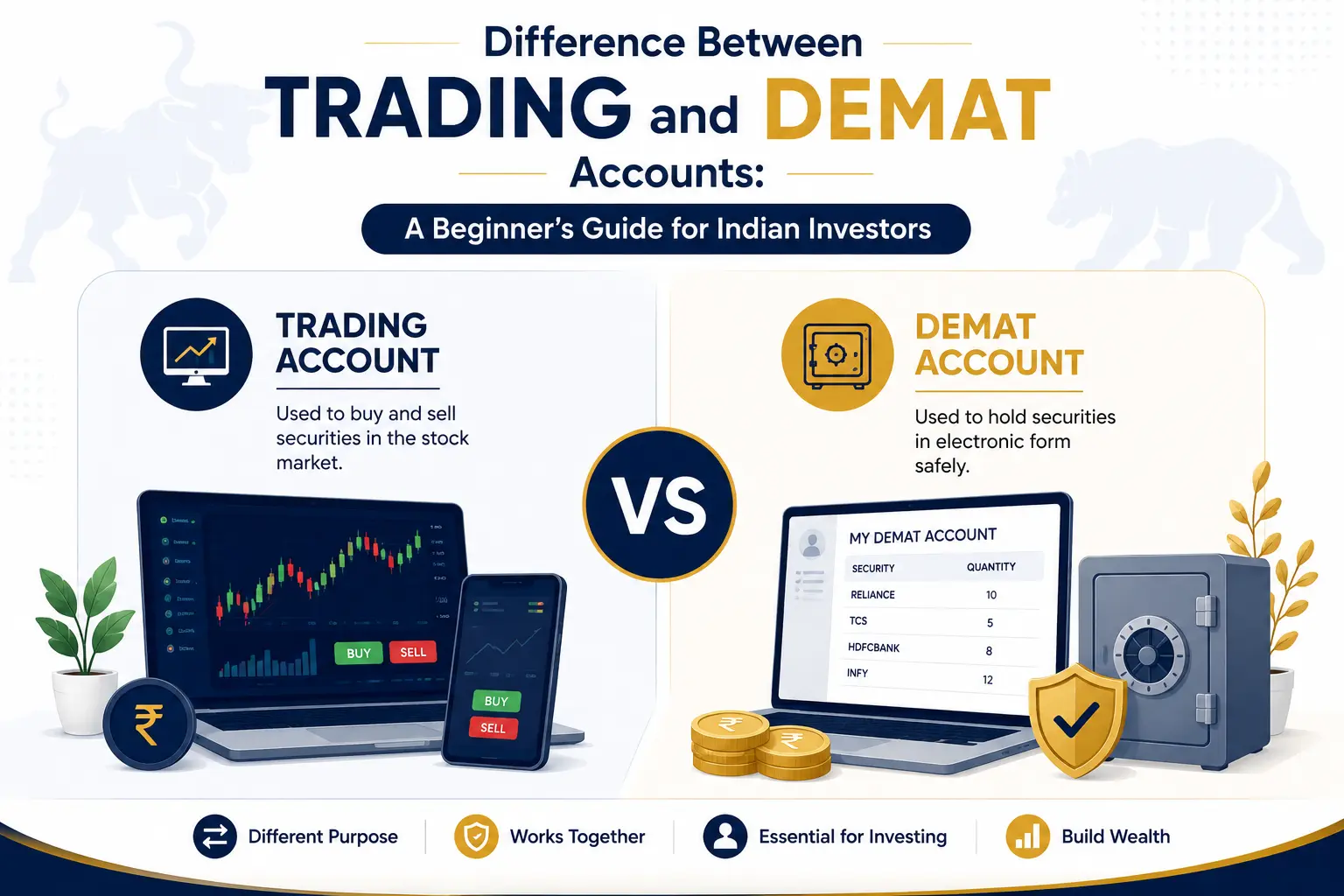
Difference Between Trading and Demat Accounts: A Beginner's Guide for Indian Investors


Was this article helpful?
🚀 Open your Demat & Trading account
- Free Account opening charges
- Free DP transaction charges ⭐
- Free premium research & market updates